
ABM for AI vendors: how to reach named UK accounts
Account-based marketing (ABM) for an AI vendor means choosing a short list of UK organisations that fit. You then...
Read more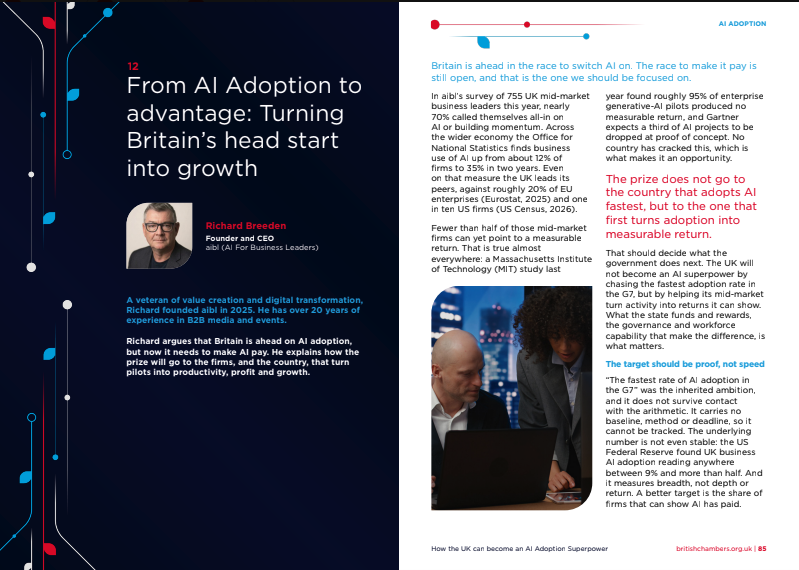
Britain leads its peers on AI adoption. Nearly 70% of UK firms surveyed say they’re all-in on AI or building momentum. Yet fewer than half can show a measurable return.
So what separates the firms that make AI pay? In aibl’s survey of 755 UK business leaders, the answer was governance and capability. That’s the case Richard Breeden makes in his essay for the British Chambers of Commerce, published on 5 November 2026.
The share of firms that can show a measurable return climbs from 22% where there’s no AI governance to 85% where governance is mature and embedded.
Governance here means three plain habits:
Enthusiasm doesn’t close the gap. Only 39% of firms that are all-in on AI but lack formal governance can show a return. Among well-governed firms that aren’t especially keen, it’s 54%.
Governance works best alongside a capable workforce. Where people are very well equipped to use AI, 72% of firms show a return, against 30% where they are only somewhat equipped (base 152).
71% of firms whose leaders have AI fully built into their own work can show a return, against 31% where leaders use it only occasionally.
We turned these findings into the aibl AI readiness model: two levers, six dimensions and four stages you can score your own organisation against.
Richard argues the UK’s AI target should track results. His essay proposes one change in three parts:
As Richard puts it: “The prize does not go to the country that adopts AI fastest, but to the one that first turns adoption into measurable return.”
How the UK can become an AI Adoption Superpower brings together 29 essays from business, technology, politics, and academia, produced by the British Chambers of Commerce with BDO. Contributors include Baroness Martha Lane-Fox, Euan Blair, and David Black of Google UK. Richard’s essay is chapter 12, “From AI Adoption to advantage: Turning Britain’s head start into growth”.
Read the full collection on the British Chambers of Commerce website, and download the State of UK AI Adoption 2026 report.
Governance and capability. In aibl’s survey of 755 UK mid-market business leaders, 85% of firms with mature AI governance could show a measurable return, against 22% with none.
That the UK should measure how many firms can show a return from AI, and help organisations build the governance and skills that make AI pay.
aibl’s State of UK AI Adoption Survey 2026, covering 755 UK mid-market business leaders at firms with £50m to £500m revenue, with fieldwork from January to March 2026.

Account-based marketing (ABM) for an AI vendor means choosing a short list of UK organisations that fit. You then...
Read more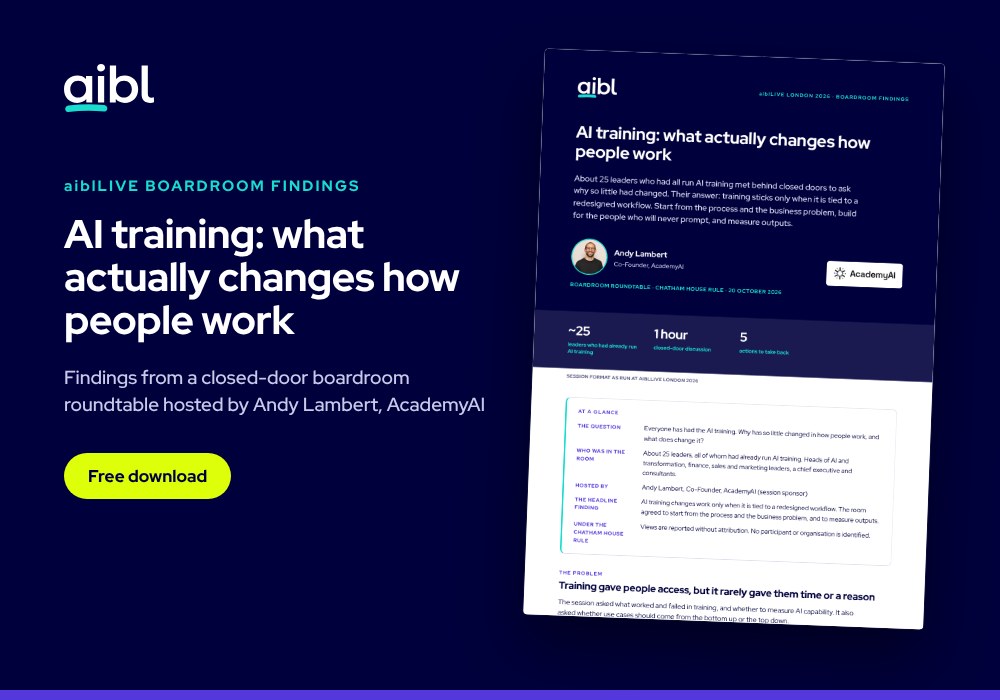
AI tools go unused because they are added to jobs that haven't changed. People get a licence and a training...
Read more
Our AI kept fewer customers than our humans PLUS: 61% of AI wins followed a failure...
Read moreGet ahead with the most actionable insights, playbooks and real-world AI use cases you can adopt right now, in your inbox every week