
Executive roundtables and CxO events for AI vendors
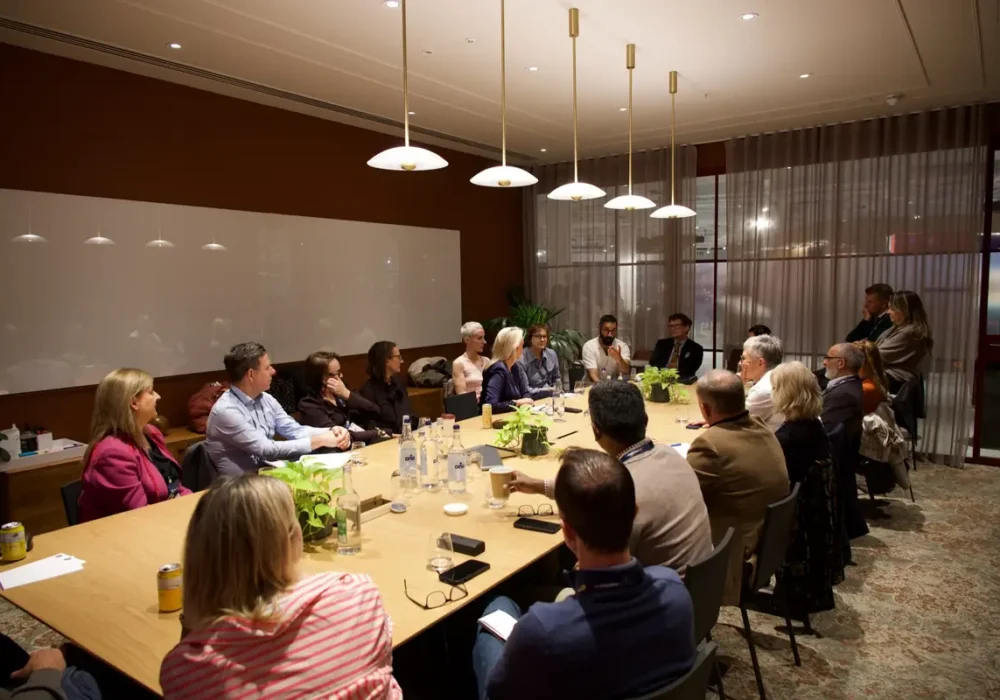
An executive roundtable works when it gets the right twelve people to talk honestly about a problem your product...
Read moreAn executive roundtable works when it gets the right twelve people to talk honestly about a problem your product solves. For an AI vendor, that matters more than the size of the room. Judge every CxO event on three things: who is invited, who chooses the topic, and whether the host keeps the sales pitch out.
This guide is for marketing and sales leaders at AI vendors and enablement partners. It helps you weigh roundtables and CIO dinners against bigger shows. It explains how the format works, what makes a senior room worth paying for, and how to judge an offer before you sign. We run leadership roundtables ourselves at aiblLIVE and the aibl Leadership Series, so we use them as the worked example and say where they fit.
An executive roundtable is a closed-door discussion for a small group of senior leaders, usually ten to twenty people. A host chairs it and keeps it on one question for an hour or so. It runs under the Chatham House rule, so people can speak freely. A vendor can sponsor it, but the conversation belongs to the guests.
The format exists because senior buyers rarely say what they really think on a stage or at a stand. Around a table, with peers in the same job, they talk about budgets, failed pilots and who in the organisation is blocking progress. For a vendor, that is the most useful hour of research you can buy. It is also the start of a relationship that a badge scan never gives you.
Most roundtables take one of three shapes. Some sit inside a larger conference as a side room. Others are standalone dinners or breakfasts, often called CIO events or CxO dinners. The rest are online versions, which are cheaper but tend to lose the candour that makes the format work.
AI vendors use CxO events because the people who approve AI spend are hard to reach and slow to trust. A good roundtable puts a vendor in a room with several of them at once. It also lets the vendor listen before it sells, which is how senior buyers prefer to be met.
AI buying is rarely one person’s call. Finance, operations and HR all have a say, alongside technology, and they often disagree on what AI is for. At aiblLIVE 2026, 39% of delegates from organisations with 500+ staff came with a colleague. A roundtable that brings more than one member of a buying committee into the conversation saves a vendor months of separate meetings.
There is a timing reason too. Of the 900+ leaders at aiblLIVE 2026, half were evaluating AI vendors now or within the next 12 months. Senior people in that window want to compare notes with peers before they talk to suppliers. A roundtable meets them at that stage, rather than after they have already drawn up a shortlist.
A senior room is worth sponsoring when the guest list shares one role and one problem. The host should also be able to show who came last time. Seniority alone is not enough. Twelve chief executives from unrelated sectors will talk past each other; twelve finance leaders facing the same AI decision will not.
Ask for evidence of the room, not a promise. Useful questions to put to any host:
The answers tell you whether you are buying a conversation or a list. A host that cannot say who came, or that offers a guaranteed number of “leads”, is selling something else.
A vendor should take part as a well-informed peer, not as the speaker. Bring a sharp question, one piece of evidence from your own customers, and someone senior who can listen well. Let the host chair. The guests will ask what you do once they trust that you understand their problem.
The vendors who get most from the format choose a topic their buyers already argue about. AI in the boardroom, paying for AI and moving from pilot to production are typical examples. They also field their most senior person, not a junior account executive, because guests notice who you sent.
Afterwards, follow up on the conversation, not the product. A short note that picks up a point a guest made carries more weight than a brochure. Then decide whether to run the topic again with a different group.
aibl runs leadership roundtables at two kinds of event. At aiblLIVE, the flagship day in London, they are one hour, by invitation and under the Chatham House rule. Each brings one role around one question. The Leadership Series runs smaller, free half-day events for one function or sector, with leadership roundtables held off the record.
At aiblLIVE 2026, four leadership roundtables ran alongside 48 case studies and demos and 12 hands-on workshops. Sierra, Gong and AcademyAI each hosted one, on AI for boards, AI for private equity, and agentic AI and job redesign. The room was senior: 75% of attendees were director level or above, and 43% were in the C-suite.
aiblLIVE 2027 runs on 13 July 2027 at InterContinental London, The O2, with twelve leadership roundtables planned. The next Leadership Series edition, AI in Travel, brings finance leaders from UK and Irish travel operators together on 11 February 2027. Guests at both come from the organisations that use AI, not from the companies that sell it.
What we do not offer is a pitch slot inside the roundtable. Partners host and take part; guests set the tone. That is the point of the format: the guests come for each other, and the partner earns its place by adding to the conversation.
A roundtable is a chaired discussion on one question, usually for an hour, and it can sit inside a larger event. A CIO dinner is a standalone evening built around a meal, with a looser agenda. Both rely on a small senior guest list and the Chatham House rule. Roundtables give a sharper conversation; dinners build relationships more slowly.
Most work best with ten to twenty guests. Below ten, one strong voice can take over the hour. Above twenty, the quieter guests stop talking and it turns into a panel. Twelve people who share one role and one problem is a good target for a one-hour session, with a host who keeps the conversation moving.
A vendor can open with a short framing question or one piece of customer evidence, but a roundtable is not a presentation. Senior guests leave, or stop speaking, when it turns into a pitch. The better approach is to take part as a peer, let the host chair, and save the product conversation for the follow-up.
Use the partner page to tell us which audience you want to meet and the question you would like the room to discuss. We will come back with how leadership roundtables, workshops, Expert Bars and demo pods could work for you at aiblLIVE 2027 and the Leadership Series.
Talk to us about partnering at aiblLIVE 2027
An executive roundtable works when it gets the right twelve people to talk honestly about a problem your product...
Read more
AI agents are AI systems that take actions as well as answer questions. For a leadership team they matter in two...
Read more
Role redesign changes what one job does once AI takes on some of its tasks. Organisational redesign changes how...
Read moreGet ahead with the most actionable insights, playbooks and real-world AI use cases you can adopt right now, in your inbox every week