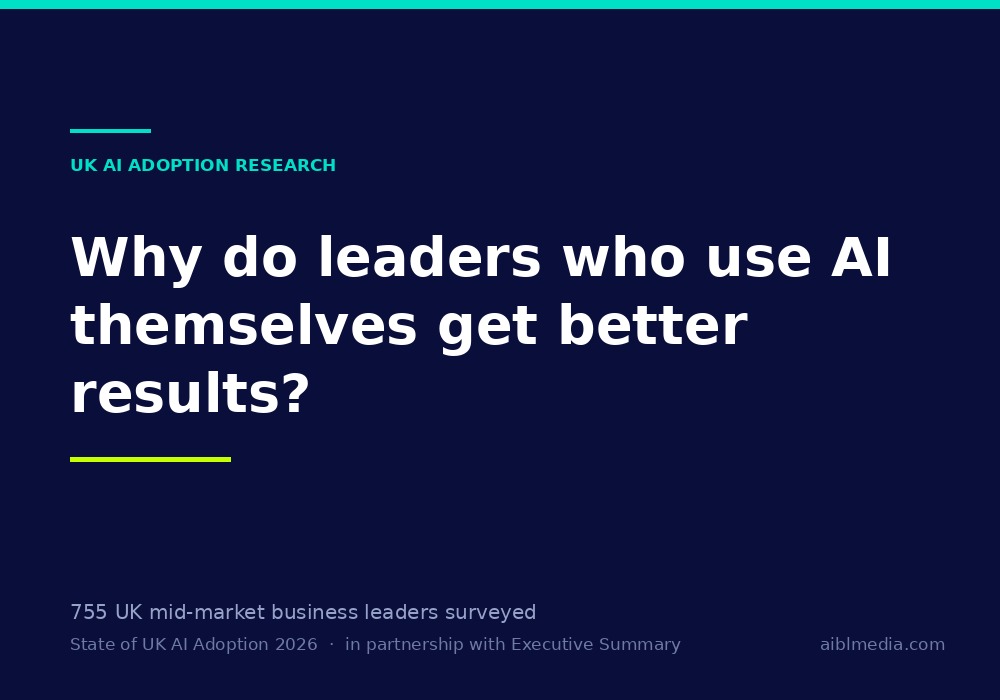
Because it changes what they can judge, not just what they know. In aibl’s survey of 755 UK mid-market leaders, those with AI built into their day report 71% measurable ROI, against 31% for leaders who only use it for the odd admin task. Personal use is its own lever, separate from governance.
The gap between hands-on and hands-off is real
The reality is that most leaders talk about AI more than they use it, and that gap shows up directly in the numbers. In aibl’s survey of 755 UK mid-market leaders, a leader’s own use lifts measurable ROI from 31% for the odd admin task to 71% when AI is built into their day.
In aibl’s survey of 755 UK mid-market leaders, 31% use AI for the odd admin task, 31% use it routinely, 50% use it for actual judgement calls, and 71% have it built into their working day. ROI climbs at every step.
This isn’t a story about tech-savvy leaders getting lucky. It’s a story about leaders who’ve learned, first-hand, what the tools are actually good for.
It’s a separate lever from governance, not the same thing twice
You might assume this is just governance wearing a different hat. It isn’t. Among leaders in equally well-governed companies, a hands-on leader reaches 80% measurable ROI, while a hands-off leader in that same governed company reaches 62%. Personal use is a lever in its own right.
That’s an 18-point gap, on top of governance both companies already have. So personal use adds value governance alone doesn’t reach.
Frankly, this makes sense once you see it. A leader who’s used the tools knows where they help and where they don’t. That judgement shapes better decisions about scope, budget and what to measure. A leader working from a briefing document doesn’t have that judgement, however well the company round them is run.
Why the most senior leaders are also the most hands-on
Look at who’s actually doing this, and a surprising pattern appears. In aibl’s survey of 755 UK mid-market leaders, 43% of C-suite leaders have AI fully built into their working day, against just 20% of the directors and heads of function beneath them.
That’s the opposite of what “start at the top” usually means in practice. It isn’t a slogan for a slide. The data shows the most senior people are, in fact, the most hands-on.
The drop-off sits in the delivery middle: the directors and heads closest to day-to-day work. That’s worth watching, because it’s exactly where AI decisions get executed. If AI training hasn’t reached that layer yet, the gap between strategy and practice will keep showing up in the numbers.
What hands-on leadership actually looks like
It doesn’t mean writing prompts all day, and it doesn’t mean becoming technical. It means using AI for the decisions you already own, often enough that you know what “good” output looks like and where the tool falls short. That is judgement a briefing can’t hand you.
That might be drafting a first pass at a board paper, stress-testing a pricing decision, or checking a plan against a model before a meeting. The test isn’t how much time it takes. It’s whether the tool has become part of how you think through a problem, not a novelty you tried once.
A leader who runs AI strategy at arm’s length is asking their people to do something they haven’t done themselves. That’s a hard position to lead from, and it shows in the numbers above.
Where a leader should start
Start with one recurring task you already do every week: a report, a review, a first draft. Use AI for it deliberately, every single time, for a month, on real work rather than a demo. That’s long enough to feel where it genuinely helps and where it doesn’t.
Don’t delegate this to “trying it once” at an away day. The point is routine use, not a demo. Once you’ve done it enough to judge where it helps and where it doesn’t, you’re equipped to make better calls about where your team should use it too.
This pairs naturally with closing the AI skills gap. A leader who’s built capability in themselves is far better placed to judge what their team actually needs, rather than guessing from a training catalogue.
Frequently asked questions
Should business leaders use AI themselves? Yes. In aibl’s survey of 755 UK mid-market leaders, those with AI built into their day report 71% measurable ROI, against 31% for occasional use. Personal use gives leaders judgement about what the tools are good for, which shapes better decisions than reading a briefing document ever could.
Does a leader’s own AI use actually change outcomes? It adds roughly 18 points of ROI on top of whatever governance a company already has. Among leaders in equally well-governed companies in the survey, hands-on leaders reach 80% measurable ROI against 62% for hands-off leaders. It’s a separate lever, not a proxy for governance.
What does hands-on AI leadership look like in practice? It means using AI regularly for decisions you already own, not trying it once at a workshop. A leader who drafts board papers, tests pricing calls or reviews plans with AI builds the judgement to guide their team’s use well, rather than directing from a distance.
Where should a leader start using AI themselves? Pick one task you do every week, such as a report or a first draft, and use AI for it deliberately for a month. In aibl’s survey of 755 UK mid-market leaders, 43% of C-suite leaders already have AI built into their day, well ahead of directors and heads at 20%.
Read the full research
This is one finding from State of UK AI Adoption 2026, aibl’s benchmark of 755 UK mid-market leaders, in partnership with Executive Summary. The full report shows how leadership behaviour, governance and capability combine to produce the highest-performing companies in the data.
Read the full State of UK AI Adoption 2026 report →