
Off the record: AI, operations, tech, and teams
This is the second half of our Off the Record series. These are quotes we agreed not to attribute, from...
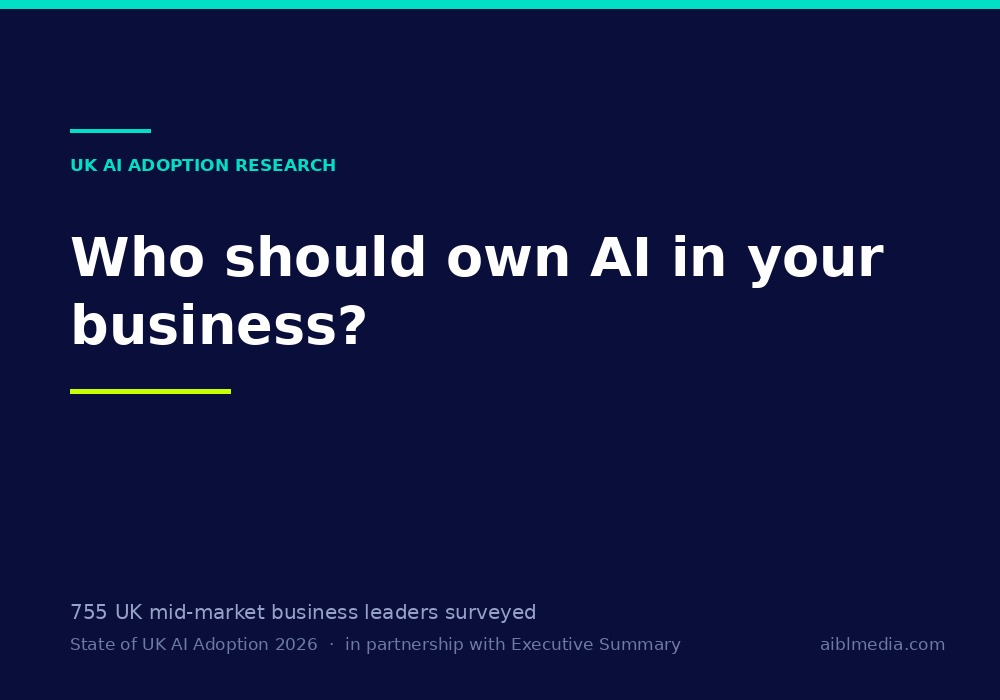
Read moreThe CEO or C-suite should own it. In aibl’s survey of 755 UK mid-market leaders, companies with an executive owner report 62% measurable ROI, against 18% with no single owner. A dedicated AI team, the option that sounds most serious, only comes third at 45%.
Who owns AI delivery predicts return better than any other structural choice UK businesses can make. That’s not a minor edge. In aibl’s survey of 755 UK mid-market leaders, it’s a 44-point gap between the best owner and the worst, from 62% measurable ROI down to 18%.
Here’s the full order, by measurable ROI: CEO or C-suite 62%, Central IT 52%, a dedicated data or AI team 45%, distributed across functions 41%, no single owner 18%.
Notice where the specialist team sits. Below Central IT. Below the executive who has other things to run. A model built to look serious underperforms a model that simply puts a name against the outcome.
The reality is that most businesses assume seriousness means a separate team. The numbers say otherwise.
A ring-fenced AI team looks like commitment on an org chart. But it often means the people closest to the business problem aren’t the people building the fix. That distance shows up in the numbers: a dedicated team reports 45% measurable ROI, behind Central IT at 52% and the C-suite at 62%.
That distance costs you. A specialist unit collects requests from every department, then builds something once, generically. It rarely gets close enough to any single function to make AI genuinely useful there.
Central IT scores higher (52%) because it’s already embedded in how the business runs. It knows the systems, the data and the people who’ll actually use the tool. Ownership works when it sits near the work, not apart from it.
This mirrors a pattern our AI adoption roadmap covers in more depth: AI succeeds when it’s built into how a team already operates, not bolted on from outside.
In aibl’s survey of 755 UK mid-market leaders, HR breaks the general rule. Central IT ownership scores 59% there, ahead of CEO ownership at 45%. It’s the one function where technical controls outweigh executive sponsorship, and the only place the main pattern flips.
HR AI tools touch recruitment data, employee records and decisions with legal weight. Those need the technical controls IT already runs, not executive sponsorship alone. Pair the two rather than picking one.
Every other function follows the main pattern. HR is the outlier because its AI use depends on infrastructure more than intent.
Good ownership shows up as behaviour, not a job title. It means a named person at executive level, accountable for the outcome, who signs off before the money goes out and answers for the result afterwards. A committee that shares that outcome usually owns none of it.
That person should also refuse to approve spend until the success metric and the pre-AI baseline are written down. Ownership and measurement are the same discipline, seen from two angles.
This connects directly to what we mean by AI enablement: giving people the tools, training and accountability to use AI well, not just installing software and hoping.
Don’t confuse a distributed model with shared ownership. Distributed ownership scores 41%, worse than a single owner at IT or the C-suite. When everyone owns AI, in practice nobody does. The lowest score of all, 18%, belongs to companies with no owner at all. That’s the group actively losing ground.
Name one executive owner for AI. Not a committee, not a working group, one person whose job includes the outcome. In aibl’s survey of 755 UK mid-market leaders, that single choice separates the 62% who can show a return from the 18% with no owner at all.
If the use case sits in HR, pair that owner with Central IT from day one. Everywhere else, keep ownership close to the C-suite or the function it serves.
Then write the success metric before you sign anything. Ownership without a number to defend is just a title.
The CEO or C-suite should own AI at executive level, for most functions. In aibl’s survey of 755 UK mid-market leaders, that model reports 62% measurable ROI, the highest of any ownership structure tested, well ahead of distributed ownership or having no owner at all.
A dedicated AI team isn’t the strongest option. It reports 45% measurable ROI, third behind Central IT and CEO or C-suite ownership. A team set apart from the business tends to build AI at a distance from the problems it’s meant to solve.
Central IT is a strong second choice, at 52% measurable ROI, and the best choice specifically for HR. IT already knows the systems and data AI depends on. For most other functions, executive ownership still outperforms it by ten points.
A named role matters less than where it sits and what it’s accountable for. The data favours ownership at C-suite level with a real success metric attached, over a title that isn’t backed by budget authority or a place in the executive team.
This is one finding from State of UK AI Adoption 2026, aibl’s benchmark of 755 UK mid-market leaders, in partnership with Executive Summary. The full report breaks ownership down by function and shows the four moves that close the gap between AI leaders and laggards.

This is the second half of our Off the Record series. These are quotes we agreed not to attribute, from...
Read more
aiblLIVE is under two weeks away. I needed to write something for this week that would be useful, but not take up...
Read more
Andy Lambert co-founded ContentCal, sold it to Adobe, and spent four years there as it became part of Adobe Express. He saw teams split between...
Watch videoGet ahead with the most actionable insights, playbooks and real-world AI use cases you can adopt right now, in your inbox every week