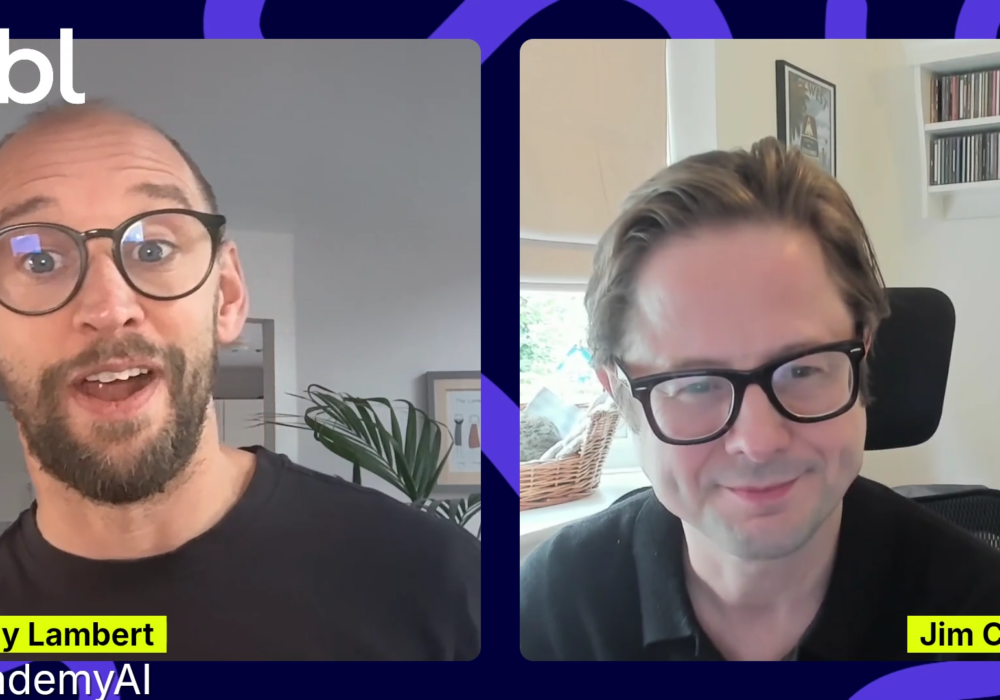
Watch the interviews here
Mark Riley, founder and CEO of Matheson AI, argues your AI capability is not a moat. Your accumulated decisions are…
Mark Riley runs Mathison AI, a boutique AI advisory in Bristol that started out advising media companies and now works with mid-cap insurance, risk, compliance, and law firms. He founded it in 2021, following six years at Dow Jones in New York running innovation and corporate ventures.
Start with the work people want rid of
CEOs describe the same result to him. “I can do my presentations really fast and my note taking is quite good now for meetings, but I haven’t seen any kind of major shift in productivity or ROI.”
He steers clients towards something less glamorous. “My rule is anything that does a lot of copy and pasting is ripe for AI.”
He starts by asking which bit of their daily routine they would like to get rid of. One is a building safety report, a complex form compiled from multiple sources, now deployed and working. “AI is very good at form filling.”
At BBC Studios and elsewhere, metadata used to go into each photograph by hand. “And now AI can do that in seconds.”
The AI is the easy bit
“In many ways the AI is the easy bit and the product is the easy bit. The harder bits are the plumbing and the data inputs and the API interactions.” Then the fine-tuning and the evals. A build reaches 80%, which might or might not be good enough. Closing the gap to 95% takes a lot of work, and it’s where clients who tried it themselves give up and come back.
aibl sees the same across mid-market AI projects. Demos run on clean examples. Production runs on the exceptions and on whether anyone can be accountable for the output.
A year or two ago Mathison was asked to transcribe the entire live output of the European and UK Parliaments, committees included, from live feeds. “And back then, transcription just wasn’t fit for the purpose. It wasn’t up to the job.”
The sticking point was diarisation, working out who is speaking as they speak. “In a committee meeting, that’s just about doable with 12 people. But you imagine trying to identify who’s asking what in… Prime Minister’s Question Time in the UK Parliament.”
They got it over the line, later than planned. “So, a bit of humility after that one, but we got there in the end.”
Efficiency is only the starting point
Adoption is a cultural and behavioural problem in his account rather than a technology one. Most AI work points inward at operations, and “people aren’t being ambitious enough yet.”
The tools arrived and the business around them stayed as it was. Bolting on tools here and there isn’t real AI transformation, and he thinks CTOs are starting to see the difference. Most firms haven’t reckoned with what going further costs, which often means “taking a scalpel to the org chart, making people take on new roles, adapt, train up, upskill, learn how to manage agents.”
He wants it reaching customer experience and customer interactions, and making life better for the people on the other end. “It gets much more exciting for me when… it creates new product, it creates new revenue streams, it creates incremental revenue around your existing business.”
A firm’s own accumulated learning is what he thinks is worth capturing. He describes a corporate memory layer, or a computer that acts as a company brain. “I think that’s kind of the over-the-horizon stuff.” It would move from knowing a lot about a business to helping it decide, which he calls going from knowledge to wisdom.
“Stop thinking of AI as a super fast search tool. Start training it to deeply understand your business and the mistakes you’ve made and the successes you had.”
Durability doesn’t come from the models
That vision doesn’t hold if it’s built on the models themselves. Model selection is no longer where the value sits. Mathison swaps them in and out, taking whichever is performing best at the time. “I think there’s a new cottage industry now in model routing and finding the best model for the task.”
“Don’t think the AI capability is a moat by any stretch, because that’s going to 10x in the next two years.” That figure is his own estimate rather than a sourced forecast, and he notes that if the people saying AGI is two years away are right, all bets are off anyway.
Companies whose product is a wrapper over someone else’s model are the most exposed. “One of the LLMs of the frontier labs will just build a replica and just clearly blast you out the water.” The labs need revenue from the application layer to repay what has gone in. He thinks that makes the next two to three years brutal even for companies with a head start. “Claude comes stalking for their business model.”
“Your value is in your heads, in your 10 years, 20 years’ worth of deals and decision making. That’s your moat.”
Mark Riley writes MediaMorph, a weekly digest on AI, media, and publishing.
Watch the interviews here
Mark Riley, founder and CEO of Matheson AI, argues your AI capability is not a moat. Your accumulated decisions are…