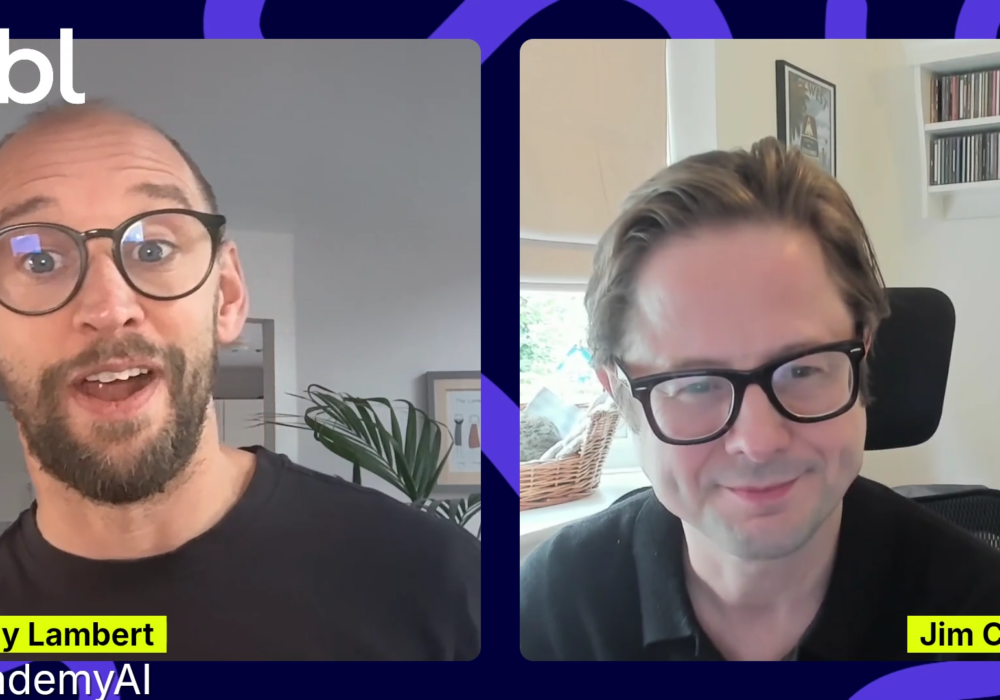
John Emmerson: Hello and welcome to another aibl Leadership Series interview. I am joined today by Mark Riley, founder and CEO of Matheson AI. Welcome to the show, Mark. Lovely to have you here.
Mark Riley: Thank you, John. Great to be here. Thank you for having me along.
John Emmerson: Mark and I met for the first time at a Mindstone event in London a few months ago, where Mark was speaking. I found everything he was saying really interesting. Great speaker. Why don’t you tell everyone a little bit about who you are, your history with AI, and what Matheson does.
Mark Riley: So, Mark Riley here in Bristol. I run a small boutique AI advisory called Matheson. We have been going about four years, principally advising media companies. We have since pivoted towards mid-cap insurance, risk, compliance, and law firms.
My AI journey began about 12 years ago when I was working for Dow Jones in New York, as innovation lead for the Wall Street Journal. I started bringing AI into the company from about 2012. So I have done a lot of learning along the way.
John Emmerson: Lovely stuff. I am going to dive straight into some questions. You have put tools into production for parliamentary transcription, insurance contract review, and building safety reporting, among many other things. Which one of those nearly did not make it, and what went wrong? It is always good to learn from the things that do not work as much as the things that do.
Mark Riley: That is an easy one. The contract review tool works extremely well and the client was very happy. The building safety report has gone into enterprise now and it is working well.
The transcription one was super ambitious. About a year or two ago we were asked to transcribe live the entire output from the EU Parliament, including committees, and the UK Parliament, including committees, taking a live feed.
Back then, transcription was not fit for purpose. It was not up to the job. The challenge was what we call diarisation, being able to identify the speakers as they pop up. In a committee meeting that is just about doable with 12 people. But imagine trying to identify who is asking what at Prime Minister’s Questions in the UK Parliament.
So we wrestled with that one. We got it over the line, but the project took a lot longer than we anticipated. A bit of humility after that one, but we got there in the end.
John Emmerson: That speaker identification piece is still something some tools and models struggle with. We use Notion here at aibl, and their call recording software is terrible at speaker identification. Is that now solved for the parliamentary transcription work, and what underlying tech do you use for it?
Mark Riley: It is certainly being solved. It is getting much more intuitive about what is actually being said, and much better at identifying abbreviations, acronyms, and technical language. We have various solutions in place, but we will just jump on the best latest model. We are quite happy to swap them in and out. I expect everyone is using Wispr Flow now, so you can see how that is moving into the mainstream.
John Emmerson: I am a huge advocate of Wispr Flow. I got my monthly stat recap the other day. Apparently I am in the top 1% of global users, which made me very happy.
I adore it. It really frustrates me when I am in a situation where I cannot use it properly. I commute into London for a couple of hours on a train a couple of times a week. I have talked to my laptop while sat at a table on the train, and people give me weird looks. It has led to some interesting conversations. But more often than not, that social awkwardness leads me to go back to typing, and I feel so unproductive when I am typing.
Mark Riley: Do you think the keyboard is dead? Do you think it is on the way out?
John Emmerson: I think it is certainly on its way out from my perspective. I am clearly in that upper echelon of Wispr Flow users, but it is just so much more efficient.
When the kids are at school, and they are on holiday at the moment, I have a 20 minute walk each way. On the way back I am just chatting to Claude using Wispr Flow. It could be transcribing an email, it could be anything, as I am walking along the street rather than tapping away and bumping into lamp posts and dogs. So I think it is amazing personally.
Mark Riley: I was just off a call with a client in Melbourne who runs AI for News Australia. There is an interesting culture point here. The hubbub of the newsroom was very loud back in the 1980s. Everyone was on the phone. Then it went quiet. Now the hubbub is coming back, because everyone is talking to their laptops.
John Emmerson: It is brilliant. We are only a small team here at aibl, five or six of us, and we have a small office. I started talking to my laptop in the office and everyone found it a bit weird. Now everyone has started doing the same thing. I think it is great. People can hear your train of thought, and it can feel a bit odd at times. But we need to get over that social awkwardness and just deal with it.
Mark Riley: My dog has got used to it now. He was a bit confused to start with.
John Emmerson: Anyway, we digress massively. Let’s get back on track, and a slight change of subject.
You have previously said that your first rule for picking an AI venture is to identify the problem clearly. You add that with AI, boring is beautiful. What boring problem turned out to be worth the most, and how did your client measure it?
Mark Riley: When we speak to a client we go through their workflows and ask which bit they want to get rid of. Which bit of your daily routine would you like to get rid of?
The clear one is the building safety report, which involves compiling a very complex form from multiple sources. AI is very good at form filling. So any task that involves filling out large, complex forms is routine.
Content tagging is another. We did a big job for BBC Studios and other media companies. You used to have to put the metadata into a photograph manually, describing what the photo is about so it could be picked up in search engines and content matching engines. Now AI can do that in seconds. So it took days out of that process.
My rule is that anything that does a lot of copy and pasting is ripe for AI.
John Emmerson: I tend to agree with that. It requires a slight behavioural change in how we go about doing what we do at work, and that can be a challenge for people. Have you seen clients interact with this disruption in different ways?
Mark Riley: I would go further. I would say AI is not really a technology challenge. It is a cultural and mindset challenge, and a behavioural challenge. I think we have moved away from thinking of it as cheating to thinking of it as an aid. But people are not being ambitious enough yet. So we will see when we get to real AI transformation, rather than just bolting on tools here and there.
John Emmerson: That is interesting. Why do you think people are not being ambitious enough? What should they be doing, and what do you think they will be doing in the next three, six, or 12 months?
Mark Riley: I have spoken to various CEOs and they say to me, look, I can do my presentations really fast and my note taking is quite good now for meetings, but I have not seen any major shift in productivity or ROI.
CTOs are starting to realise that the real magic happens when you do an entire business transformation through AI. That often means taking a scalpel to the org chart, making people take on new roles, adapt, train up, and upskill. Learning how to manage agents.
Then you build something we are leaning into now, a kind of corporate memory layer, or something that acts as a company brain. That can start to move from just knowing a lot about you to actually being able to aid decisions and strategy. I think that is the over-the-horizon stuff.
John Emmerson: I do not think we are that far away from it. We have a version of that we use here at aibl with our team.
I think you are right about this being a behavioural change and a cultural piece. It has come up in every single one of these interviews I have done. When we started moving towards aiblLIVE we did not have a workforce track, which we now have, focused on the people function.
The shift in the past six months has been amazing. It has gone from being a thing that sits in the tech department to something diverse across the whole organisation. It is more and more being influenced by that people function, and how you embed it, how you drive behavioural change, how you change your org charts, how you change culture. It is a really big part of this, because it is so disruptive.
Mark Riley: One hundred per cent. It is an interesting philosophical question whether your agents and bots should report to the CTO or the head of HR. Whose responsibility is it?
John Emmerson: A couple of people have said they have changed their org structures to actually put agents on them. How do you feel about that?
Mark Riley: Smart. Very smart. They have got to have accountability, and someone has got to monitor and manage them. So people should know where they are, where they sit, and who is in charge of them. That is really cool.
John Emmerson: Interesting. I have not heard anyone describe it like that before.
You say most AI solutions already exist, and that firms should de-risk by outsourcing or buying off the shelf. When was the last time you looked at what a client had commissioned and found they had paid to build something they could have bought?
Mark Riley: My advice there is that you should do your homework and research to see what someone else has tried before. It might not be the exact solution, but that is better than setting off and doing it yourself.
There is also a tendency I see with clients to think they can fix all their problems themselves using vibe coding. They will try to figure it out, then come back to us later and say, okay, we give up, can you come in and help us.
The bit people miss with AI is two things that are really hard. In many ways the AI is the easy bit, and the product is the easy bit. The harder bits are the plumbing, the data inputs, and the API interactions. So actually doing your data management.
The other hard piece people forget about is the fine tuning and the evals. They can get something to work to 80%, which might be fine, but not good enough. Getting it to 95% takes a lot of work, and that is where they need specialists to come in rather than doing it themselves.
John Emmerson: That is really interesting. We were talking about doing something this morning in the office and having exactly this debate. Should we vibe code it ourselves, or should we just buy something off the shelf? We ended up deciding we should probably buy the off the shelf option. Frankly, who has the time to spend creating the perfect solution when you can pay someone a relatively small amount to do it, and probably do it infinitely better as well.
Mark Riley: What was the situation? What was it?
John Emmerson: We have not got an AI chatbot on our website that people can interact with, that helps them understand who we are, what we do, and asks them questions if they are interested in any of our products. For us, as an AI-versed business, it feels like something we should absolutely have.
So I said we should just build that ourselves. Claude Code, we can do that, we can vibe code it, it would take a couple of days to get right. My co-founder Rich said no, we should buy it, because it would cost us a relatively small amount each month and it would be done. With all those things you just described, the infrastructure underneath it, the maintenance. And as we both know, because this world moves so fast, something we build now will be obsolete in two months.
Mark Riley: Okay, sounds like a good move.
John Emmerson: What is your approach to something slightly left field? We have taken the stance not to buy annual packages for anything we use at the moment. We are very much month by month with any of the AI tools, programmes, or software.
The reason is that although it makes everything more expensive by about 20% to 30%, it gives us the flexibility to flip from one thing to another, should there be a sudden massive improvement in one model versus another. What is your take on that? Do you think that is wise? Do you do it differently?
Mark Riley: I am exactly the same. I will always start off on a trial, then month by month, then review it at the end of the month. It is scary how many subscriptions you can have running now if you are not careful. I have the flexibility to ditch it, and there might be a better solution that comes along. So I endorse that 100%. Stay nimble.
John Emmerson: Going back to this idea of buying things off the shelf or building it, what are your thoughts on what the future might hold?
There was a ridiculous stat I read quite a while ago, which I keep churning out, that there were 300 new AI tools coming onto the market globally every single day. It is probably more than that now.
All of these tools tend to be fairly niche, and eventually there will be a commoditisation. In my belief there will be commoditisation, and the big players will soak up all of these little players and be able to do everything. What are your thoughts on that?
Mark Riley: I am quite a fan of the website There’s An AI For That, which is where people tend to park their first product launches, along with Product Hunt. I use that as a research tool to see what is going on out there. And 90% will wither on the vine.
The whole SaaS apocalypse debate kicked off around November last year. The argument was that you should not be buying a CRM now, you should build it yourself. Which is kind of true. That sort of went away, and it is coming back again a bit. I was looking at buying Monday or Salesforce, and I decided that for my small business I could just build one myself. So I vibe coded a kind of Trello board for clients and prospects, and it works very well. It cost me a few tokens.
The companies that are vulnerable are the ones that are clearly just wrappers. You will find that one of the LLMs or the frontier labs will build a replica and blast you out of the water, because it will be part of a package.
So it is going to be pretty brutal in the next two to three years, especially because these frontier models are going to look for new revenue in the application layer. They want to get their investment back. So they are moving into that space.
Some very sophisticated companies that have got head starts on ingratiating themselves into your workflows could be very vulnerable in the next year or two, when Claude comes stalking for their business model.
John Emmerson: We have a really basic example. I was the biggest fan in the world of Gamma six months ago, and still am. I think it is a brilliant thing. But then Claude Design came along, and it is part of my Claude package, so I do not have to pay extra for Gamma. It does a similar job. Not quite as good, in my opinion, but not far off.
Mark Riley: That is so interesting. I am the same, but I am still sticking with Gamma. Almost out of loyalty and love. I have been with it for so long, and it knows me, and it knows what I am trying to create.
Why are people still paying for Lovable is the other question, because with these vibe coding platforms you can do it just as well with Codex or Cowork. So why are people still sticking with these platforms? I think the answer is familiarity, and knowing your way around the UI. They are also very clever businesses that are still growing massively. So it is a bit of a mystery, but people are very loyal to these platforms.
John Emmerson: There will be an element of brand loyalty there that you get in any industry and sector. People like a particular brand, they like a particular UX. There will be a context history thing there as well.
You mentioned that Gamma knows you. So you will be the same with these things. Often it is easier to stick with what you know than what you do not know, compared to that human behavioural change piece.
Mark Riley: Yes, exactly.
John Emmerson: It is already coming through in which AI tools we use, rather than whether to use AI at all.
So we talked about the SaaS apocalypse. You warned previously that AI is not SaaS, because the revenue model has to account for inference charges against usage. That was aimed at people building AI products. On the other side of the table, are buyers getting caught out, in your opinion? This links to what we were just talking about, the whole business model.
Mark Riley: Yes and no. On the no side, we are seeing a lot of token usage discounted by the likes of OpenAI and Anthropic. They are trying to build customer bases using highly discounted subscription schemes. You hear that people on a $200 Claude subscription are actually getting $8,000 worth of tokens out of them. So they are on the good side of the trade for now.
It is the Uber model. The venture capitalists are discounting the usage to increase the customer base.
That said, those using the Claude or OpenAI APIs, where it is not capped, and the token maxing culture that started in the spring this year, got seriously burned. They are just haemorrhaging tokens. There is the story about Uber getting through a year’s worth of tokens in three months.
It depends on how you are using it. There is a new cottage industry now in model routing, and finding the best model for the task. You do not need to use Fable 5 every time you want to do a menial task. So people are figuring it out.
I worry about some of these solutions that are bespoke to an industry, like Harvey. I think they are having to move their business model to token usage rather than seat models. So we will see. But I suspect the old SaaS seat model is probably a thing of the past.
What I would like to see, and I think this is starting to happen already, is people paying for outputs. Rather than paying for a seat, rather than paying for tokens, you actually pay for the output. Do you remember the good old CPA model in advertising, cost per acquisition?
John Emmerson: I do, yeah.
Mark Riley: In those days you would not pay for the advert. You would only pay if the advert created an insurance contract, or a test drive for a car. I would like to see AI embrace that more. So I would only pay for the impact AI has on my business as a clear upside. But we will see.
John Emmerson: That is a tricky one, and this is John Emmerson’s opinion, not a widely held one. The reason the CPA model did not work is that as the seller you have no control over the quality of the product or the advert. So you have nothing to do with the conversion rates, other than putting it onto whatever platform you have and driving traffic to it.
We have a similar thing in the world of events. People say, well, we will take a stand at your event, but we will give you a cut on any commission we make out the back of it. If you are the best business in the world with incredible salespeople, then that might be worth it. If you are the opposite of that, then it is absolutely not worth it. So it is that control piece. I am not sure AI companies will go down that route on that basis.
Mark Riley: No, it is the old arm wrestle, is it not? Who carries the risk? Is it the media company with the media property and the advert, or is it the car dealership? So we will probably meet somewhere in the middle. But I think the current token model is fairly unsustainable for most businesses, unless you do clever model routing.
John Emmerson: I have no idea where it is going to go, and at aibl we try to think about the here and now rather than the future. But ultimately the amount of investment going into the AI companies is going to have to be repaid in some way. So they are going to have to think about how they generate that revenue.
You mentioned application-based stuff, which makes a lot of sense. But ultimately these are subscription businesses, to use a really simple term, and that is where the majority of their bankable and sustainable revenue is going to come from.
Mark Riley: Interesting.
John Emmerson: I believe as part of Matheson AI you have developed a four-step process: education, advisory, integration, then build. I imagine when you are speaking to clients, lots of people try to skip straight to build without doing those first three steps. Is that right? Are they right to? Do they need those other three steps first?
Mark Riley: AI maturity has moved a lot since I started Matheson. Back in 2023 we would start with education, and people were saying, holy cow, what is this thing. We would go in and do a webinar or a lunch and learn and try to bring them up to speed.
Upskilling is still important. There is still a huge demand for things like Claude integration training. Context engineering is a big one.
We still see value in the workshop phase, where we look at surfacing maybe 10 or 15 use cases for them, bespoke to them, by looking at their workflows. Then we will triage that. The triage piece is hard. You have got to understand the business, be very empathetic to it, and see what they can do. Once they have done the use case identification, you can move to prototype.
That is the flow we like. But we now see clients coming to us with a use case, saying, right, build me this. And we say fine, that cuts out the first two steps. You understand what you need and you understand the technology, so we will do that as well. We are happy to jump in at any point.
John Emmerson: When firms come to you having already tried to build or adopt with another supplier, what is the biggest mistake you have inherited? Was there a warning sign, or was it only obvious once you got into the weeds?
Mark Riley: I am going to slightly dodge the question. It has not really happened. Not catastrophically.
They have tried doing it themselves, and then they will come and say, okay, can you come and fix this and do it properly. But nothing springs to mind where we have had to come and clean up the mess.
There is a danger people fall into with vibe coding. There is a new role for vibe coding fixers, who come in and clean up the security patches on Lovable prototypes. So that is always an interesting one. But no, nothing major. We have always been on the road with our clients from the start normally, because we have been going five years. So we have not seen anything really bad.
John Emmerson: One of your rules is to build for where AI models will be in two years, not where they are now. So I have two questions. How on earth do you do that in a world that moves so fast? And when you are trying to sell your services into an organisation that wants immediate ROI, which is certainly a challenge we face in events, how do you justify taking a little bit longer?
Mark Riley: That advice was primarily for entrepreneurs building a new product or tool, something they want to put into the market now, but which needs to be robust in two years so it does not get wiped out, as we talked about earlier.
The enterprise can adopt tools now and see immediate impact in terms of savings and efficiency. If you are enterprise, go for it now, but de-risk it by testing proofs of concept and prototypes before going to full enterprise launch. For entrepreneurs, do not just sit on today’s technology. You have to be really aware of where this stuff is going to be in two to three years. That is hard. Some people are saying AGI is two years away, so all bets are off at that point.
I think you can get going now, for sure. Just be aware that you should be very agnostic about the models. For me, the value is no longer in the model selection. It is in the data and the knowledge and the experience that lives within your company.
So that is one thing I am trying to teach my clients. Your value is in your heads, in your 10 years or 20 years worth of deals and decision making. That is your moat. Do not think the AI capability is a moat by any stretch, because that is going to 10x in the next two years. So you have got to lean into what you are best at and what you know most about, and then build AI around that. That should make you robust.
John Emmerson: It is interesting that you say most enterprises can expect an ROI immediately. There are loads of stats still flying around from people like Forrester and McKinsey that 94% of businesses do not see any ROI on their AI spend. Do you think that is wrong?
Mark Riley: Can we debunk the MIT study from last summer, the 85% one? It was an absolutely diabolical report and it is going to be completely disputed. It was a terrible survey and it did not reflect the real world. It did enormous damage, because it was a very spurious 85.
So no, there are plenty of ways. All our prototypes that showed ROI got into production, without doubt. You have just got to be clever on the selection, clever on the application, and make sure it is solving a real problem and not just showing off the technology.
Then de-risk it. Start in a small sandbox environment, test it with some select data, be agile in your product development, roll it out when it is working, and then take it around the company. So I get quite frustrated by these studies, which are deeply spurious in my mind.
John Emmerson: I tend to agree with you, Mark. I do not understand how it is possible that there is no ROI. Maybe it is just because you and I use it more than the majority of people, and we are slightly more fluent. But it is enormously helpful to me as a tool in terms of my productivity, and my ability to do other things that add more value to what we are doing. I simply do not understand how it is not the same for others.
John Emmerson: We are nearly at time, so I am going to ask my final question. Our audience, as you know, is predominantly scale-up and mid-market leaders looking to adopt AI in more effective and efficient ways. What would be your single piece of advice to one of those individuals about what they should be thinking about or doing in the next three to six months?
Mark Riley: Two things. One is that I am trying to advise my clients to move away from thinking of AI as purely an efficiency tool and time saver. Yes, it is very good at that. But it gets much more exciting for me when it creates new products, new revenue streams, and incremental revenue around your existing business. That often means taking it away from just your internal operations, and thinking about how it can improve your customer experience and your customer interactions, making life better for them.
Number two is leaning into this company brain idea, and moving from knowledge to wisdom, as I put it. Stop thinking of AI as a super fast search tool. Start training it to deeply understand your business, the mistakes you have made, and the successes you have had. Then it can be a much more valuable tool going into the future. Those are my two bits of advice.
John Emmerson: Fantastic. Mark, thank you so much for joining me today. We really appreciate it. It has been a really interesting conversation, and I wish you and Matheson AI all the best of luck in the coming months and years.
Mark Riley: It is great to talk. Thanks for having me on, John. Thanks a lot.
John Emmerson: Thanks, Mark.