
Oddbox found a better use for AI than making ads
When Oddbox's board asks why the company isn't making more ads with AI, Gastón Tourn says the next question...
Read more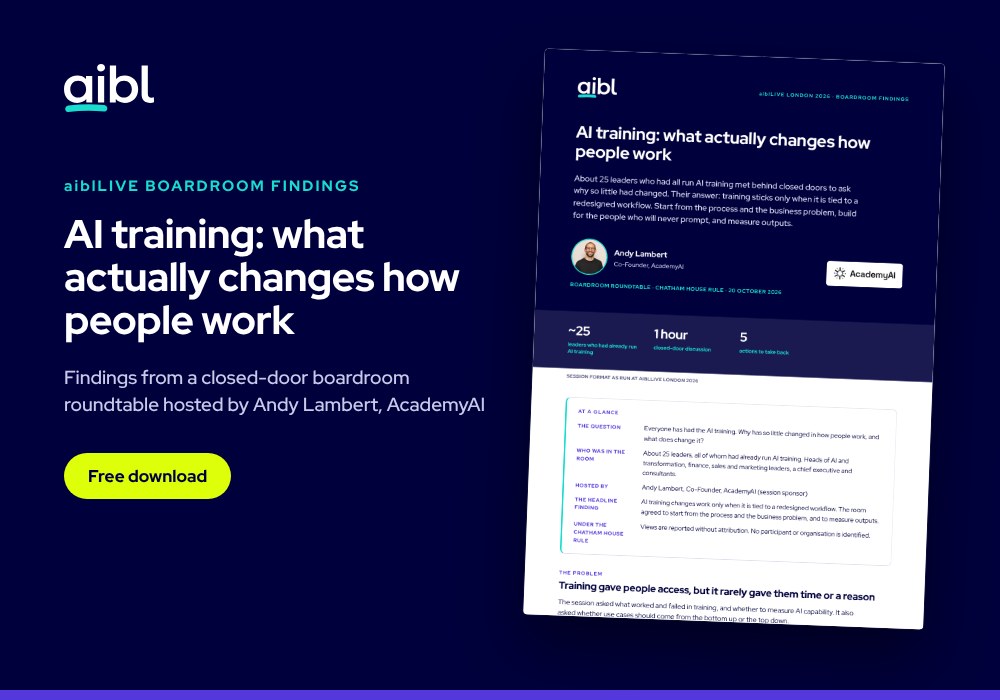
AI tools go unused because they are added to jobs that haven’t changed. People get a licence and a training session. They don’t get time to practise, use cases that fit their own work, or a workflow that expects AI. Adoption follows when you fix those three things and measure what people do with the tool, not how often they log in.
This guide is for COOs, CHROs and AI leads whose AI rollout is live but quiet. It explains why usage stalls after launch, what organisations with high weekly use did differently, and how to tell real adoption from activity.
Most AI tools go unused for three reasons. People have no time to learn them, the training doesn’t match their actual job, and the work around the tool stays the same. Add unclear rules on what is allowed. Most staff then try the tool once, hit a wall and go back to the old way.
Time comes up first in almost every account. Somerset Bridge Group, a UK motor insurer, told aiblLIVE London 2026 that time was its biggest barrier, because daily delivery crowded out learning. Its Chief People Officer, Katherine Hawkins-Jones, put it plainly: “We didn’t have a software tool or development problem. We had an adoption problem.”
Fit comes second. Rémi Hottois of Mendo worked with Engie on its Copilot rollout. He said top-down training built on the use cases leaders pick misses many people. It doesn’t fit their job or their level, so they don’t use it.
The third reason is the workflow. About 25 leaders who had all run AI training met at an aiblLIVE roundtable. Their headline finding was that training changes how people work only when it is tied to a redesigned workflow. Several said people feel busier when AI means extra chat output on top of the old process.
Low adoption turns AI spend into a cost with no return. You pay for licences, training and setup, but the work is done the same way, so nothing on the P&L moves. The money leaks quietly, because a live tool with a healthy login count looks like progress until someone asks what changed.
The research shows how common this is. In aibl’s State of UK AI Adoption Survey 2026 (755 UK mid-market leaders surveyed), only half (49.6%) could show measurable ROI from AI. Four in five (79%) had already seen an AI initiative fail.
Unused tools also push people elsewhere. More than half of the organisations surveyed (55%) have shadow AI, and 53% of those say staff use it to move faster than IT approvals. When the approved tool doesn’t fit the job, people find one that does, outside your rules.
Give people protected time, practice on tasks from their own job, and a named person to ask. Then change the workflow so the AI step is part of how the work gets done, not an optional extra. The organisations with the highest use did all four, and they started small before widening.
Protected time. Somerset Bridge Group gave staff time away from business as usual through an AI Academy and fortnightly learning sessions. Its leaders learned out loud and gave explicit permission to experiment. Reported AI use rose from 66% to 84% across two surveys, though the respondents differed.
Practice on the real job. Engie, working with Mendo, put an AI coach inside Copilot. Each person practised weekly on use cases matched to their job and level. Coached staff became power users far faster than colleagues left to progress alone, and Engie then funded licences for more people. The Engie Copilot adoption case study sets out the method.
Champions in every team. YuLife, a 140-person insurer, recruited champions in every team and added a dedicated AI enablement role. It introduced AI in stages, from everyday questions to answers grounded in its own knowledge. According to its co-founder, 94% of its people now use AI every week. The YuLife case study covers the five people steps behind that figure.
A workflow that expects AI. The roundtable leaders agreed to start from the process and the business problem, then build for people who will never write a long prompt. Some had a small group build simple tools for colleagues, so the AI sits inside the work.
Managers decide which work gets time, so they decide whether AI gets practised. If a team’s manager doesn’t use the tool, rarely mentions it and never changes what they ask for, the team reads that as a signal. aibl calls this layer the frozen middle, where AI plans most often stall.
Alignment shows up in the numbers. In aibl’s survey, only 24% of leaders say five of their managers would name the same AI priorities. Where all five do, 79% show measurable ROI, against 37% where three of five do.
The fix is to give managers the same support as their teams, and a reason to care. Train them first, ask them to set one AI goal for their team’s real work, and review it like any other target. Our guide to the frozen middle and AI adoption explains why managers resist and how to bring them with you.
Measure the work, not the logins. Track which use cases people run and whether the job got faster or better. A login count or a licence total tells you the tool is switched on. It doesn’t tell you whether anyone works differently.
Mendo sorts each team’s Copilot and ChatGPT activity into use cases, then shows the team what it uses against what it could use. That turns a vague usage figure into a list of specific next steps for that team.
Set a baseline before you start. Somerset Bridge ran a readiness survey of more than 220 people first, then followed up. It now reviews each new AI idea on its commercial value.
The roundtable leaders warned that self-reported time savings can mislead, so test them against real examples. Our piece on adoption versus capability explains why usage figures flatter.
Pick one team with a job they repeat every week. Give them protected time, practice on that job inside the tool, a champion and a manager who uses it too. Measure whether that job improved. Then use the result to decide where to go next.
Starting with one team keeps the cost of being wrong small. If it works, you have a method and a result to show the board. If it doesn’t, you learn why on one team rather than across the whole organisation.
If you need outside help with training, the AI Enablement Directory lists vetted UK partners in AI training and capability building. Our guide to what AI enablement is covers the wider work that makes AI pay back.
To see how your organisation compares, try the free AI ROI benchmark. It scores your AI maturity against the leaders in aibl’s survey in about three minutes.
The survey figures come from State of UK AI Adoption 2026, aibl’s survey of 755 UK mid-market leaders, in partnership with Executive Summary. Percentages are based on the 724 responses analysed. Case study figures are as stated on stage at aiblLIVE London on 20 October 2026.
Read the full State of UK AI Adoption 2026 findings
Usually because they lack time to learn, the training doesn’t match their own job, and their workflow hasn’t changed to include AI. Unclear rules on what is allowed make it worse. Most people try the tool, hit a problem they can’t solve alone and go back to the way they already know.
Give people weekly practice inside Copilot on tasks from their own job, protected time to learn, and a champion in their team. Engie did this with an AI coach built into Copilot. Coached staff became power users far faster than colleagues left alone, and Engie then funded licences for more people.
There is no single benchmark, and a high login rate can hide shallow use. A better test is whether people use AI every week for named tasks in their job. YuLife reports 94% weekly use across its 140 people. Track the use cases your teams run and whether those jobs improved.
Longer than the rollout. Engie saw coached staff become power users within about three months, faster than colleagues left alone. YuLife introduced AI in stages, with agents last. Start with one team and one job, prove the result, then repeat the method rather than rolling out to everyone at once.

When Oddbox's board asks why the company isn't making more ads with AI, Gastón Tourn says the next question...
Read more
A quick one on research this week. I was interested to read a recent article from The Strategic Management...
Read more
Account-based marketing (ABM) for an AI vendor means choosing a short list of UK organisations that fit. You then...
Read moreGet ahead with the most actionable insights, playbooks and real-world AI use cases you can adopt right now, in your inbox every week