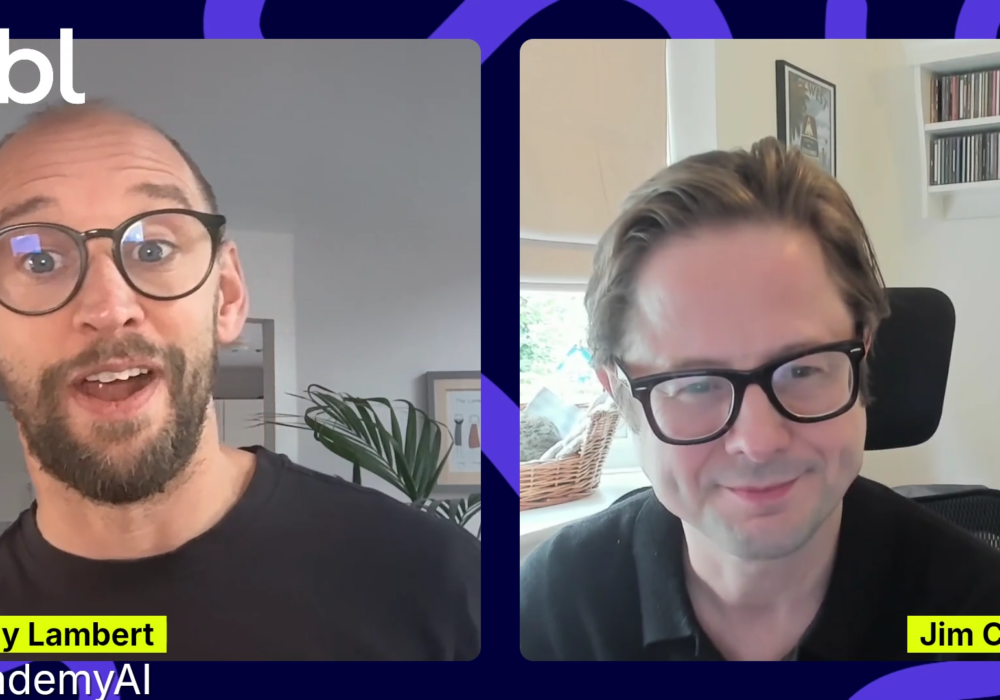
Watch the interview here
Max Haining, founder of 100 School believes companies are failing because they’ve given people access without giving them a structured way to…
“For the last two years, organisations have been chucking mud at the wall,” says Max Haining. “Now lots of companies are thinking: we’ve made a huge investment here. How do we actually turn it into results?”
Max is the founder of 100 School, an AI capability business focused on changing how people work with AI, not just whether they have it.
The best teams he’s observed haven’t just got faster; they’ve escaped whole categories of work. He calls them the Navy SEALs of AI. They “feel like they’re living in the future. Ultimately, they’re not doing any of the same tasks as two years ago.”
Most organisations aibl works with are nowhere near that. The tools are in place; the ways of working haven’t followed.
More workshops just make it worse
The default response is to add more, which Max argues compounds the problem.
“Let’s almost have a shootout of workshops to give our employees the best, the latest, greatest technology and features that they can use with AI. Now that’s not necessarily a bad approach, but what often happens with that is people are overwhelmed.” The result, he says, feels like keeping up but just adds chaos, stress, and anxiety.
His answer is to go two steps back from the features entirely, focusing not on what tools to teach but on what behaviours make someone agile enough to learn new ones independently. “If you have to wait for that and that’s spoon-feeding,” he says, “your organisation isn’t agile enough to keep up with pace of change.”
What the top 1% do differently
“We frame it as a behaviour change product that happens to deliver content,” Max says. “Our anti-goal is to be another B2B kind of learning provider where we create custom content that lives and dies in a matter of weeks… and that no one actually changes their behaviour as a result of.”
The framework, which 100 School calls AIQ, came from what Max describes as a listening tour of San Francisco: hackathons, companies, the top 1% of AI users in practice rather than in theory. The difference, he found, was how they thought.
Max argues most people don’t use AI badly so much as fail to see where it applies beyond the most basic uses as a souped up search engine or editorial punch-up machine. This is what 100 School calls Imagination. Fluency follows: the ability to direct it well enough to get useful outputs. Then Judgement: knowing when what comes back is wrong. Without it, that’s where problems like AI dumping emerge: colleagues forwarding AI-generated work with no review and no ownership. A set of 12 behaviours, baked into every lesson, is how 100 School measures whether the change is taking hold.
Unlearning under fire
Getting people to unlearn behaviours built up over years is the real work, in the middle of their existing job and targets.
“To assume or to try and drive that change in all that chaos,” Max says, “is a hard thing to do.”
The programme is fifteen lessons, dropping into inboxes at whatever cadence fits the team: two a week over seven weeks, or faster if the culture supports it. Each takes fifteen minutes: short enough for a coffee break, long enough to produce something useful that day. AI is what makes that viable. The speed of it allows for an outcome in a timeframe that would have been harder to achieve teaching anything else. It’s still an ask, Max says, but a manageable one.
Running alongside is a shared Slack or Teams channel where everyone shares what they’re learning. Max calls it the cultural layer, and says it’s the most important part of the programme. That’s where the tipping point happens: colleagues who aren’t on the programme see the energy, see the results, and reconsider.
You’ve spent the money but you haven’t given people a way in
For the sceptical mid-market leader with limited resources and a graveyard of failed training programmes:
“You’ve invested a lot of money at this point, given people access to tools. But the activation point is missing: you haven’t given people a way to work this into how their teams operate day to day.”
You can’t give people chaos, he says, tons of workshops scattered around with no thread. You need structure, pathways, progression. And without a way to measure it, you have no idea whether any of it is working.
“If you do those two things,” he says, “that is when you’ll start to feel a little less sceptical of your AI investment.”
Watch the interview here
Max Haining, founder of 100 School believes companies are failing because they’ve given people access without giving them a structured way to…