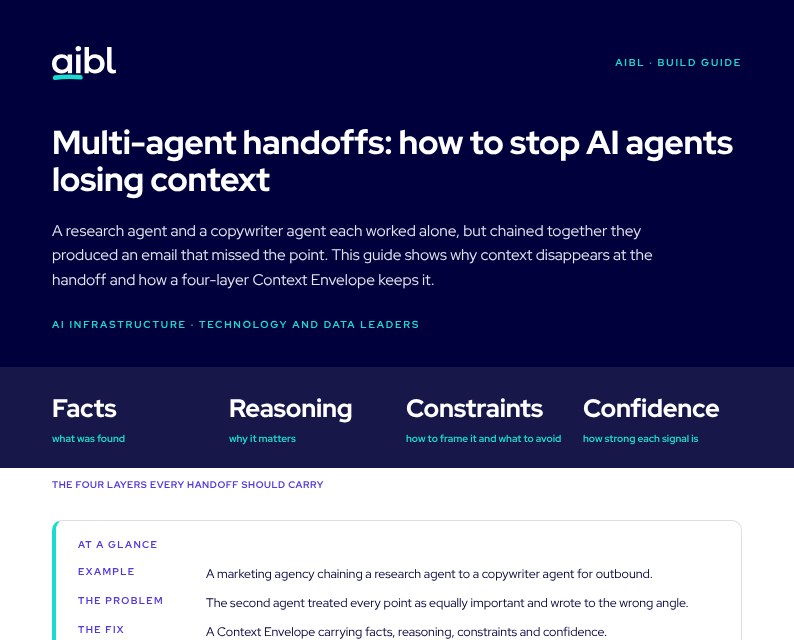
A marketing agency’s research agent worked well on its own. Chained to a copywriter agent, it fell apart: the copywriter treated a new VP’s Amazon background and a 15% share price fall as equally important, and wrote a cost-cutting email that missed the point.
Three things vanish at a handoff: the reasoning behind each point, how confident the claim is, and the rules that stop obvious mistakes. The Context Envelope carries them across.
The four layers every handoff should carry
Agent chains are treated like relay races: pass the text and the job is done. But the next agent reads a flat list of points with no sense of which matter. The reasoning, the confidence level and the constraints stay with the first agent.
A structured handoff that separates facts from intent. It holds the facts, the reasoning about which matter, the constraints on framing, and a confidence rating for each signal. In the agency’s example, the envelope said the Amazon hire was the hook and the share price was noise.
Give the first agent an encoder prompt that requires the four fields, and the second a decoder prompt that follows the constraints strictly and favours high-confidence signals. In production the agents pass the envelope directly as structured data.
If you are chaining agents together, the full guide gives you the format and the prompts:
This guide first appeared in aiblBRIEF. Read the original article: Why your agents keep losing context (and how to fix it).