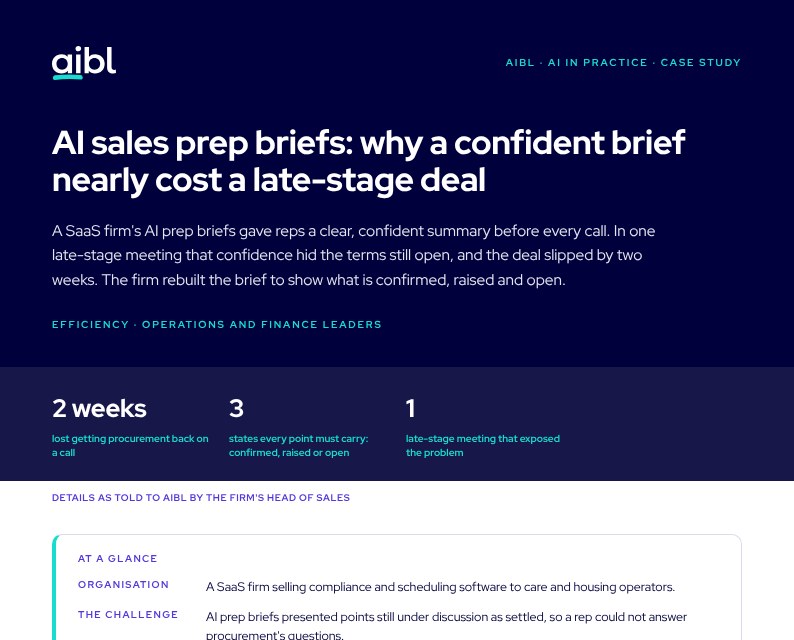
A SaaS firm selling to care and housing operators had used AI prep briefs for months when one nearly cost it a deal. The brief told a rep the pilot was agreed. It did not tell him which terms were still open, and procurement asked about exactly those.
The deal closed two weeks late. The fix was not a better model. The firm rewrote the brief so it separates what was confirmed from what was only raised, with every point traced back to the call it came from.
Details as told to aibl by the firm’s head of sales
The prompt asked for something clear and confident to take into the room. That flattened every point still under discussion. The rep knew a pilot was agreed but could not say which regions were in scope, what the review criteria were or whether a timeline had been discussed.
It rewrote the output so every point is marked as confirmed, raised or still open, with a link to the call it came from. If a rep cannot trace a claim on scope, pricing or rollout back to a transcript, it stays open in the brief.
Check whether the prompt rewards confidence over accuracy. A brief that always sounds certain hides the ambiguity reps most need to see before a meeting with procurement or a new stakeholder.
If your reps use AI briefs before calls, the full case study sets out what went wrong and the format that fixed it:
This case study first appeared in aiblBRIEF. Read the original article: How a better prep process created a new problem.