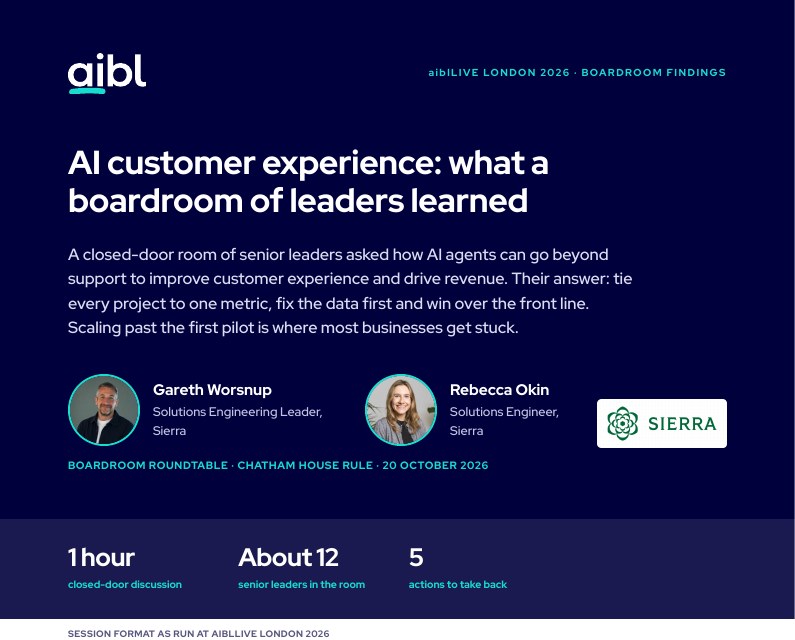
About a dozen senior leaders met behind closed doors at aiblLIVE London 2026 to ask how AI agents can go beyond support to improve customer experience and drive revenue. Their answer: tie every project to one business metric, fix the data underneath first and bring the front line with you.
The hard part is not the first pilot. It is scaling past it, and that stalls on structure, incentives and fear more than on the technology.
Session format as run at aiblLIVE London 2026, under the Chatham House rule
Tie each project to one business goal, such as deal speed, calls per week or proposal throughput. Record the baseline before you start, review after two weeks or a month, and stop what does not move the number. Being strict about stopping was the change that mattered.
The data and the systems. Leaders described fragmented estates, decades-old data and rules that differ across borders. Putting a bot on top of that gives poor answers, so the first step is consolidating systems and getting full value from tools already owned.
Rarely because of the technology. The room pointed to federated structures, dependence on other teams for budget and data, managers who lose status if headcount falls, cautious risk appetite and worry about what a regulator will say if an agent gets something wrong.
The full findings report covers what the room said, without attribution:
From a boardroom roundtable at aiblLIVE London 2026, held under the Chatham House rule and hosted by Gareth Worsnup and Rebecca Okin of Sierra. See all the workshops and boardroom roundtables from the day.