Practical AI adoption insight, every week. Join 5,700+ aiblBRIEF subscribers
aibl
  • Practical AI Insights
    • By function
      • AI and transformation leaders
      • C-suite
      • Boards
      • Sales and marketing leaders
      • HR and people leaders
      • Customer and CX leaders
      • Operations and finance leaders
      • Technology and data leaders
    • Learn And Apply
      • AI explained
      • AI case studies
      • AI build stories
      • AI playbooks
      • AI workshop guides
      • Boardroom findings
      • Leadership Series report
      • AI leader interviews
      • Newsletter archive
  • Our Research
    • State of UK AI Adoption 2026
    • What our research says
    • AI analysis
  • Events
    • aiblLIVE 2027
      • Overview
      • Register your interest
    • Leadership Series
      • Coming soon
  • Past Events
    • aiblLIVE 2026
      • Overview
      • The agenda
      • Session downloads
      • Photo Gallery
      • Who attended
      • What they said
      • Our partners
    • Leadership Series
      • workforceLIVE
      • growthLIVE
  • AI Benchmark Tool
    • Benchmark your AI ROI (Beta)
  • Find AI Enablement Partners
    • AI Enablement Listings
      • Search the listings
      • Register your business
    • By Category
      • AI Strategy & Readiness
      • AI Implementation & Deployment
      • AI Training & Capability Building
      • AI Agents & Agentic Workflows
      • AI Governance & Risk
      • Generative AI Applications
      • Data & Analytics
      • Process & Document Automation
  • Partner
    • Partner with us
    • List your firm in the Directory
    • Insights for vendors
  • About
    • About Us
    • Contact Us
Subscribe to aiblBRIEF
  • Practical AI Insights
    • By function
      • AI and transformation leaders
      • C-suite
      • Boards
      • Sales and marketing leaders
      • HR and people leaders
      • Customer and CX leaders
      • Operations and finance leaders
      • Technology and data leaders
    • Learn And Apply
      • AI explained
      • AI case studies
      • AI build stories
      • AI playbooks
      • AI workshop guides
      • Boardroom findings
      • Leadership Series report
      • AI leader interviews
      • Newsletter archive
  • Our Research
    • State of UK AI Adoption 2026
    • What our research says
    • AI analysis
  • Events
    • aiblLIVE 2027
      • Overview
      • Register your interest
    • Leadership Series
      • Coming soon
  • Past Events
    • aiblLIVE 2026
      • Overview
      • The agenda
      • Session downloads
      • Photo Gallery
      • Who attended
      • What they said
      • Our partners
    • Leadership Series
      • workforceLIVE
      • growthLIVE
  • AI Benchmark Tool
    • Benchmark your AI ROI (Beta)
  • Find AI Enablement Partners
    • AI Enablement Listings
      • Search the listings
      • Register your business
    • By Category
      • AI Strategy & Readiness
      • AI Implementation & Deployment
      • AI Training & Capability Building
      • AI Agents & Agentic Workflows
      • AI Governance & Risk
      • Generative AI Applications
      • Data & Analytics
      • Process & Document Automation
  • Partner
    • Partner with us
    • List your firm in the Directory
    • Insights for vendors
  • About
    • About Us
    • Contact Us
  • Subscribe to aiblBRIEF

AI bias and data drift: how Experian keeps models true to reality

Downloads | AI case studies, Technology and data leaders
Share this session:

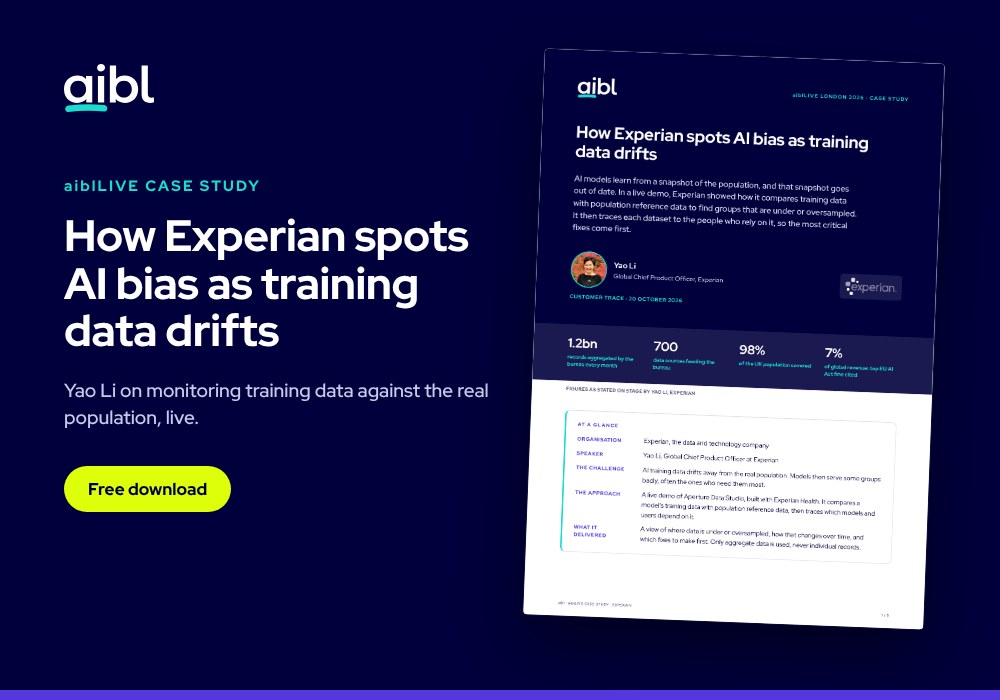
AI bias often creeps in after a model is built, as its training data drifts away from the real population. Yao Li, Global Chief Product Officer at Experian, showed how to catch it in a live demo at aiblLIVE London 2026.

Experian compares a model’s training data with population reference data to find groups that are under or oversampled. It then traces each dataset to the models and people that depend on it, so the most critical fixes come first.

Experian in numbers

  • About 1.2 billion records are aggregated by Experian’s bureau every month.
  • 700 sources feed those records, including banks and insurers.
  • 98% of the UK population is covered by the bureau.
  • Up to 7% of global gross revenue is the EU AI Act fine Li cited for non-compliance.

All figures as stated on stage by Yao Li.

How does training data cause AI bias over time?

The population a model learned from stops matching the population it serves. In Experian’s demo, a 2023 baseline was compared with later data by income and age. The biggest change was in the lowest income band, a group Li says is traditionally overlooked. A model trained on the old picture serves them worst.

The population that are most affected is actually the ones that need it the most.

Yao Li, Global Chief Product Officer, Experian

Is oversampling a source of AI bias too?

Yes. Li says teams must check for two problems at once.

Undersampling means telling a model too little about a group, as happened with women and people of colour in early facial recognition. Oversampling means giving it far more data on one group than it needs. Both skew what the model learns.

Which AI bias problems should you fix first?

Fix first where critical users depend on the data. Experian maps each drifting dataset to the models and people it feeds.

In the hospital demo, one dataset fed admissions, ambulance arrival and triage models. The admissions model serves clinicians, billing and compliance. Critical users like these justify extra spend, while a prediction that is still good enough can wait.

Can you check for bias without using personal data?

Yes, by comparing at population level. Li says Experian’s monitoring uses only aggregate data, such as the share of a group in a postcode, and never individual records. That reference data works as a mirror held up to a training set, showing whether a group is under or overrepresented and how that changes.

Key takeaways

  • Keep a baseline. Record your training data’s population mix so you can compare it later.
  • Check both directions. Too much data on one group skews a model as well as too little.
  • Recheck after big shifts. Mergers, platform changes and events like COVID move populations.
  • Rank fixes by who depends on the data. Spend first where users are critical.

About the speaker

Experian logo

Yao Li is Global Chief Product Officer at Experian, and an engineer and AI researcher by training. She spoke on the Customer track at aiblLIVE London on 20 October 2026.

What’s in the full case study

If your models were trained a year or more ago, this is the check to run. The full PDF walks through the live demo step by step.

  • How the monitoring works: baseline, present, and how to read the change.
  • Two kinds of bias, and real-world shifts from COVID to the school holidays.
  • How to rank fixes by tracing data to the models and users that rely on it.
  • Five actions to take back to your own organisation.

For data and analytics leaders, heads of AI, risk and compliance teams, and product owners of AI models. Five pages, about a seven-minute read.
Catch AI bias before it costs you

AI bias and data drift: how Experian keeps models true to reality
aibl
Subscribe to aiblBRIEF

Explore

  • For business leaders
  • For partners
  • About
  • Contact

AI Insights

  • All articles
  • AI case studies
  • Interviews
  • UK AI adoption research

Events

  • aiblLIVE 2026 session library
  • aiblLIVE 2027

More

  • aiblCONNECT
  • AI Enablement Directory
  • aibl Information Pack for AI’s
  • The State of AI Adoption Key Findings
© 2026 AIBL MEDIA LIMITED (DBA: aibl | AI for business leaders), Company registration number: 16634894 - The organisers of aiblLIVE do not, under any circumstances make attendee data available to third parties for resale. Should you receive an email offering data purporting to be from aiblLIVE – or any other event organised by aibl media limited – please delete the message, block the sender, and do not respond or interact in any way.
  • Privacy Policy