
Off the record: AI, operations, tech, and teams
This is the second half of our Off the Record series. These are quotes we agreed not to attribute, from...
Read moreThis is the second half of our Off the Record series. These are quotes we agreed not to attribute, from conversations with operators, investors, consultants, and vendors. All we’ve done is clean up the language and remove any identifying information.
Last week we looked at business models, ROI, and the future. This time it’s operations, tech, and teams.
Everyone wanted an exciting customer-facing project. But we started with credit control instead, debtor days dropped by 11, and that bought us the credibility for everything else.
A FTSE client sent a new contract with three pages on AI, including a warranty that we’d never put their data into a model. We couldn’t sign it honestly, so we spent a month writing our own policy just so we had something to negotiate from.
Our renewal had a whole section on AI governance this year. We answered ‘no formal policy’ to most of it and the premium went up, which did more for our governance than any board paper.
Procurement teams now send 200-question RFPs that are obviously AI-generated, so we answer them with AI. I sometimes wonder whether a human reads either side.
AI sat with IT for a year and nothing happened, because IT doesn’t own any of the processes. It moved to me as COO and started working, mainly because I could tell people to change how they work.
The AI forecast is more accurate than ours on average and much worse when something unusual happens. We now use it as the starting point and let the team argue with it, which is better than either on its own.
Half of supply chain management is chasing suppliers for delivery dates by email. AI now drafts and sends those, chases and flags the replies that need a human, which has freed up about a day a week per buyer.
If you’ve still got a backlog of features, you’ve got the wrong tech lead. I’m advising several companies so I can see the difference between a team that’s using AI in the right ways and those that are getting it wrong or just paying lip service. When it’s integrated properly and embraced by smart people, serious product leaps should take days, if not hours.
I was told never to build. We tried three off-the-shelf tools for quoting and none could cope with how messy our product catalogue is, so we built a small one, and it’s the best thing we’ve done.
I’ve been coding since I was 12, so this is hard for me. I used to love coming in Monday morning with a new bit of kit that I’d worked on for 48 hours straight. I loved being a hero. But about a year ago I realised that if I kept working that way, I’d be holding us up. I don’t think it’s too strong to say that AI has 10x’d me. Maybe more. But it took letting go of my way of working and that’s not easy. Working with AI is about providing the context in minute detail and giving it what it needs to succeed. It’s being a great manager, not a doer in the same way. I can’t say I enjoy it in the same way, but the results are undeniable.
Two years ago any request for product enhancements was £50k and three to six months. Now it’s a few thousand pounds and a week.
Security is the reason most of our AI projects are slow, and also the reason none of them have ended up in the newspaper. I’ve made peace with that trade.
We used to take 15 to 20 recent graduates every year. This year we took on eight graduates because AI does so much of the first-draft work. We haven’t figured out how to treat them differently, so they’re generating useful work, but not learning from the experience. I’m genuinely worried about who our senior associates will be in 2032. I don’t think anyone has solved that.
I made the mistake of saying ‘nobody will lose their job because of AI’ at a town hall. I believed it, but I shouldn’t have promised it, and now every restructure gets read through that sentence. And the truth is, some people will lose their jobs to AI in our company. So far it’s been tangential or impacted new hiring, but the people we need in tech today are different from the team we have now.
One of my analysts told me over a pint that she does a week’s work in two days. She hadn’t told her manager because she assumed she’d just get more work, and she was right.
The hardest part is training the people who decide how work gets done. Managers resist training, full stop, unless it’s an offsite with senior leadership. They’ve also got disincentives to embrace AI. They think they ‘own’ data and workflow or have no interest in reducing their future budgets and headcount. When they do help us evaluate, some are still measuring people on volume of output because the machines are producing the volume.

This is the second half of our Off the Record series. These are quotes we agreed not to attribute, from...
Read more
aiblLIVE is under two weeks away. I needed to write something for this week that would be useful, but not take up...
Read more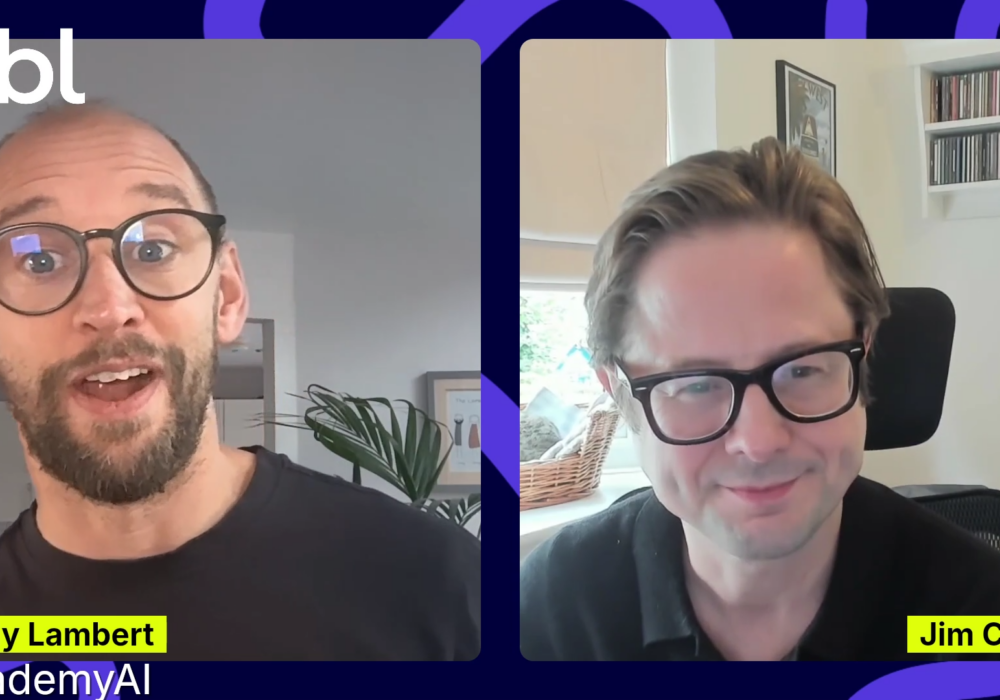
Andy Lambert co-founded ContentCal, sold it to Adobe, and spent four years there as it became part of Adobe Express. He saw teams split between...
Watch videoGet ahead with the most actionable insights, playbooks and real-world AI use cases you can adopt right now, in your inbox every week