
The Visibility Trap: Measuring AI Answers Beyond the Ranking with Stuart Bruce, Purposeful Relations
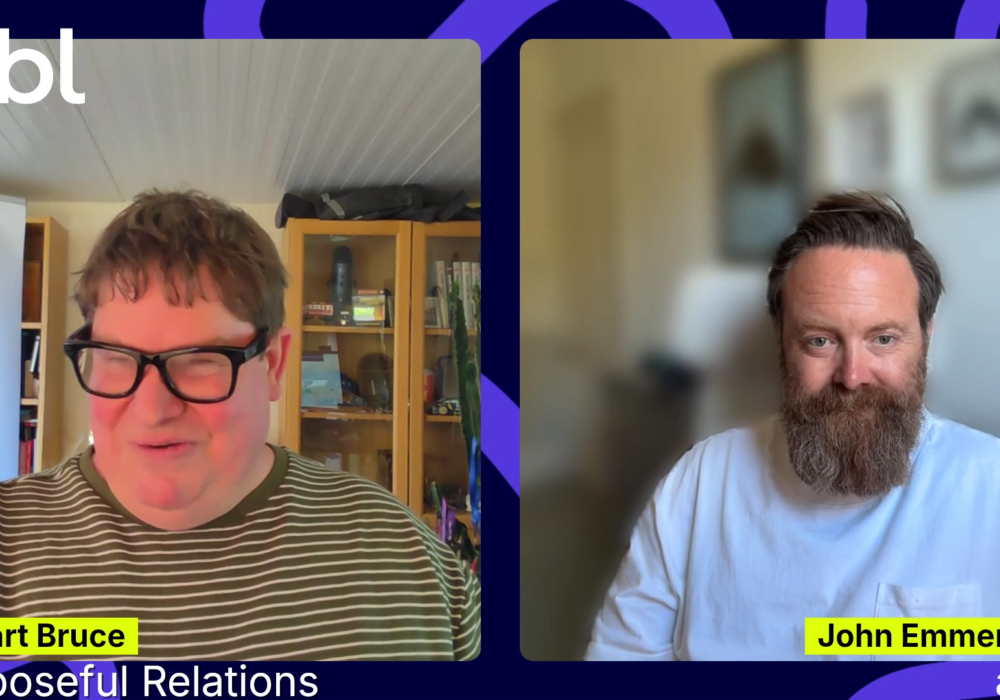
Stuart Bruce, co-CEO of Purposeful Relations, argues AI is not just a tool. It is a stakeholder describing you to everyone else...
Watch videoMost teams treat AI as a tool they use. It is also a stakeholder, telling everyone else who you are.
Stuart Bruce is co-CEO of Purposeful Relations and has spent more than 30 years in communications. He came up with the AI-as-stakeholder idea over Christmas 2024, before anyone else was talking about it.
What you will learn:
The article – Showing Up in AI Answers Isn’t the Same as Changing Behaviour
John Emmerson: Welcome to another aibl podcast, our Leadership Series. I am delighted to be joined today by Stuart Bruce, co-CEO of Purposeful Relations. Stuart, welcome to the show. Lovely to have you here.
Stuart Bruce: I’m delighted to be here, John. I’ve enjoyed many previous episodes.
John Emmerson: Excellent. Why don’t you start by telling the audience a little bit about yourself and what you do at Purposeful Relations.
Stuart Bruce: My background is in public relations and communications, which I have been doing for more years than I care to remember. At least 30. Throughout that time I have always been fascinated by innovation. Why do we do things like this? Is there a better way of doing it? Why do we even do that? Is there a better way to achieve the outcome we are looking for?
About three or four years ago I teamed up with an old friend to start Purposeful Relations. Our purpose is to help communications teams improve performance through innovation. Usually that means more innovative use of AI, and understanding AI. It is also about data and measurement, because for some reason maths was not the favourite subject at school for a lot of comms and PR people.
John Emmerson: The world of AI is what I am particularly interested in, so let’s jump straight into some questions.
You have argued previously that AI itself should be treated as a new stakeholder for comms teams. That is really interesting, because I hear the same thing from HR teams, separate from AI adoption inside the function. Can you unpack that distinction and describe what you mean by it?
Stuart Bruce: Absolutely. AI as a stakeholder is a concept that I came up with in early, well, it was actually over Christmas 2024. I was looking at it and thinking, why are we spending so much time on adoption when AI has a much bigger impact than just how we use it?
AI creates new content. Just like a journalist, or a politician, or a think tank would create new content by synthesising information from multiple sources. That is what AI is doing. Every time somebody puts in a question or a prompt, it is synthesising new information. That means it is a stakeholder.
So we have got to start thinking about how we can understand that process more. Then, secondly, what can we do to influence it? How do we make sure that we show up accurately, and that it is saying the right things about the policies or issues that we care about?
What was quite interesting is that I was not 100% sure I was on the right lines, because nobody else was talking about it. So I talked to some clients and we were doing stuff internally. Then in April 2024, Oxford’s Saïd Business School came out with a paper that basically said the same thing. And I thought, I’m not crazy, this actually is a thing.
When Rupert Younger, who was head of the centre for corporate reputation there, came up with this, I thought, we have got to lean into it, lock, stock and barrel, and do a lot more thinking and research around it.
John Emmerson: You mentioned synthesisation of content there, which seems to be a hot topic. I was on a call with a chap called Joe Clark, who is head of insights at Nomad Foods. Nomad own frozen food brands like Birds Eye. He was talking about how they use synthetic research to replace the old qualitative research they used to do. For the uneducated listeners amongst us, can you describe what you mean by synthesisation of content?
Stuart Bruce: Important distinction. I was not talking about synthetic research, which is a different concept.
What AI is doing when it creates an answer is creating new content. If you look at how traditional search worked, it was incredibly simplistic. You needed to rank high so people could see your content, but it was your content. It was stuff that had been created by you, or by media sites.
AI is not doing that. AI is giving you something it has synthesised, that it has created using all of those different sources available to it. So it is a different thing to synthetic audiences.
John Emmerson: That makes sense. And I guess that goes back to your point about a journalist or a think tank. They are using their sources to create the content. The AI is using a different set of sources, sometimes the same ones, to create its content.
Stuart Bruce: Absolutely. This is where it gets complicated as well, because it is a two-way process.
If you are an organisation or an individual creating information and publishing it, AI is going to see that. It is going to be able to read it. But what you are creating is possibly being influenced by what you have researched using AI. So all of these things are a two-way process. It is not linear.
Think about how other stakeholders are going to operate. They are using AI as well. If a politician is going to say something about you, or a journalist is going to write something about you, the chances are they will use AI to help them research it. But at the same time, the thing they then create is going to influence what AI says to the next stakeholder, the next person that uses it.
John Emmerson: So how should a comms team stakeholder map change to account for these AI systems?
Stuart Bruce: The first thing to understand is that we have multiple AI models. Believe me, if you do enough of these audits, they can be saying very different things about the same organisation, the same individual, or the same topic.
So the first thing is doing as comprehensive a map as possible. Very like traditional stakeholder mapping, except you are doing it with AI language models. You want to understand what they are going to say about a range of different topics and issues.
One of the problems you often get is that people look at it in too simplistic a way. That is why there is a lot of talk about snake oil in this space. There are 101 different tools out there that claim to measure your presence or your visibility in AI answers. The reality is that they cannot possibly work.
The reason they cannot possibly work is this. For traditional search, you have access to data. For traditional media monitoring, you have access to data. For traditional social listening, you have access to data. But with AI answers, you do not have access to the prompts people are actually putting in, and you do not have access to the answers AI is giving.
So the best these tools can do is directional telemetry. The key part of it is not the tool you use, it is the methodology behind it. What we always do is use multiple tools, because you cannot rely on a single one. If you use a basket of different tools and then analyse the answers, that is where you can get quite a clear directional picture.
John Emmerson: When you say you are using multiple different tools, can you give me an example of something you have done that would highlight how best to use them?
Stuart Bruce: First of all, just to give you an indication of the size of this market. One of the tools we use is called Profound, a startup that began about two years ago. Earlier this year they raised significant investment at a unicorn valuation.
So it is huge. But they are only one player in the market. There is a whole host of these different tools. There is a company called Peec out of Germany, and there are lots more. What we will do is take a selection of those tools to run an audit of an organisation.
The reason I focus on the tools is that broadly there are two different categories. There are those that use a panel of real user prompts. That sounds good in theory. But then you have to ask, where do these prompts come from? Have you ever shared your prompts with one of these companies? No, and I do not know anybody that does.
Peec is quite transparent about how they did it. They buy the data in from companies that get you to install browser extensions, which scrape your prompts. So that is how they are getting the data.
You have got an instant issue there. If you are researching a consumer brand, that is reasonably okay. There is the ethical dimension of where the prompts come from, but in terms of the information you are getting, lots of consumers are going to have these extensions on their computer, so you will get their prompts. In a corporate or institutional environment, you will not. There are not many corporates or institutions where you can install any old browser extension on your work computer. So there is a blind spot with tools like that.
The alternative approach, and this is why your question about synthetic audiences was quite interesting, is that you can create personas. That is the approach we take.
We identify different types of stakeholder personas. It might be a journalist, it might be a customer, it might be an employee, it might be a politician. We create these personas and then create a series of prompts that we think that persona is going to use.
We can do that in three ways. Sometimes it is human insight. There is also AI to help us do it. But there is also actually talking to real people. Focus groups, having discussions with people in those persona categories. You can then get a really good grasp of what those prompts should look like. Then you have a really solid base for sampling and understanding what AI is going to be saying about an organisation.
John Emmerson: That is interesting. So there is still a place for old school tactics like a focus group.
Stuart Bruce: Absolutely, and it is a really good way of validating those other two methods. It would be quite expensive if you just did focus groups. But if you do those other two bits of research and then test it, you see whether, if we actually speak to people, we are getting similar answers back. If you are, you can be sure you have done it right.
John Emmerson: I am going to change tack slightly. You have written about PR, marketing, SEO, and advertising all fighting for ownership of GEO. Is there a single owner in your opinion, and if so, why?
Stuart Bruce: No, there should not be a single owner, and that is because of the complexity of it.
You might say I would say this because I come from a PR background, but I do think communications and PR should lead on it. That is not because we are expert in all the areas it covers. It is because we have got this 360 degree view of an organisation. We are not just interested in customers, we are not just interested in employees, we are not just interested in search. We look at everything.
And risk is really high up on our agenda. Very often the comms person is the naysayer and the doom-monger in the room, who can say, yes, but have you thought of this? This could go wrong. That is a really important part of doing this. So that is why I would argue that comms should lead the process.
Of course there are some expert domains in there. Some of the things you need to do to be cited properly in AI answers are around technical skills where traditional SEO people would have expertise. You can work with them and use their expertise and their skill. What you do not want is them leading it, because there are so many external factors that influence it.
For example, if we wanted to make sure that you were a trusted source for AI, it is going to be things like: is John’s biography on the company website the same as his LinkedIn profile? Has he been quoted in the media? Is he speaking at events? Has he won awards? All of these different signals are things AI will look at. None of them are things SEO people would traditionally be involved in.
John Emmerson: That makes sense. You mentioned risk there. What happens to brand and reputational risk when GEO sits inside a marketing or SEO team instead of comms?
Stuart Bruce: I think they will look at it from a narrower perspective. This is one of the flaws of the tools out there. They are all obsessed with visibility. Do we get ranked in an AI answer? Whereas the real risk lies in how you get ranked. What does it say about you?
I can give you a practical example. I spoke at an event earlier this year where one of the other people on the panel was the head of comms for the British Heart Foundation. She was talking about how, in AI answers, it is quite possible for it to give you wrong information about what to do if you have a heart attack, or if you have got problems.
John Emmerson: Really?
Stuart Bruce: Yes. For them it is a really big priority, correcting those AI answers and working out what they can do to influence them. That is not traditionally the type of thing digital would be looking at. They would be looking at whether the British Heart Foundation ranks high, whether people know to go there for advice, how likely people are to donate. Rather than looking downstream at how accurate the answers are. What are they actually making people do, and how are they changing people’s behaviour?
John Emmerson: That is super interesting. Hallucinations were a big problem 12, nine, six months ago. In my experience it has dissipated a bit as the models have got better, and as they changed some of the underlying thinking around how the LLM deals with that binary yes or no, must-give-an-answer problem.
Stuart Bruce: But there are two different issues at play here. One is hallucinations, where AI does not know something and makes it up. The other is where it is factually incorrect because of the source material.
John Emmerson: Which we could still have in search, right?
Stuart Bruce: Yes, absolutely. But there it is clearer, because you know where the information is coming from. One of the problems with AI answers is that even though it gives citations, people do not necessarily look at them. They read the answer and treat that as the answer. They will not go and say, there are 12 different sources here. One was the British Heart Foundation. Another was a fringe website in the USA.
John Emmerson: I think that is right. A lot of that comes back to the use of the tools themselves. If we just talk about LLMs, because that is what most people are familiar with, the way you have it set up and the level of robustness you give it about its sources matters. Then that ladders down into the prompt itself, and how much detail you give it about where it should look for answers.
If you just ask how do I treat a heart attack, and give it none of that information, you are likely to get a different set of answers than if you say, you should be looking at the British Heart Foundation website, the NHS website, and whatever else it is, and I want scientifically checked and verified advice. It is that level of information that I still think people are struggling with.
Now this is basic prompting ultimately, but it is also in the way the systems are set up, which I do not think a lot of people spend enough time on when they onboard a new system. Whether it is Claude, or Codex, or OpenAI, or Perplexity, all the way down to the more niche stuff for individual teams.
Stuart Bruce: No, 100%. If you look at the personal settings on my AI tools, for a start, lots of people do not go into the customisation options, so they have never even set them.
Mine has got all sorts of things in there. Do not be sycophantic. Do not try to please me. If you do not know the answer, say you do not know the answer. It has got loads of custom instructions like that. So I literally cannot remember when I last saw a hallucination, because I am so stringent on trying to stop them. But most people do not.
John Emmerson: I am quite similar. I think I started with, do not blow smoke up my ass, because I found the tools were constantly saying, that’s a great idea, John. And I was like, no, it’s not, it’s terrible, I want you to criticise it.
Anyway, we digress, as I often do on these things. Let’s get back into it.
My next question links to what we have already been talking about. Data and measurement is one of your core practice areas. When it comes to measuring AI or GEO, how are organisations doing? Are they getting it wrong? Are they simply not doing it?
Stuart Bruce: I think most are not yet doing it. They have recognised that there is an issue, but they are not 100% sure how to proceed. If you look at LinkedIn, it is full of people talking about this. And I already mentioned the 101 tools out there, which vary massively in price.
You have basically got three different types. You have got the ones that come from the SEO companies that are pivoting. You have got the new ones that are just startups. Then you have also got some from the traditional PR, comms, and reputation measurement market, who are now beginning to add these features to their tools.
Most corporates or organisations are just confused. They do not know what to buy, or what they are meant to be measuring. It does not help that at least two of those categories focus very much on visibility.
Anybody that knows about measurement in the communication space knows we have got the hideous thing called advertising value equivalence, where people would measure a piece of media coverage and say, ooh, that would cost X pounds if you paid for it as an advert. Then they times it by a random number, because editorial is worth more than advertising. And it is total bullshit, pardon my language. It is just fraudulent. It is made up.
But despite that, because it is a simple number, some people still use it. And my fear is that visibility is the new AVE, because it is a really simple thing. Look, we come up in 80% of answers. So what?
What you actually want to know is what that means for your stakeholders. Is that going to change their behaviour? Is that going to change what they think and believe? What companies need to focus on is not just whether we appear in answers, but how it is affecting stakeholder behaviour. Are they going to buy something? Are they going to apply for a job? Is it going to help a politician make a decision about new legislation? It is linking to the outcome rather than just looking at output, which is visibility.
John Emmerson: You have answered my next question already. I was going to ask which metrics comms teams over-index on, and it sounds like visibility is the one. I was also going to ask which metrics they ignore, and you have just listed a load of those. Is there anything else in that ilk?
Stuart Bruce: It is probably worth making some reference to some standards. There are a couple of things that can help comms teams, or indeed a broader organisation, approach this in a mature manner.
The first is the AMEC GEO principles. AMEC is the International Association for the Measurement and Evaluation of Communication. I am not going to say that again. In June this year they published the seven GEO principles. It does not tell you how to do it, but it tells you what good measurement looks like, and you should be able to tick all of those.
The second one, which I actually helped to write, came out last month from the Public Relations and Communications Association. It is basically a how-to guide. It translates those principles into some practical ideas and steps.
There are too many of them to go through them all. But to give you one example, do not just use one tool, because all that is going to tell you is what that tool thinks. You have got to use a mixed methodology to get any reasonable insight. Also understand that it is a snapshot in time. Just because it is saying this today does not necessarily mean you are going to get the same answers tomorrow, because of the way AI models actually work.
John Emmerson: While we are talking about guidelines and rules, the EU AI Act’s transparency rules are, I believe, now enforceable. I also believe you have noted before that most PR and comms teams are not ready. What does non-readiness mean, specifically for mid-market businesses who might not be experienced in PR across the EU?
Stuart Bruce: I think the main thing is that people look at it and say, transparency, we have got to be transparent about this. Actually, if you already had good governance in place, nothing has changed.
If you are making something that is substantially created by AI without human involvement, or without human oversight and approval, then it was already good governance that you should be disclosing that fact. What the EU AI Act does is put that into legislation, with some fairly scary fines.
Most organisations do not have governance in place. And if they do, it is something they set up really early and it is now out of date. Some are quite draconian. I did a project with a client the other week and its AI policy was totally at odds with what I had been asked to come in and do with them. If I had done even just 10% or 20% of what they wanted to do, they have got a policy that says they should not be doing it. But nobody had actually updated it, because it was written by legal and IT in the early days.
John Emmerson: Things move so quickly. You have got to constantly be looking at these policies. Probably quarterly is a good cadence at the moment, based on the rate of change.
I imagine you work with a range of different teams. Agencies, governments, nonprofits, corporates. In your experience, who is furthest ahead on AI right now, and who is furthest behind? I realise this is a generalisation before you answer.
Stuart Bruce: The answer might surprise you. It is government. In the comms space it is government by a considerable margin.
The UK Government Communication Service has about 7,000 people. That is all of the comms people in arms length bodies, central government departments, and so on. They were very early to recognise the opportunities of AI.
They developed a tool called GCS Assist, which has about 50 plus different communications tasks and workflows it can help people with. For example, it can review a crisis communications plan.
Before people get access to GCS Assist, they have to go through a training programme. So you are not just given the keys. The analogy I always use is that it is a bit like giving people a company car without checking they have got a driving licence. When you give them an AI tool, you have got to make sure they know how to drive before you give it to them. That is what GCS does.
It is quite interesting that they developed that approach. It is the approach we use with clients, and they are doing some amazing things. I think they have got something like 80% or 90% adoption now across those 7,000 people, using an AI tool for at least part of their job on a daily or weekly basis.
To give you one practical example of how they used it. There are more than 400 crisis communications plans across government, everything from the Environment Agency to a central government department. They used GCS Assist to assess all of these plans and label them green, amber, or red, according to how closely they complied with best practice standards and how good they were. I think 70% were amber or red. They then used the GCS Assist tool to turn that around. So it is the other way round now, and they are all green. The AI tool actually helped to improve the plans. That is the type of thing that would have been a one or two year expensive programme previously.
John Emmerson: Do you think there is any reason why government are so far ahead of everyone else?
Stuart Bruce: I think GCS have got a history of being at the leading edge of communications. When I talked about measurement, they were one of the first to adopt best practice measurement frameworks back in around 2010. So they have got a track record of doing it.
It is worth shouting out the previous CEO of GCS, Simon Baugh. He left in November. He was very much the driving force behind making sure the Government Communication Service adopted AI. When they were doing it, they were way ahead of the rest of government. They won government AI awards for being at the leading edge and making it happen.
John Emmerson: Fair play to them. Astonishingly, we have nearly run out of time. It is always remarkable how quickly these conversations go.
I always end on the same question, which you may have noticed as you have viewed a few of the other ones. Our market here at aibl is scale-up and mid-market leaders predominantly. If you are a senior communications individual within a mid-market organisation, what would be your one piece of advice?
Stuart Bruce: When they are looking at using AI, it is to improve what they do. It is not about saving time.
I will use the GCS example again. When you are a single manager, which is often what you have got in scale-ups and mid-sized companies, you have only got one or two people in the comms team. It is really hard for them to develop best practice, because they have got nobody to bounce it off.
AI is the perfect foil for red teaming, bouncing your ideas off, and upping your game. That is where GCS found some of their biggest improvements. It was within the really small teams, where they did not have anybody to turn to for help. So it is to embrace it, but not to do your job for you. To improve how you do your job.
John Emmerson: I like that a lot. It has been an absolute pleasure talking to you today, Stuart. Thank you very much for your time. Best of luck with everything you are doing with Purposeful Relations over the coming weeks and months. I look forward to catching up with you very soon.
Stuart Bruce: Thank you, John. It has been a delight.
Bruce developed the idea over Christmas 2024, after noticing how much attention went to AI adoption and how little went to AI’s wider effect. His argument is that when a model answers a question, it creates new content by pulling together multiple sources. That is the same thing a journalist, a politician, or a think tank does. It makes AI a stakeholder in its own right. The practical consequence is that organisations need to understand how models describe them, and then work out how to influence that. Oxford researchers published a paper reaching a similar conclusion shortly afterwards.
Only directionally, in Bruce’s view. With traditional search, media monitoring, and social listening, you have access to real data. With AI answers you do not. Nobody can see the prompts people actually type or the answers they receive, so any tool claiming a definitive visibility score is overstating what it knows. His term for the best available result is directional telemetry. The method matters more than the software. His team uses a basket of tools rather than one, then analyses the answers, which produces a reasonably clear picture without pretending to precision that does not exist.
Bruce draws a direct comparison with advertising value equivalence, the discredited practice of pricing coverage as though it were an advert and multiplying by an arbitrary figure. It survived for years because it produced one simple number. His concern is that AI visibility is heading the same way. Appearing in 80% of answers is an output, and it tells you nothing about what those answers said or whether anyone acted on them. The useful question is whether AI answers change stakeholder behaviour: buying something, applying for a job, or informing a policy decision.
No single function, according to Bruce, though he argues communications should lead it. His reasoning is not about expertise. It is that comms holds a 360 degree view of the organisation, covering customers, employees, policy, and reputation at once, and that risk already sits high on the comms agenda. Specialist work still belongs with specialists. Getting cited properly in AI answers involves technical tasks where SEO teams have real skill. What he cautions against is letting a narrow function lead, because the signals that build trust sit well outside anything SEO has traditionally covered.
Bruce lists the kind of checks that have little to do with technical optimisation. Does the biography on your company website match the same person’s LinkedIn profile? Have they been quoted in the media? Do they speak at events? Have they won awards? These consistency and credibility markers are what a model draws on when deciding whether to rely on you. His point is that none of them are things an SEO team would traditionally handle, which is part of why he thinks comms should lead the work rather than sit alongside it.
Bruce takes a calm view. If you already had good governance, nothing has changed. Content substantially created by AI without meaningful human involvement or approval should always have been disclosed. The Act writes that expectation into law and attaches penalties. His practical concern is different. Most organisations do not have governance in place at all, and those that do often wrote it early and have not revisited it since. He describes arriving at a client where the AI policy directly contradicted the work he had been brought in to do, because legal and IT had drafted it and nobody had updated it.
Bruce is clear that the goal is better work rather than faster work. In a one or two person team there is nobody to test your thinking against, which makes it hard to develop good practice. His suggestion is to use AI as a foil for red teaming: argue with it, ask it to attack your plan, and use it to raise the standard of your own judgement. He points out that the UK Government Communication Service found its biggest gains in exactly those small teams, where people previously had nobody to turn to for a second opinion.
Stuart Bruce, co-CEO of Purposeful Relations, argues AI is not just a tool. It is a stakeholder describing you to everyone else...
Watch video
Stuart Bruce is co-founder and co-CEO of Purposeful Relations, which advises communications teams on AI,...
Read more
Everyone now knows that most AI projects fail. Most of any type of project fails after all. The 80% figure from...
Read moreGet ahead with the most actionable insights, playbooks and real-world AI use cases you can adopt right now, in your inbox every week