
Zero mandate, zero budget: AI adoption at Scania
Speaking in the Workforce track at aiblLIVE, Patrik Hedljung, Scania's AI Adoption Manager, described trying to...
Read moreAt the growthLIVE roundtable in London, speakers described a B2B buying journey where the decision increasingly happens inside AI agent conversations that vendors cannot see. The through-line: better data and automation help only if you are still in the conversation, because agents now check reviews, reputation and third-party signals before a buyer ever surfaces in a pipeline.
Last week we covered the growthLIVE roundtable from London, 10 June. This week, the speaker sessions. The talks covered different ground. The thread underneath was the same.
The objective hasn’t changed, argued Matt Pahnke, VP of product at Customer.io. Right message, right audience, right time. What has changed is the infrastructure.
Les Mills, the New Zealand fitness platform, built exactly that. An AI segmentation tool identified customers showing early churn signals, connecting behavioural data to retention campaigns before a cancellation was ever filed. Every campaign hinges on “the quality of the data and the cleanliness of the data and also the activation of the data.”
Achilleas Kasimidis, who leads GoStudent’s global revenue operations, faced the same problem at the level of individual conversations. Account managers would open WhatsApp to find 200 messages waiting: new leads, angry customers, cancellation requests, support queries, all in the same queue.
“Normally what the sales team would do at any given moment, they will wake up, they will open up WhatsApp, they probably have about two hundred messages in the inbox, but they have to go one by one and answer those replies.”
Achilleas had never written a line of code. He built it himself. The co-pilot reads every incoming message, analyses intent, and flags urgency. The account manager opens the interface and the triage is already done. A suggested response sits alongside each conversation, reviewed, adjusted if needed, and sent.
“For now, this is still done semi-automated by [the] account manager. We’re still testing it to understand how well AI instructs replies. But the idea is very soon, we automate most of that communication, about ninety percent.”
Two to three hours a day returned to revenue activity, and for the first time, the team has full visibility into those conversations: what customers are asking, what they’re worried about, and what drives cancellations.
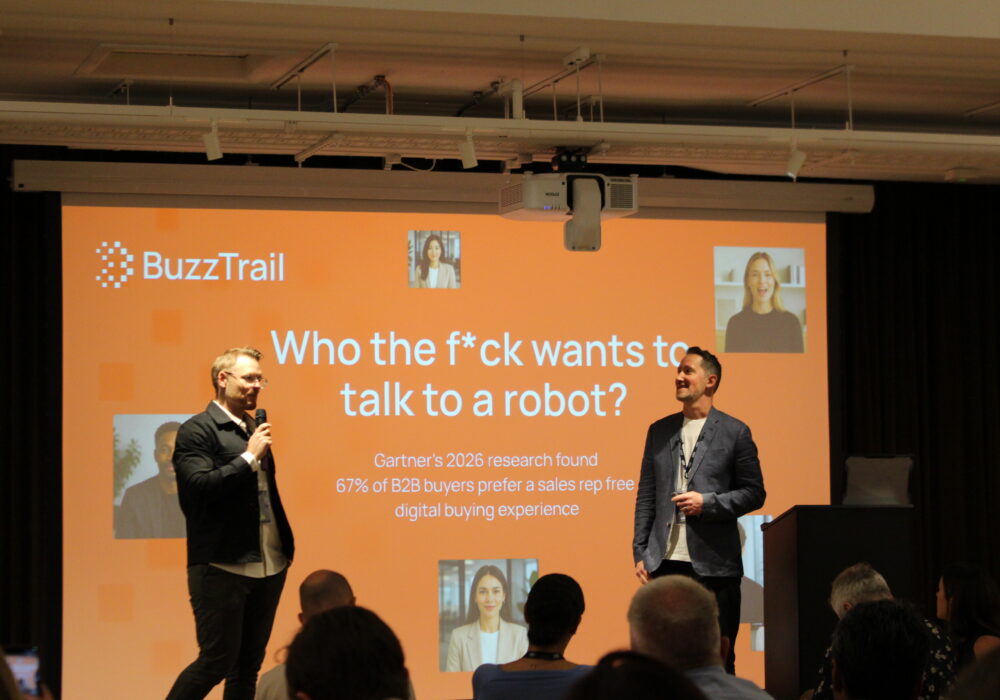
Mike Pritchett and Chad Lakin, co-founders of BuzzTrail, started from a different angle. Not how to handle existing conversations more efficiently, but how to have conversations that could never happen at human scale.
B2B buyers don’t want to talk to salespeople until they’ve already decided. They want to ask questions without feeling pressured into a pipeline, or stupid for not knowing the answers. An AI replica, trained on a presenter’s content and manner, offers something a human SDR can’t: availability without agenda.
“People actually don’t want to talk to this guy or girl, or anyone in that situation, because a), they feel pressured getting into that process of a sales pipeline, and b), they often feel stupid as well because they don’t have the questions fully formed or the answers to the questions.”
A client ran a webinar with 25,000 attendees. 97% dropped off afterwards because the SDR team couldn’t follow up fast enough. The client called it a sonic boom: intent arriving all at once, overwhelming the team, disappearing into a CRM black hole. At the end of the session the presenter handed off to a replica, trained on the same content, capable of holding thousands of simultaneous one-to-one video conversations.
The data captured through every conversation extends well beyond sales follow-up: product roadmap, sales strategy, marketing signals that would otherwise disappear into a CRM and never surface.
Tracy Pilon, Microsoft’s UK marketing lead, started with a structural problem. The decision has moved. In previous digital shifts, the decision moved within the funnel or into new channels. Today, research and purchasing decisions increasingly happen in a system the brand can’t enter, run by an agent the brand can’t influence, on behalf of a buyer who hasn’t appeared anywhere yet.
Editor’s note: the effect of AI on product research varies enormously by sector and audience, but is already estimated to affect over half of all new B2B purchases. See this week’s research below for more.
“Perception is no longer good enough. Because you are going to be judged on your performance. And the agent is going to judge that performance, and they’re going to look at trust signals, they’re going to look at reviews, they’re going to look at community forums.”
The agent isn’t clicking through an ad. It’s checking off-site reputation before the buyer surfaces in a pipeline. By the time a prospect appears, the decision may already be made.
Awareness, consideration, and conversion are collapsing into a single conversation, 24 to 28 words long on average. The metrics built to track all that, bounce rates, click-throughs, form fills, sit outside the moment entirely. What replaces them is whether your content is present in the conversations agents are already having, structured for machines, not browsers, on behalf of buyers who will never visit a website to find it.
Better data, faster triage, conversations at scale: all of it assumes you’re in the conversation. Tracy’s point is that the prior question, whether the agent selects you at all, is being answered somewhere that infrastructure doesn’t reach.
AI agents are tools that research vendors and build a shortlist on a buyer’s behalf, reading public content, reviews and reputation before any salesperson is involved. They compress the old awareness-to-decision journey, so much of the evaluation now happens before a vendor knows the buyer exists.
They shift the job from crafting a pitch to making sure your public information is accurate, consistent and easy for a machine to read. Agents weigh what they can find and verify, so the quality of your data and content matters more than the polish of a message.
Yes, but earlier and through evidence rather than outreach. Influence now sits in what an agent can find about you: clear reviews, accurate listings and public proof. If those signals are missing or messy, the agent moves on before a conversation starts.
Get your data and public content in order first, then answer real demand fast when it appears. Teams that respond slowly lose most of the interest they generate, so the speed of human follow-up still decides who wins the deal.

Speaking in the Workforce track at aiblLIVE, Patrik Hedljung, Scania's AI Adoption Manager, described trying to...
Read more
This is the second half of our Off the Record series. These are quotes we agreed not to attribute, from...
Read more
aiblLIVE is under two weeks away. I needed to write something for this week that would be useful, but not take up...
Read moreGet ahead with the most actionable insights, playbooks and real-world AI use cases you can adopt right now, in your inbox every week