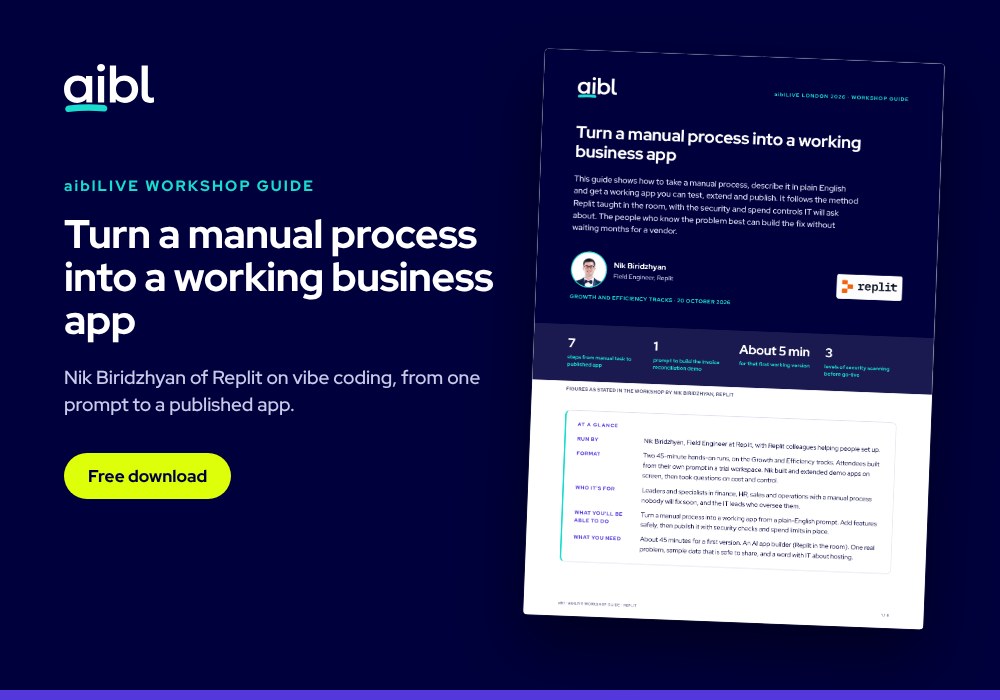
Vibe coding lets the person who knows a manual process describe it in plain English and get a working app back. At aiblLIVE London 2026, Nik Biridzhyan, Field Engineer at Replit, ran a hands-on workshop showing how, from the first prompt to a published app.
In the room, he built an invoice reconciliation app from one prompt, added a feature live and published it. This guide turns that session into a method you can run with your own team, including the controls IT will ask about.
Pick manual work that should already be automated, or a tool gap you have learned to live with. Nik asked the room to look back over their month and name the work that frustrated them. A real, costly problem gives you a better result and something to measure when someone asks what the spend delivered.
If you’re solving a valuable problem, you’re going to get a really good outcome.
Nik Biridzhyan, Field Engineer, Replit
For a quick test, one short prompt is enough. Nik’s invoice demo came from a single plain-English prompt and took about 5 minutes to build. For anything people will rely on, write a fuller spec first. In his words, building is what costs the most, so clearer instructions up front save rebuilding later.
Make one change at a time, preview it, then merge it. In Replit each change runs as a separate task on its own copy of the app, so colleagues can work in parallel. If a change goes wrong, a checkpoint returns the app and its database to the last good state.
Set the controls before the first app goes live. Nik described spend limits for people and teams, admin views of who is building what, and three security scans before publishing. Some firms host the platform in their own cloud. He also advised keeping real API keys out of any shared workspace.
Adding a tool like Replit doesn’t change what data they have access to already.
Nik Biridzhyan, Field Engineer, Replit

Nik Biridzhyan is a Field Engineer at Replit, working with customers from its London office. He ran this workshop on the Growth and Efficiency tracks at aiblLIVE London on 20 October 2026.
If your teams have processes nobody will automate for them, this is a method to borrow. The full guide takes you through it step by step.
For finance, operations and HR leaders, and the IT leads who support them. Six pages, about a nine-minute read.