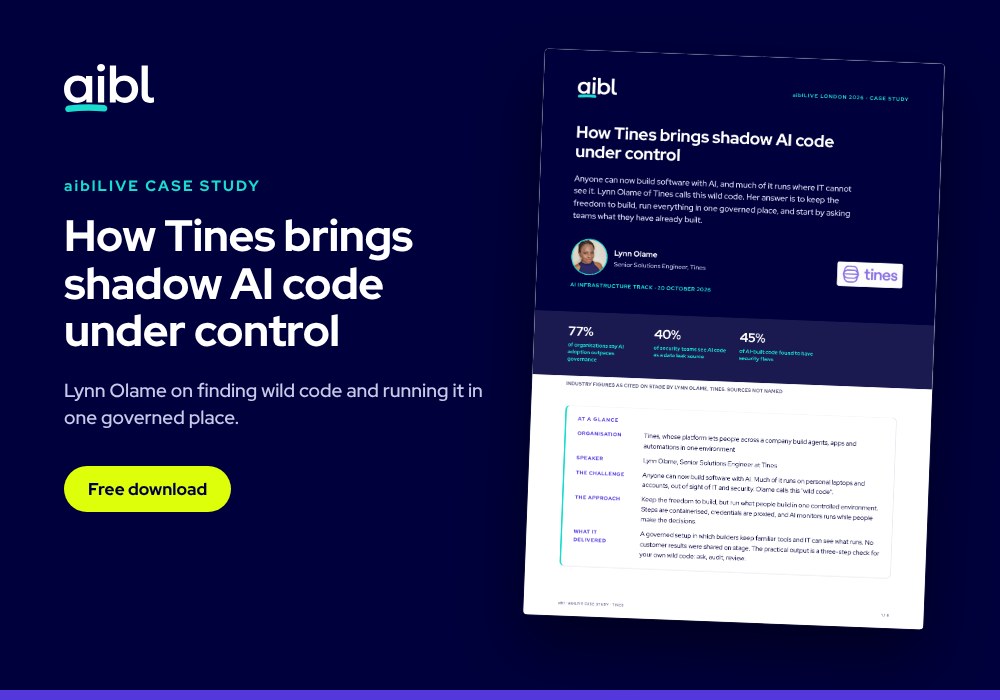
Shadow AI now includes code: people across the business build tools with AI that IT cannot see. Lynn Olame, Senior Solutions Engineer at Tines, calls it “wild code”, and set out how to find and govern it at aiblLIVE London 2026.
Her approach keeps the freedom to build, but runs what people build in one controlled, monitored place. It starts with a simple step: ask teams what they have already built.
All figures as cited on stage by Lynn Olame, without a named source.
Wild code is shadow AI that builds things. Olame defines it as invisible apps, agents and automations built with AI across a company that IT does not know about. It often lives on personal laptops and accounts. Like an iceberg, the hidden part is usually bigger than the approved code IT can see.
Coding is no longer a barrier. Anybody can build. You just need to be able to define the process you want to automate.
Lynn Olame, Senior Solutions Engineer, Tines
Because AI writes working code without knowing your rules. It will not know your policies, whether a build is GDPR or SOC 2 compliant, or whether the builder should have access. Olame lists the results: technical debt, exposed credentials, workflows that break when an API changes, and rising token costs nobody can explain.
An AI council sees strategy, not daily use. It decides which LLM to adopt and which projects to fund. Olame says it often misses who is using personal accounts, which systems people are connecting, and which automations should be going through IT. By the time it notices, it may be too late.
Separate building from running. Olame argues against both blanket bans and a free-for-all. People keep building with tools they know, such as Claude, OpenAI or GitHub. Their work runs in one environment with containerised steps and proxied credentials. AI flags errors and suggests fixes, and a human decides.
Monitor with AI, but a human to actually make the decisions about those changes.
Lynn Olame, Senior Solutions Engineer, Tines

Lynn Olame is Senior Solutions Engineer at Tines, whose platform lets people across a company build agents, apps and automations in one environment. She spent her earlier career at Salesforce. She spoke on the AI Infrastructure track at aiblLIVE London on 20 October 2026.
If you suspect more AI is being built in your business than you know about, start here. The full PDF goes deeper than this page, in the speaker’s own words.
For CIOs, CISOs, IT and security leads, and anyone running AI governance. Six pages, about a seven-minute read.