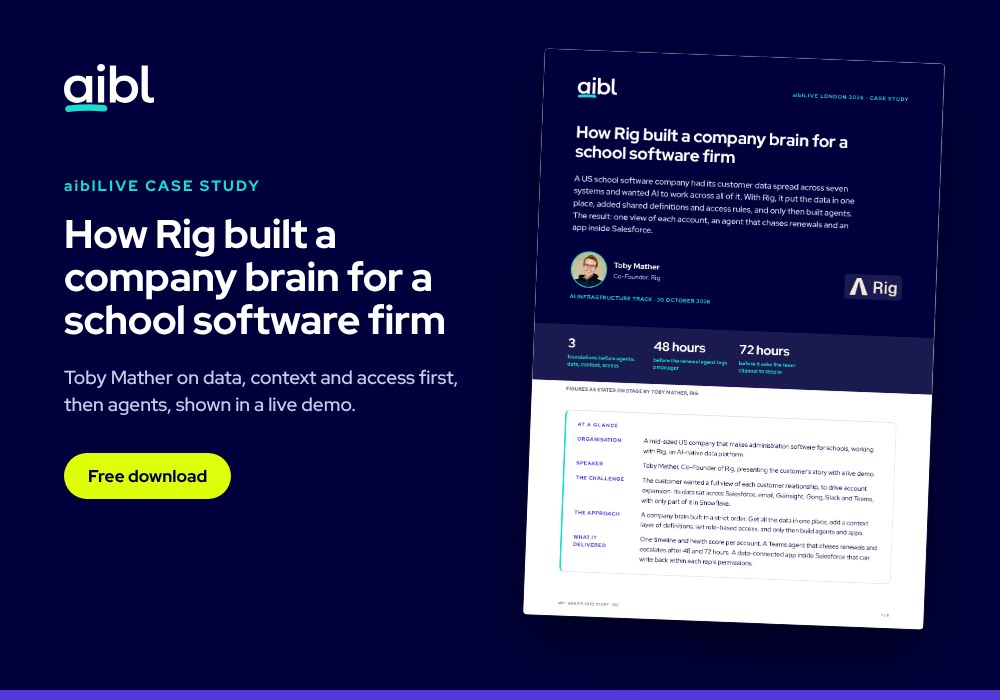
Build a company brain in a strict order: data in one place first, then shared definitions, then access rules, and agents last. Toby Mather, Co-Founder of Rig, showed how a US school software company did it, with a live demo at aiblLIVE London 2026.
The customer’s data sat across seven systems. Once it was unified, the company built one view of each account, a renewal agent in Teams and an app inside Salesforce. Here is how it worked.
All figures as stated on stage by Toby Mather.
A company brain is an access gateway that people and AI agents plug into to do work. Mather contrasts it with the common setup where each person has their own AI assistant and their own set of MCP connectors. That leaves data scattered, access ungoverned and metrics defined differently by every agent.
This is the sort of boring bit that no one wants to vibe code, but it has to happen.
Toby Mather, Co-Founder, Rig
Follow four steps in order. Put all your data in one place, in a warehouse such as Snowflake. Build a context layer of definitions, connections and terminology. Set role-based access so each agent sees only what it should. Only then build agents and apps. Keep the layers separate so any one can be swapped.
It is a detailed dictionary of your data: what it means, how it connects and who may see it. It holds shared metric definitions such as win rate and ARR, links old and new product names, and carries usage rules for agents. In Rig, it updates itself when tools or data change.
It’s basically a really detailed dictionary of all your data, what it means, how it connects together, and who’s allowed what.
Toby Mather, Co-Founder, Rig
At scale, direct connections cost more and control less. Mather says vendors such as Salesforce and HubSpot limit or charge for heavy API use. APIs cannot enforce one metric definition, and they return limited history. A warehouse copy also lets agents query far larger volumes. For a small startup, ten MCPs is basically fine.

Toby Mather is Co-Founder of Rig, an AI-native data platform that helps companies build company brains across fragmented data. He spoke on the AI Infrastructure track at aiblLIVE London on 20 October 2026.
If your AI agents keep getting different answers from the same data, start here. The full PDF goes deeper than this page, in the speaker’s own words.
For CTOs, CDOs, RevOps and data leads planning AI agents across many systems. Five pages, about a seven-minute read.