Practical AI adoption insight, every week. Subscribe to aiblBRIEF
aibl
  • Practical AI Insights
    • The research
      • Benchmark your AI ROI (Beta)
      • State of UK AI Adoption 2026
      • What our research says
      • AI analysis
      • Leadership Series report
      • Newsletter archive
    • Learn and apply
      • AI explained
      • AI case studies
      • AI build stories
      • AI playbooks
      • AI workshop guides
      • Boardroom findings
      • AI leader interviews
  • aiblLIVE
    • 2026 session library
    • aiblLIVE 2027
  • Find AI enablement partners
    • AI Enablement Directory
      • Search the directory
      • Register your business
    • By Category
      • AI Strategy & Readiness
      • AI Implementation & Deployment
      • AI Training & Capability Building
      • AI Agents & Agentic Workflows
      • AI Governance & Risk
      • Generative AI Applications
      • Data & Analytics
      • Process & Document Automation
  • Partner with aibl
    • For enablement partners
    • For AI platforms and vendors
    • Insights for vendors
    • Market insights reports
  • About
    • About Us
    • AI For business leaders
Subscribe to aiblBRIEF
  • Practical AI Insights
    • The research
      • Benchmark your AI ROI (Beta)
      • State of UK AI Adoption 2026
      • What our research says
      • AI analysis
      • Leadership Series report
      • Newsletter archive
    • Learn and apply
      • AI explained
      • AI case studies
      • AI build stories
      • AI playbooks
      • AI workshop guides
      • Boardroom findings
      • AI leader interviews
  • aiblLIVE
    • 2026 session library
    • aiblLIVE 2027
  • Find AI enablement partners
    • AI Enablement Directory
      • Search the directory
      • Register your business
    • By Category
      • AI Strategy & Readiness
      • AI Implementation & Deployment
      • AI Training & Capability Building
      • AI Agents & Agentic Workflows
      • AI Governance & Risk
      • Generative AI Applications
      • Data & Analytics
      • Process & Document Automation
  • Partner with aibl
    • For enablement partners
    • For AI platforms and vendors
    • Insights for vendors
    • Market insights reports
  • About
    • About Us
    • AI For business leaders
  • Subscribe to aiblBRIEF

Claims automation at Royal Mail: human checks before AI decides

Downloads | AI case studies

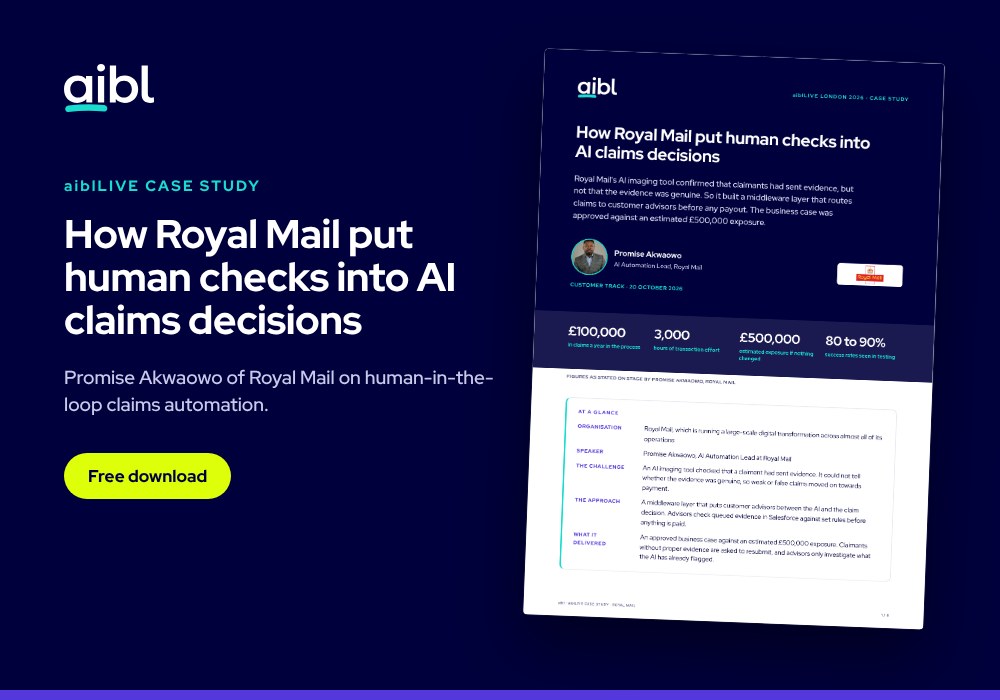
Royal Mail fixed its claims automation by putting a human check before every AI claims decision. Its AI imaging tool confirmed that evidence had been uploaded, but not that it was genuine. Promise Akwaowo, Royal Mail’s AI Automation Lead, explained the fix at aiblLIVE London 2026.

A middleware layer now sends claims to a Salesforce queue, where customer advisors check the evidence against written rules. Only then does a claim go on to payment or back for resubmission. Here is how it works.

Royal Mail in numbers

  • Around £100,000 in claims a year go through the process.
  • About 3,000 hours of transaction effort, and the equivalent of two to three employees.
  • About £500,000 is Akwaowo’s estimate of what Royal Mail risked losing by keeping the old process.
  • Around 80 to 90% success rates in testing, with every non-match meant to fall into a defined exception.

All figures as stated on stage by Promise Akwaowo.

What went wrong with the AI claims checks?

The AI treated the presence of an image as proof. It confirmed that a claimant had uploaded a picture or PDF, but could not tell whether it showed the item they bought. Wrong evidence could pass and move towards a payout, causing rework, financial risk and customer friction when claims were later rejected.

The AI already assumes that that is the right evidence and it passes the check and it goes to make a decision.

Promise Akwaowo, AI Automation Lead, Royal Mail

How does the human check work?

Each claim lands in a Salesforce queue before any decision is made. Customer advisors check the evidence against rules about what counts as proof. They also merge or flag duplicate submissions. Valid claims go on to fulfilment, and weak or false evidence goes back to rework with a request to resubmit.

Errors are sorted into business exceptions, where the rules are wrong, and application exceptions, where the AI or automation fails. That tells the team what to fix.

How did Royal Mail build the business case?

It costed the process as it stood. Akwaowo set the annual claims value, the hours of effort and the staff involved against an estimated £500,000 exposure from doing nothing. He also spent three to four days in discovery with the claims advisors. The business case was approved.

How does Royal Mail handle claims fraud?

Proportionately. Legal and compliance teams set the evidence rules and a value threshold, and only claims within it are investigated. Experienced advisors spot evidence that looks wrong, including images that may have been altered with AI. Asking for resubmission helps too, because claimants who know their evidence is false stop the process.

You can’t chase every case. You’d definitely just be on a goose chase for no reasons.

Promise Akwaowo, AI Automation Lead, Royal Mail

Key takeaways

  • Check what your AI actually verifies. Finding a file is different from reading what is in it.
  • Put a person at the decision point. Queue uncertain claims for trained staff with written rules.
  • Cost the risk of standing still. Royal Mail’s case rested on claims value, hours and exposure.
  • Set a threshold for fraud work. Agree with legal and compliance which claims to chase.

About the speaker

Royal Mail logo

Promise Akwaowo is AI Automation Lead at Royal Mail. He works with business teams across the organisation, from customer experience to warehouses and finance, to find where simplification, automation and AI can help. He spoke on the Customer track at aiblLIVE London on 20 October 2026.

What’s in the full case study

If your automation makes decisions on evidence customers supply, this is the control to borrow. The full PDF goes deeper than this page, in Akwaowo’s own words.

  • The four costs of treating presence as proof, and the numbers behind the business case.
  • The workflow, step by step: upload, content check, human validation and routing.
  • How exceptions and testing work, including the 80 to 90% success rates seen in testing.
  • Five actions to take back to your own organisation.

For heads of customer operations, claims and fraud leads, COOs and automation leads. Six pages, about an eight-minute read.
Stop paying out on false evidence

Claims automation at Royal Mail: human checks before AI decides
aibl
Subscribe to aiblBRIEF

Explore

  • For business leaders
  • For AI platforms and vendors
  • About
  • Contact

AI Insights

  • All articles
  • AI case studies
  • Interviews
  • UK AI adoption research

Events

  • aiblLIVE 2026 session library
  • aiblLIVE 2027

More

  • aiblCONNECT
  • AI Enablement Directory
  • aibl Information Pack for AI’s
  • The State of AI Adoption Key Findings
© 2026 AIBL MEDIA LIMITED (DBA: aibl | AI for business leaders), Company registration number: 16634894 - The organisers of aiblLIVE do not, under any circumstances make attendee data available to third parties for resale. Should you receive an email offering data purporting to be from aiblLIVE – or any other event organised by aibl media limited – please delete the message, block the sender, and do not respond or interact in any way.
  • Privacy Policy