Practical AI adoption insight, every week. Subscribe to aiblBRIEF
aibl
  • Practical AI Insights
    • The research
      • Benchmark your AI ROI (Beta)
      • State of UK AI Adoption 2026
      • What our research says
      • AI analysis
      • Leadership Series report
      • Newsletter archive
    • Learn and apply
      • AI explained
      • AI case studies
      • AI build stories
      • AI playbooks
      • AI workshop guides
      • Boardroom findings
      • AI leader interviews
  • aiblLIVE
    • 2026 session library
    • aiblLIVE 2027
  • Find AI enablement partners
    • AI Enablement Directory
      • Search the directory
      • Register your business
    • By Category
      • AI Strategy & Readiness
      • AI Implementation & Deployment
      • AI Training & Capability Building
      • AI Agents & Agentic Workflows
      • AI Governance & Risk
      • Generative AI Applications
      • Data & Analytics
      • Process & Document Automation
  • Partner with aibl
    • For enablement partners
    • For AI platforms and vendors
    • Insights for vendors
    • Market insights reports
  • About
    • About Us
    • AI For business leaders
Subscribe to aiblBRIEF
  • Practical AI Insights
    • The research
      • Benchmark your AI ROI (Beta)
      • State of UK AI Adoption 2026
      • What our research says
      • AI analysis
      • Leadership Series report
      • Newsletter archive
    • Learn and apply
      • AI explained
      • AI case studies
      • AI build stories
      • AI playbooks
      • AI workshop guides
      • Boardroom findings
      • AI leader interviews
  • aiblLIVE
    • 2026 session library
    • aiblLIVE 2027
  • Find AI enablement partners
    • AI Enablement Directory
      • Search the directory
      • Register your business
    • By Category
      • AI Strategy & Readiness
      • AI Implementation & Deployment
      • AI Training & Capability Building
      • AI Agents & Agentic Workflows
      • AI Governance & Risk
      • Generative AI Applications
      • Data & Analytics
      • Process & Document Automation
  • Partner with aibl
    • For enablement partners
    • For AI platforms and vendors
    • Insights for vendors
    • Market insights reports
  • About
    • About Us
    • AI For business leaders
  • Subscribe to aiblBRIEF

AI market research at Nomad Foods: what synthetic consumers miss

Downloads | AI case studies

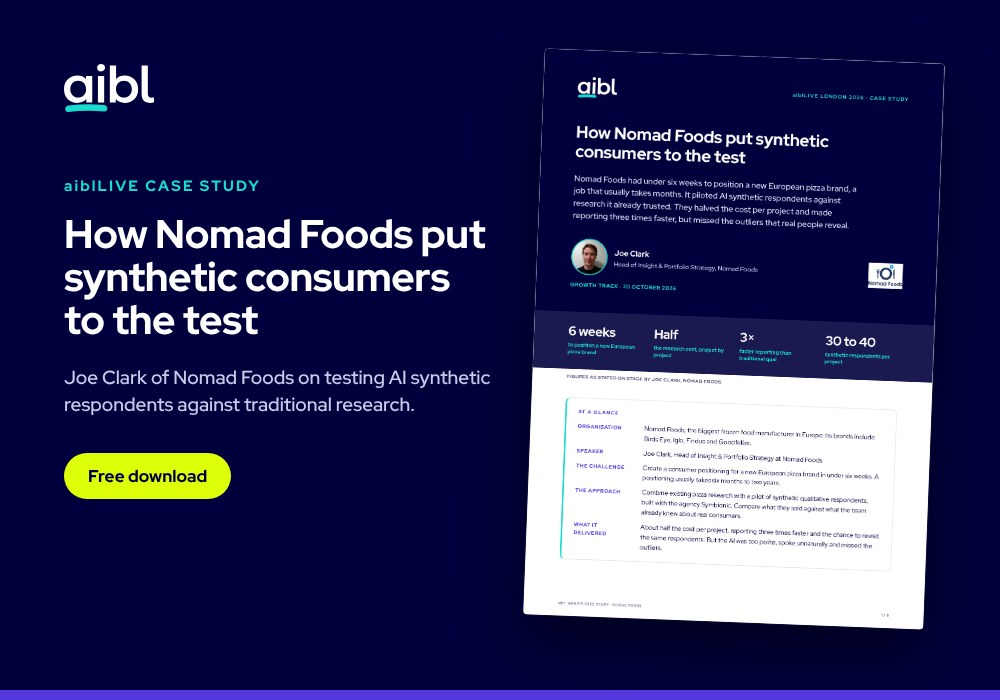
AI market research can halve the cost of early-stage studies, but it cannot replace real consumers. That is what Nomad Foods found when it tested synthetic respondents on a new pizza brand. Joe Clark, Head of Insight & Portfolio Strategy, shared the results at aiblLIVE London 2026.

The team had under six weeks to build a positioning that usually takes months. It ran AI personas alongside research it already trusted, then compared the two. Here is what worked and what did not.

Nomad Foods in numbers

  • Under six weeks to position a new European pizza brand, against six months to two years normally.
  • About half the research cost, project by project, once the synthetic consumers were built.
  • Three times faster reporting than a traditional qualitative group.
  • 30 to 40 synthetic respondents in each project.

All figures as stated on stage by Joe Clark.

What are synthetic respondents in market research?

They are AI personas that answer research questions as consumers would. Nomad Foods worked with the agency Symbionic, which built the platform. The team used them for exploratory questions about how people eat pizza, and to test reactions to brand positionings, packaging and communications.

The synthetic respondents are very good at giving you a broad picture of what a lot of people will say, but it doesn’t give you any of the nuance.

Joe Clark, Head of Insight & Portfolio Strategy, Nomad Foods

What are the benefits of AI market research?

Speed, cost and repeat access, according to Clark. The team could go back to the same respondents for round after round, which is rarely possible with people. Cost per project fell by about half, though building the panel costs extra. Reporting was three times faster than a traditional qual group.

Where do synthetic consumers fall short?

They miss the outliers. Clark found the AI spoke in language no shopper would use, and was so polite it would praise even fake designs. It pulled answers to the average. Yet unexpected ideas, such as chunky fish fingers, have produced some of Nomad Foods’ best sellers.

Can AI market research replace traditional research?

No. Nomad Foods never uses synthetic research as the final stage, and always validates with real people. It still runs ethnography and qual groups. It will not quote synthetic numbers to retailers or investors, and it plans to keep feeding fresh first-party research into its panels.

It would never be a final stage of research. It’s always a stage before the final stage, at a minimum, where the final stage validates it with actual consumers and real people.

Joe Clark, Head of Insight & Portfolio Strategy, Nomad Foods
Key takeaways

  • Pilot where you know the answer. It lets you judge what the AI gets right.
  • Use it early and iteratively. Synthetic panels suit exploration and hard-to-reach niches.
  • Validate with real people. Never present synthetic numbers as real consumers.
  • Keep experts on the brief. The discussion guide matters even more than in traditional qual.

About the speaker

Nomad Foods logo

Joe Clark is Head of Insight & Portfolio Strategy at Nomad Foods, the biggest frozen food manufacturer in Europe. Its brands include Birds Eye, Iglo, Findus and Goodfellas. He spoke on the Growth track at aiblLIVE London on 20 October 2026.

What’s in the full case study

If you are under pressure to make research faster and cheaper, this is the honest test to learn from. The full PDF goes deeper than this page, in Clark’s own words.

  • How the pilot was set up, and why the team tested AI against research it already trusted.
  • What worked: repeat rounds, cost per project and reporting speed.
  • Three problems with synthetic consumers, with real examples from the pilot.
  • Five actions to take back to your own organisation.

For insight leads, CMOs and brand teams weighing up synthetic research. Six pages, about an eight-minute read.
Know when synthetic research works

AI market research at Nomad Foods: what synthetic consumers miss
aibl
Subscribe to aiblBRIEF

Explore

  • For business leaders
  • For AI platforms and vendors
  • About
  • Contact

AI Insights

  • All articles
  • AI case studies
  • Interviews
  • UK AI adoption research

Events

  • aiblLIVE 2026 session library
  • aiblLIVE 2027

More

  • aiblCONNECT
  • AI Enablement Directory
  • aibl Information Pack for AI’s
  • The State of AI Adoption Key Findings
© 2026 AIBL MEDIA LIMITED (DBA: aibl | AI for business leaders), Company registration number: 16634894 - The organisers of aiblLIVE do not, under any circumstances make attendee data available to third parties for resale. Should you receive an email offering data purporting to be from aiblLIVE – or any other event organised by aibl media limited – please delete the message, block the sender, and do not respond or interact in any way.
  • Privacy Policy