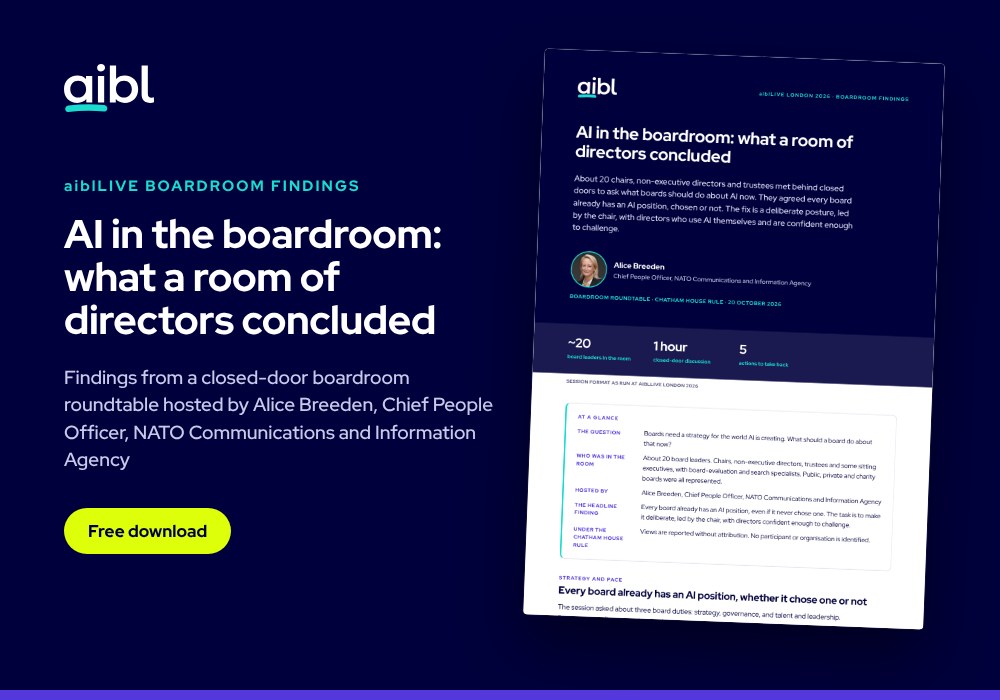
Every board already has a position on AI, even if it never chose one. That was the headline finding when about 20 chairs, non-executive directors and trustees met to discuss AI in the boardroom at aiblLIVE London 2026. The closed-door roundtable ran under the Chatham House Rule, so views are reported without attribution.
The room agreed the task is to make that position deliberate. It needs a chair who leads, directors who use AI themselves and a risk appetite that lets executives experiment. Here is what the room concluded.
Name the posture it already has. Staff are using AI, often informally, so a board that sets no position has declared one by default. Participants said the first job is to decide where AI creates advantage, where it changes the business model and how its risks are reduced. Not knowing and not doing is itself data about the board.
Most of the room said yes, and one participant called hands-on use the one non-negotiable. The split was over depth. One chair warned against technical rabbit holes and kept the focus on decisions and risk. Another director used a rough prototype to show management a third option it had missed, and argued that depth sharpens challenge.
Not as a single fix, the room said. Board evaluators reported a wide gap between AI’s importance to strategy and the know-how around the table. Options discussed included practitioner directors, rotating advisers and boards that mix independents with sitting executives. Several people said the chair matters most, and that chairs who understand AI at a systems level are scarce.
Frame it as risk and strategy, which directors already know how to judge. Several participants drew on how boards learned to govern cyber. The board decides what must be protected, and specialists protect it. The room warned that moving too slowly carries its own risk, so boards should agree a risk appetite for small experiments.
The roundtable was hosted by Alice Breeden, Chief People Officer at the NATO Communications and Information Agency, at aiblLIVE London on 20 October 2026. The discussion ran under the Chatham House Rule, so no participant or organisation is identified.
If your board is still treating AI as an occasional agenda item, start here. The full PDF sets out what the room concluded and where it disagreed.
For chairs, non-executive directors, trustees and company secretaries. Six pages, about a nine-minute read.