Practical AI adoption insight, every week. Subscribe to aiblBRIEF
aibl
  • Practical AI Insights
    • The research
      • Benchmark your AI ROI (Beta)
      • State of UK AI Adoption 2026
      • What our research says
      • AI analysis
      • Leadership Series report
      • Newsletter archive
    • Learn and apply
      • AI explained
      • AI case studies
      • AI build stories
      • AI playbooks
      • AI workshop guides
      • Boardroom findings
      • AI leader interviews
  • aiblLIVE
    • 2026 session library
    • aiblLIVE 2027
  • Find AI enablement partners
    • AI Enablement Directory
      • Search the directory
      • Register your business
    • By Category
      • AI Strategy & Readiness
      • AI Implementation & Deployment
      • AI Training & Capability Building
      • AI Agents & Agentic Workflows
      • AI Governance & Risk
      • Generative AI Applications
      • Data & Analytics
      • Process & Document Automation
  • Partner with aibl
    • For enablement partners
    • For AI platforms and vendors
    • Insights for vendors
    • Market insights reports
  • About
    • About Us
    • AI For business leaders
Subscribe to aiblBRIEF
  • Practical AI Insights
    • The research
      • Benchmark your AI ROI (Beta)
      • State of UK AI Adoption 2026
      • What our research says
      • AI analysis
      • Leadership Series report
      • Newsletter archive
    • Learn and apply
      • AI explained
      • AI case studies
      • AI build stories
      • AI playbooks
      • AI workshop guides
      • Boardroom findings
      • AI leader interviews
  • aiblLIVE
    • 2026 session library
    • aiblLIVE 2027
  • Find AI enablement partners
    • AI Enablement Directory
      • Search the directory
      • Register your business
    • By Category
      • AI Strategy & Readiness
      • AI Implementation & Deployment
      • AI Training & Capability Building
      • AI Agents & Agentic Workflows
      • AI Governance & Risk
      • Generative AI Applications
      • Data & Analytics
      • Process & Document Automation
  • Partner with aibl
    • For enablement partners
    • For AI platforms and vendors
    • Insights for vendors
    • Market insights reports
  • About
    • About Us
    • AI For business leaders
  • Subscribe to aiblBRIEF

AI change management at the Met Office: why the people came first

Downloads | AI case studies

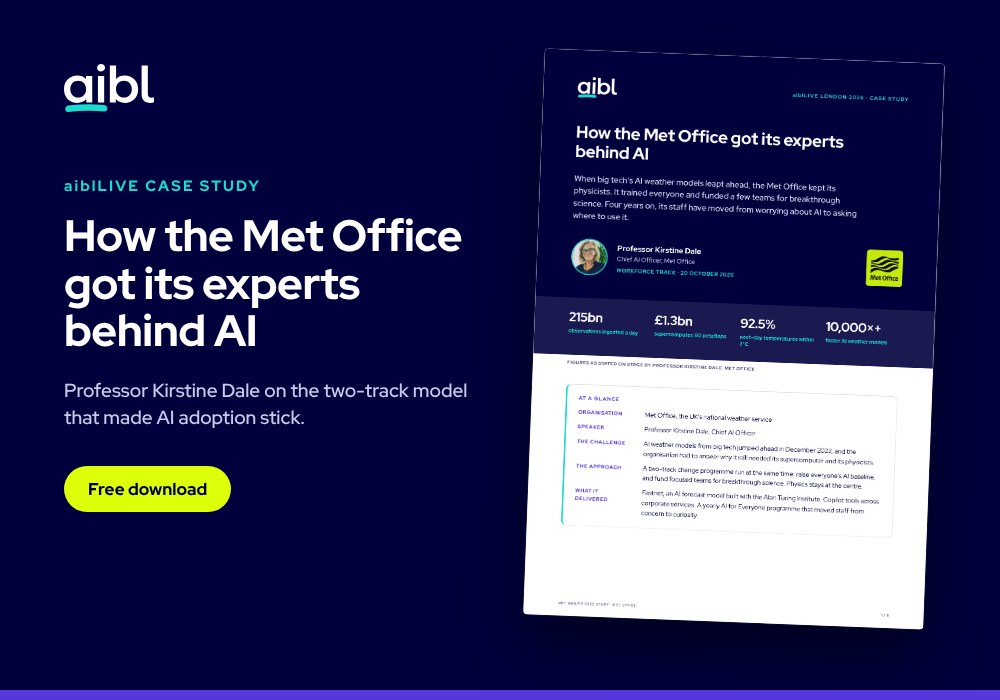
AI adoption at the Met Office was a change management problem, not a technology one. That was the headline from Professor Kirstine Dale, the Met Office’s Chief AI Officer, at aiblLIVE London 2026. A wave of AI weather models in late 2022 put the organisation under pressure. A 60-year-old home of physicists suddenly had to justify its people and its new £1.3 billion supercomputer.

The response was to keep the physics and bring everyone with it, while a few funded teams pushed for breakthrough science. Here is how it worked.

The Met Office in numbers

  • 215 billion observations arrive every day, from satellites, radar, buoys and aircraft.
  • £1.3 billion buys the 60-petaflop supercomputer it runs with Microsoft.
  • 92.5% of next-day temperature forecasts land within 2°C.
  • Tens of thousands of times faster: that is how much quicker the new AI weather models run than the physics-based ones.

All figures as stated on stage by Professor Kirstine Dale.

What forced the rethink?

A step change in weather models built by others. Around December 2022, new models from large technology companies suddenly looked far stronger, and the questions landed fast.

We’ve just signed the contract for a 1.3 billion pound supercomputer. Folk were like, what do you need a supercomputer for? And why do you need a workforce full of physicists?

Professor Kirstine Dale, Chief AI Officer, Met Office

How did the Met Office respond?

It ran AI adoption as a two-track change programme. One track raised the floor, so everyone understood what AI was and where it could help. The other raised the ceiling, funding focused teams for breakthrough science, including the Fastnet model built with the Alan Turing Institute.

The floor work became the AI for Everyone programme: training, surgeries, tools, hackathons and seminars, backed by clear policies. The aim was to make AI useful across the organisation, not only in specialist teams.

Why keep the physics at all?

Because AI models are fast but not self-sufficient. Dale said the AI models run tens of thousands of times faster than the physics-based ones, which is why both belong together.

Physics supplies the training data. It gives the deep process understanding needed to explain a safety-critical forecast. And it covers a changing climate that AI models have not seen in training.

What is the lesson for other organisations?

Change starts and ends with people, and AI has to serve the mission rather than become it. The workforce moved from worried, to confident, to curious about where to use AI well.

If I was only allowed one lesson, the lesson would be that change starts and ends with people. AI adoption is really not a technology challenge.

Professor Kirstine Dale, Chief AI Officer, Met Office

Key takeaways

  • Treat it as a change programme. The technology is the easier part.
  • Raise the floor and the ceiling together. Baseline skills for everyone, funded teams for the hard problems.
  • Keep the expertise you have. Physics gives the Met Office the training data and the explanations AI cannot supply.
  • Move people from worried to curious. The measure of success at the Met Office was a change in mood as much as skill.

About the speaker

Met Office logo

Professor Kirstine Dale is Chief AI Officer at the Met Office. She leads the responsible use of AI in weather forecasting, climate science and national resilience. She spoke on the Workforce track at aiblLIVE London on 20 October 2026.

What’s in the full case study

If your AI rollout is stalling because people see it as a threat, this is the model to borrow. The full PDF goes deeper than this page, in Professor Dale’s own words.

  • A two-track model you can run at once: baseline skills for everyone, and funded teams for the hard problems.
  • A way past job fears: how AI for Everyone moved staff from worrying about their jobs to asking where AI helps.
  • The case for keeping your experts, and three reasons a hybrid beats replacement.
  • Five actions to take back to your own organisation.

For COOs, CHROs and transformation leads rolling out AI where trusted experts and safety-critical decisions are involved. Five pages, about a seven-minute read.
Get your experts behind AI

AI change management at the Met Office: why the people came first
aibl
Subscribe to aiblBRIEF

Explore

  • For business leaders
  • For AI platforms and vendors
  • About
  • Contact

AI Insights

  • All articles
  • AI case studies
  • Interviews
  • UK AI adoption research

Events

  • aiblLIVE 2026 session library
  • aiblLIVE 2027

More

  • aiblCONNECT
  • AI Enablement Directory
  • aibl Information Pack for AI’s
  • The State of AI Adoption Key Findings
© 2026 AIBL MEDIA LIMITED (DBA: aibl | AI for business leaders), Company registration number: 16634894 - The organisers of aiblLIVE do not, under any circumstances make attendee data available to third parties for resale. Should you receive an email offering data purporting to be from aiblLIVE – or any other event organised by aibl media limited – please delete the message, block the sender, and do not respond or interact in any way.
  • Privacy Policy