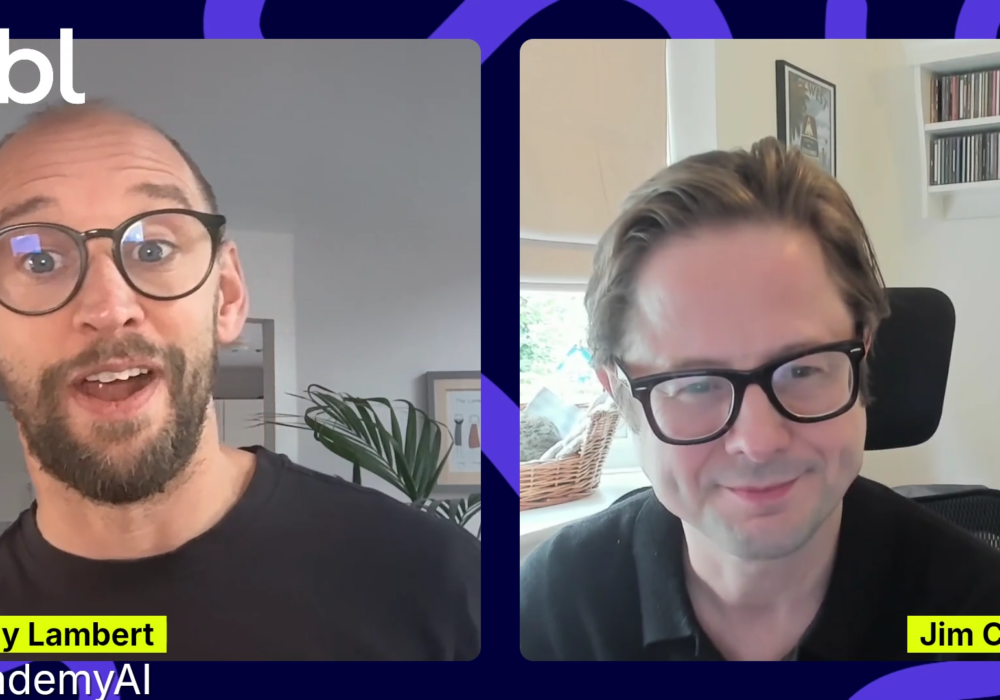
Watch the interview here
Rahim Hirji, founder of Superskills, thinks we’re missing something profound in our approach to AI…
The human capabilities that determine whether AI investment compounds or merely costs — curiosity, change readiness, principled judgement — are already present in most workforces. What most organisations lack is a deliberate programme to develop them alongside AI deployment. Rahim Hirji, founder of SuperSkills and adviser to 200+ organisations on AI adoption, calls this the missing fourth dimension: without it, AI makes the fast things faster and leaves the high-value work unchanged.
That’s the question that Rahim Hirji thinks businesses should be asking. Hirji is the founder of SuperSkills and the author of SuperSkills: The Seven Human Skills for the Age of AI, and he’s been asking this question in one way or another for the last three years with over 200 organisations.
Every organisation investing in AI right now has a version of the same approach and we’ve written about the pattern before. Usually it looks like a version of setting a strategy, identifying use cases and automating processes, seeking to reduce costs or boost revenue opportunities. These are legitimate goals, and they’re also almost universal. What Hirji argues is that the organisations who treat this as the complete picture are missing the dimension that will ultimately separate the ones who compound their AI investment from the ones who merely spend it.
That dimension is human capability. Not as a soft counterweight to the hard business of AI implementation, but as the operating system that determines whether any of the rest of it works.
As remarkable as AI can be, it’s not a replacement for the human brain and its ability to be creative, build relationships or earn trust.
This is a pattern Hirji sees repeating across industries. A bank automates its research function, cuts a team of ten down to two, saves money, and loses the institutional wisdom to ask the right questions. Not to retrieve answers, but to decide which questions are worth asking in the first place. In many cases, they’re now rebuilding the team, and the cost of the lesson can exceed that of the original headcount.
Rahim draws a distinction between execution and authorship as one of the more useful reframings in recent thinking about AI and work. For thirty years, the knowledge economy rewarded people who could research, build, format, coordinate and optimise. Most of the time, AI does that now, faster and cheaper.
“What it cannot do is decide what’s worth executing or set direction. Nor can it weigh competing values or make the judgement call that sits upstream from any workflow.” The transition organisations need to make isn’t about doing the same things faster with better tools, but fundamentally reorienting toward the work that was always more valuable and has usually been crowded out by the work AI is now absorbing.
Every truly valuable AI workflow has a point where a human needs to be present, and not simply to monitor, but, often to intervene. For example, AI doesn’t have a sense for when the data for a client doesn’t look right or deserves a closer look. A drop in trade from a long-standing client just looks like a churn risk to the AI, which fires off a discount-based retention offer. The human in the loop can recognise that the account management team has had turnover, and they deserve a human touch to reinvigorate the relationship. It’s the difference between observation and true oversight, and it’s where our uniquely human capabilities add enormous value.
You might have noticed that we haven’t dissected the seven SuperSkills from Rahim’s book, and you’ll have to pre-order one to dig deep, but let’s close with a teaser.
The seven SuperSkills have a specific order and interrelationship, starting with curiosity before moving on to change readiness, big picture thinking, principled innovation, empathy, global adaptability and ending with an augmented mindset.
“And I’d put them in that order. I think that curiosity, being ready for change and having empathy are equally important. But the reason why I call out curiosity is that people never say ‘I’m not curious’, right?.”
For the research behind this, see how AI is reshaping HR and people functions in the UK mid-market.
“I think curiosity is the skill that’s most under threat right now because of AI.” The muscle of curiosity atrophies if you never use it, and the organisations that let AI do the asking as well as the answering are building a structural dependency that compounds in one direction only. Form a hypothesis before you open the chat window. Ask the question about the question.
Watch the interview here
Rahim Hirji, founder of Superskills, thinks we’re missing something profound in our approach to AI…