
Zero mandate, zero budget: AI adoption at Scania
Speaking in the Workforce track at aiblLIVE, Patrik Hedljung, Scania's AI Adoption Manager, described trying to...
Read more
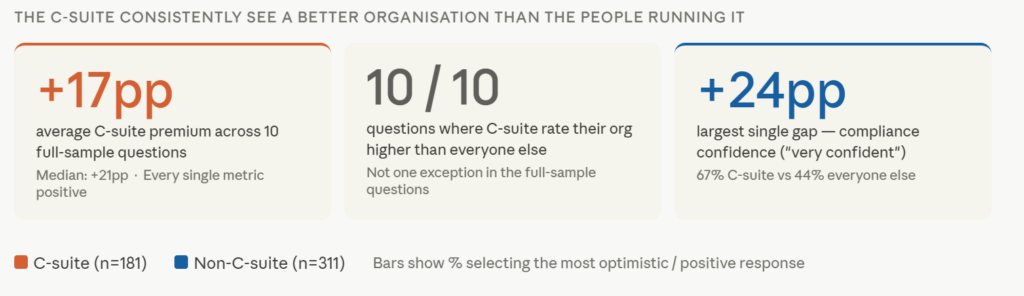
The C-suite in the mid-market is justifiably proud of being closer to the work and to clients than they would be in the enterprise. UK mid-market C-suite leaders rate their AI progress 17 percentage points higher on average than the operational layer doing the work — and up to 24 points higher on AI compliance. This is the central finding from aibl State of UK AI Adoption Survey 2026 (n=755). The organisations that close this gap consistently report stronger returns than those operating on the board-level version of events. But they’re still focused on strategy and reporting upwards to the board and investors, and can’t be involved in every aspect of the day-to-day. That distance often shows up in studies that identify a gap between how executive leadership believes is true and what the people doing the work believe.
Our research shows the same pattern. There’s a consistent C-suite premium on the findings that averages out at +17 points higher across a variety of questions, and top out at +24 points on the topic of AI compliance.
The further you are from the work, the more the organisation looks like the version of itself that was presented to you in strategy decks and meetings, in the careful language that tends to travel upward through hierarchies. The closer you are to the work, the more you see the workarounds, the handoff failures, the functions pulling in different directions, and the training that didn’t land or got ignored.
A human organisation can absorb a remarkable amount of internal misalignment through informal judgement, tribal knowledge, and the kind of quiet course-correction that experienced people do without being asked. Those mechanisms are invisible in process documentation and reporting, which is why they don’t show up in the C-suite’s picture. But when you automate a process, you automate the documented version of it and the undocumented, load-bearing work disappears.
For the research behind this, see aibl’s research on AI transformation in the UK mid-market.
The organisations that are consistently reporting strong returns aren’t necessarily better at AI, but they do appear to be better at seeing themselves clearly. Their leadership’s assessment of alignment, governance maturity, and capability tracks more closely with what the operational layer reports. Their narrower gap means decisions get made against a more accurate picture of what the organisation can actually do.

Speaking in the Workforce track at aiblLIVE, Patrik Hedljung, Scania's AI Adoption Manager, described trying to...
Read more
This is the second half of our Off the Record series. These are quotes we agreed not to attribute, from...
Read more
aiblLIVE is under two weeks away. I needed to write something for this week that would be useful, but not take up...
Read moreGet ahead with the most actionable insights, playbooks and real-world AI use cases you can adopt right now, in your inbox every week