
Who should own AI in your business?
The CEO or C-suite should own it. In aibl's survey of 755 UK mid-market leaders, companies with an executive...
Read more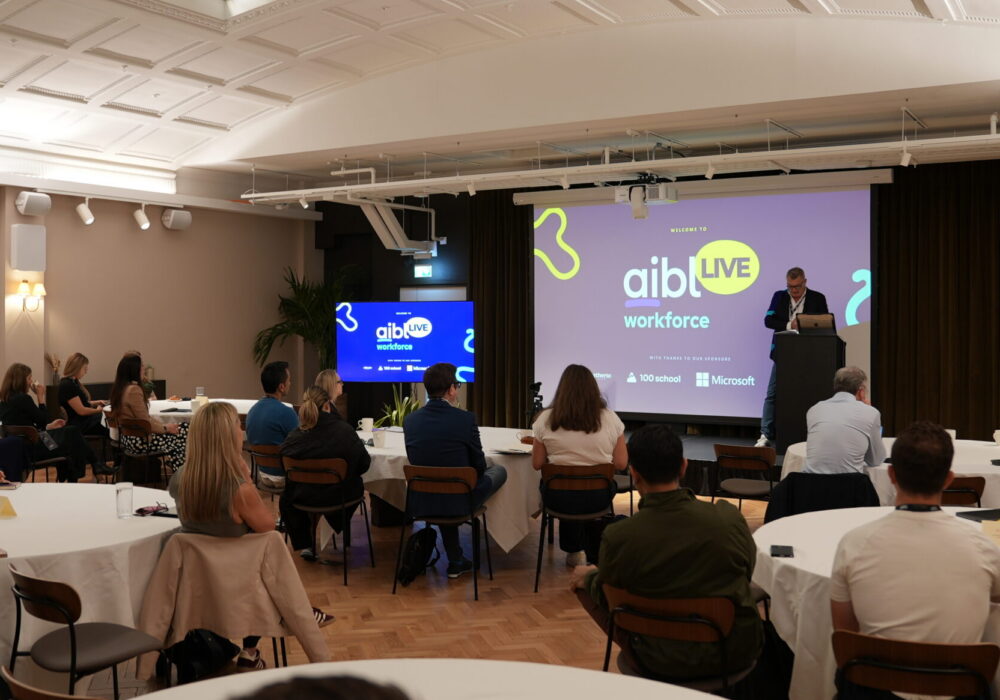
Last week we hosted aibl’s first workforceLIVE event in London, focusing on Capabilities, Culture and Change. The day was structured around talks from leaders helping to implement AI and round tables where attendees shared lessons and war stories.
We were delighted with the audience, their feedback and their +75 NPS score for the day. If you’re interested in the go-to-market side of AI, you can apply here to join us at the next Leadership series event, growthLIVE: AI for Marketing, CRM and Revenue Growth on the 10th of June.
Our lead article digs into the talks, but I’ll kick off the way we did in the morning, with some findings from our survey of over 750 leaders in the UK mid-market. See the full workforceLIVE survey data on AI for HR for the research behind this.
There is a lot of data to choose from, but I settled on clarity as the thread, because there’s a consistent difference between the companies that have aligned their strategy, departments and employees, and those that haven’t. That first group is much more likely to have achieved positive ROI from their AI investments.
We started at the top with strategy and The 5 Managers Test. We shared those findings in the newsletter two weeks ago, so here’s the short version: we asked respondents to count how many out of five managers would agree on their top AI priorities.
When the count was high (4 or 5), over half the sample reported positive ROI, hitting a nearly 80% share when there’s full agreement. But there’s a big drop for the companies with lower levels of strategic agreement, with roughly one-third seeing positive results.
Then we moved down a level to look at the relationship between parts of the company.
AI systems are only as good as the data they’re trained on, and data is inherently cross-functional, so we asked respondents to gauge the alignment between the key groups, including executive management, HR, Ops/Finance, GTM and Technology.
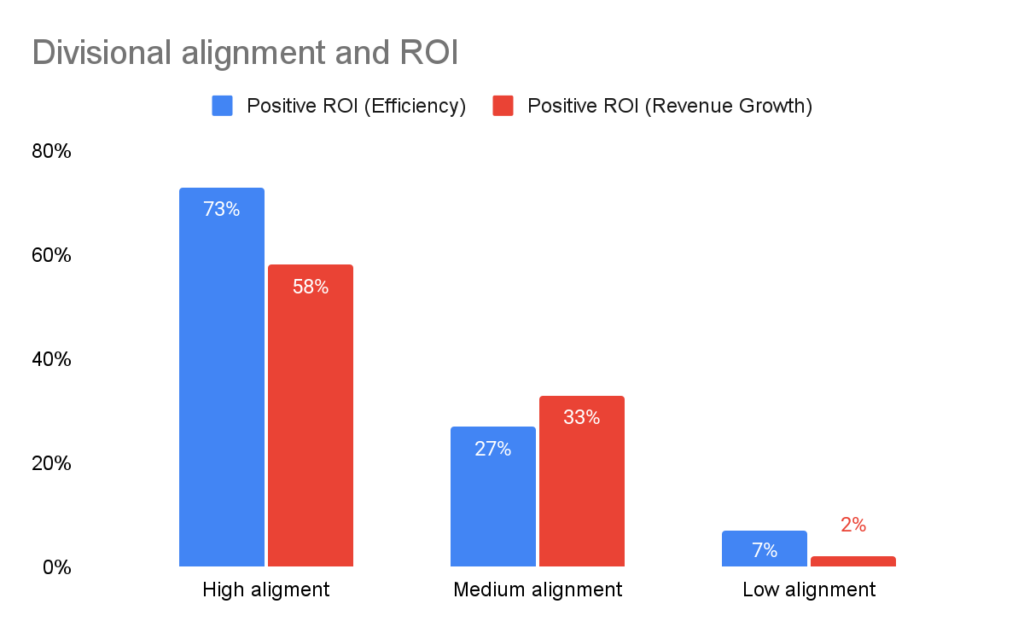
Whether the goal for AI is efficiency or revenue, the chances of achieving positive ROI drops sharply with the level of alignment.
We’ve talked about breaking down silos forever, but AI highlights the tension when we implement an end-to-end technology. Every boundary is a potential failure point, and it’s easier to blame the technology than to address weaknesses in our fundamental ways of working.
We ended on how an organisation’s approach to their employees impacts the success of an AI rollout. The survey asked respondents in the People/HR function about the support their organisations provide in training and guidance and once again, there’s a sharp distinction in success. Nearly three-quarters of the companies where employees are considered to be ‘well equipped’ are seeing positive results, more than twice the rate for those that say their employee support is insufficient.
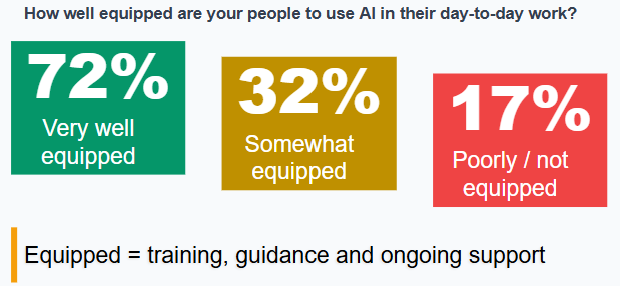
For organisations focused on efficiency, cost reduction, process automation, operational improvement, the gap is even sharper. Among efficiency-driven organisations where people are very well equipped, 81% report positive ROI. For those where employees are only somewhat equipped, that drops to 32%. The bottom line is that the organisations seeing returns have made a deliberate investment in genuine capability.
Here’s how we see it.
At the top of the organisation, misalignment on strategy means the wrong things get funded and prioritised.
In the middle, misalignment between functions means the right things don’t actually connect end to end, and AI is an end-to-end technology being dropped into a functionally siloed structure.
For individuals, inadequate training means the people closest to the work can’t convert tool access into real output.
Each layer amplifies the others. An organisation with clear strategy but poor cross-functional alignment fails at the handoff. An organisation with strong alignment but undertrained people converts the plan into activities rather than outcomes. And critically, the leadership layer that’s most confident everything is working is often the layer with the least visibility into where it’s breaking.
The organisations in our sample that are consistently reporting measurable ROI have built the conditions for AI to function: shared priorities, negotiated boundaries between functions, and people who actually know how to work with it day to day.
Now let’s get to our brilliant speakers!
Want to hear more insights like these in person? aiblLIVE London 2026 brings together UK mid-market leaders tackling real AI adoption challenges. Find out more and register your interest.
Alignment across three layers: leaders agreeing on strategy, departments coordinating, and staff equipped to use the tools. Among the UK mid-market leaders surveyed, where a management team fully agreed on AI priorities nearly 80% reported positive ROI; where agreement was lower, only about a third did.
Yes, sharply. Among the UK mid-market firms surveyed, those whose staff were well equipped to use AI saw nearly three-quarters report positive ROI, more than double the rate of firms that left staff under-supported. Capability built in-house is one of the strongest predictors of return.
Because misalignment at any one layer undermines the rest. If leaders disagree on priorities, departments do not coordinate, or staff are not equipped, the technology cannot deliver end to end. Each gap amplifies the others, so the tool is rarely what failed.
Less than they think. Full agreement across a management team is the exception, and it is exactly the group reporting the highest ROI. Getting managers to agree on a small set of AI priorities is often the first practical move toward a return.
The CEO or C-suite should own it. In aibl's survey of 755 UK mid-market leaders, companies with an executive...
Read more
Lead with the number your CFO already trusts, not the tool a vendor is selling. Write the success metric and the...
Read more
Readiness for AI is not about the tools you buy. It comes down to two things the survey shows decide the return:...
Read moreGet ahead with the most actionable insights, playbooks and real-world AI use cases you can adopt right now, in your inbox every week