
Practical AI glossary: terms every business leader should know
This glossary defines AI terms every business leader encounters when evaluating AI adoption. ## Core AI...
Read more
Only 38% of UK organisations prioritise inclusive AI workforce transformation, leaving most vulnerable to skills gaps that directly impact productivity. Yet companies that successfully implement structured AI training see measurable improvements in revenue performance. The AI skills gap is real but solvable—the investment window is narrowing.
The global AI skills gap costs $5.5 trillion in lost productivity. Only 35% of employees have received formal AI training, despite 94% of CEOs naming it a strategic priority. For UK mid-market organisations, cost (42% cite it) and training availability (37%) remain the biggest barriers.
The opportunity signal is clear: 88% of organisations use AI in at least one function, but only 38% of knowledge workers use generative AI daily. Adoption exists; depth doesn’t.
The best programmes combine role-specific depth with organisation-wide foundations.
Role-specific training targets actual workflows: marketing needs prompt engineering and content workflows; finance requires predictive analytics and automation; operations needs workflow optimisation. The pattern that works is “Learning in the Flow of Work”—embedding training directly into job workflows rather than generic offline courses. This drives faster skills transfer and higher engagement.
Organisational foundations matter too. All employees need baseline knowledge: what AI can and cannot do, ethical considerations, where AI adds value in their domain, and how to work effectively with AI tools.
Successful organisations use both, sequenced strategically.
External providers are faster for foundations and introducing major toolsets. Internal development is cost-effective for long-term capability, requiring: a skills audit by role, internal champions who model AI use, and peer-led learning (frontline teams teach adjacent functions).
Cost ranges from £500 per employee (online, self-paced) to £2,000–£5,000 per employee (role-specific with expert facilitation). Most mid-market organisations see this as investment in future-proofing.
AI training only matters if it changes behaviour. Track three layers:
Training quality: completion rates, assessment scores, learner satisfaction.
Skill application: do trained employees actually use AI tools daily? Track adoption rates, task completion times, output quality, usage frequency.
Business impact: percentage of tasks automated or AI-assisted, time savings, quality improvements, revenue impact from new AI capabilities.
Establish baseline metrics before training begins. Without knowing the before-state, you cannot measure improvement.
Only 38% of UK organisations reach all roles, ages, and technical abilities in AI training. Non-technical roles—operations, admin, junior practitioners—often get overlooked despite handling repetitive, high-impact tasks where AI delivers immediate value.
Inclusive training requires: short modules (under 20 minutes), role-specific examples, accessible language, multiple delivery formats, clear pathways for different ability levels.
Organisations that invest here achieve adoption rates 2–3 times higher than one-size-fits-all approaches.
Step 1: Audit current capability. What skills exist? Where are gaps? What tools are already in use?
Step 2: Define role-specific needs. AI training for developers differs completely from marketing or finance roles.
Step 3: Choose a starting point. Begin with one high-impact team (sales, marketing, operations) rather than organisation-wide. Success here builds momentum.
Step 4: Blend internal and external. External partners handle foundations; internal champions sustain adoption.
Step 5: Measure from the start. Track completion, skill application, business impact. Review quarterly and adjust.
Step 6: Plan for persistence. AI capabilities evolve rapidly. Budget quarterly updates minimum.
The organisations pulling ahead in AI aren’t buying the most expensive tools—they’re ensuring employees know how to use them effectively, understand where AI adds value, and feel confident experimenting.
That capability comes from structured training, applied in ways that fit how people actually work. Mid-market leaders who invest practically, inclusively, and with clear measurement now will have material advantage later.
A: Self-paced online training costs approximately £500 per employee. Role-specific programmes with expert facilitation typically cost £2,000–£5,000 per employee. Most mid-market organisations pilot with 20–50 people and expand based on measured ROI.
A: Generative AI training focuses on using large language models and AI content tools in day-to-day work. AI literacy training is broader: it covers where AI adds value, how to identify opportunities, ethical considerations, and how to work effectively with AI tools across your organisation.
A: Organisations typically anticipate 28 months for transformation value to outweigh upfront costs. However, high-impact automation and efficiency gains can show ROI within 6–12 months.
A: Start with a high-impact, self-contained team where AI has clear application (sales, marketing, or operations). Success here builds momentum and generates internal advocates who drive broader adoption.

This glossary defines AI terms every business leader encounters when evaluating AI adoption. ## Core AI...
Read more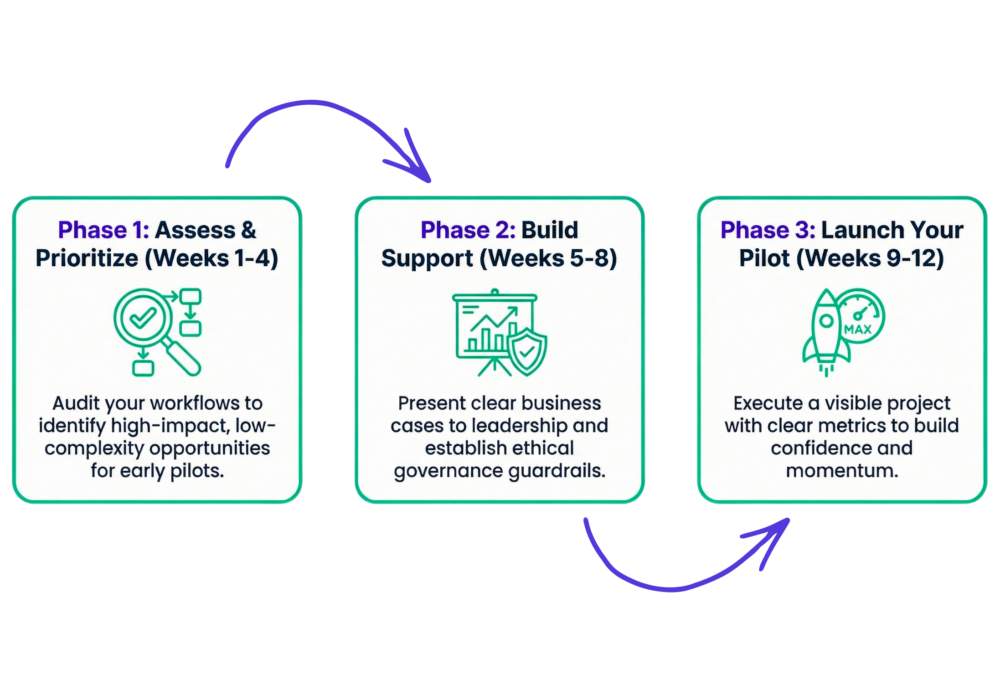
An AI adoption roadmap is your systematic plan for moving AI from interesting ideas to embedded business...
Read more
A governance framework is the set of policies, roles, and decision processes that keep your organisation safe...
Read moreGet ahead with the most actionable insights, playbooks and real-world AI use cases you can adopt right now, in your inbox every week