
The Visibility Trap: Measuring AI Answers Beyond the Ranking with Stuart Bruce, Purposeful Relations
Stuart Bruce, co-CEO of Purposeful Relations, argues AI is not just a tool. It is a stakeholder describing you to everyone else...
Watch videoAgentic AI is software that can take on a goal, plan the steps to reach it, and carry those steps out across your systems with limited hand-holding. A chatbot answers when you ask it something. An agent goes and does the job: it reads the data, decides what to do next, acts, checks the result, and comes back when it needs you. That is the difference that matters for a mid-market operator, and it is why the conversation has moved past chatbots.
Chatbots gave you a smarter search box. Useful, but you still did the work. Agentic AI changes what the work is. Instead of asking a tool for an answer and then acting on it yourself, you hand the tool an outcome and let it work through the sequence. That shift is where the return sits, but only when the agent can reach across more than one part of the business.
Generative AI produces content: text, code, images, a draft reply, a summary of a long document. You prompt it, it responds, and that is the transaction. It has no memory of your goal and takes no action on your systems.
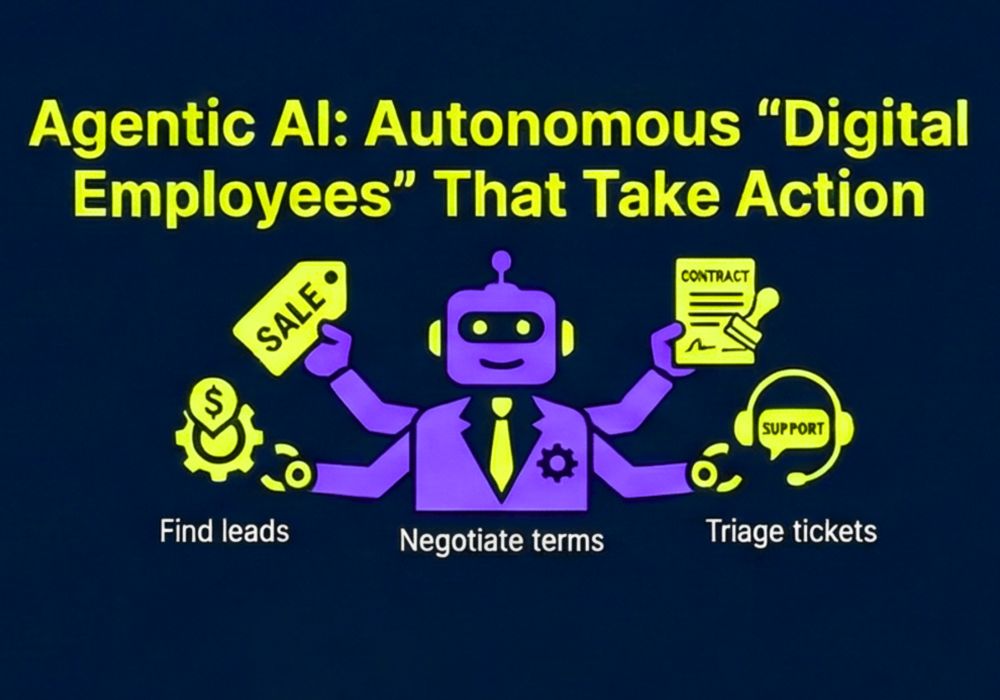
Agentic AI uses that same generative capability as one part of a wider loop. It sets sub-goals, calls tools and databases, takes actions such as sending an email or raising a ticket, and adjusts based on what happens. Generative AI writes the outreach message. An agentic system finds the prospect, checks the fit, writes the message, sends it, and books the meeting when they reply. One produces; the other acts.
Sales prospecting and outreach. An agent pulls a target list against your ideal customer profile, enriches each record, drafts a tailored opener, sends it, handles the first reply, and puts qualified meetings on a rep’s calendar. The rep spends their time in conversations, not in list-building.
Procurement and vendor management. An agent watches contract renewal dates, gathers quotes, checks spend against budget, flags terms that have drifted from your standard, and prepares the renewal pack for a buyer to approve. It does not sign anything. It removes the chasing.
Customer support triage. An agent reads each incoming ticket, pulls the customer’s order and account history, resolves the routine cases end to end, and routes the rest to the right person with the context already attached. Your team stops sorting the queue and starts on the hard tickets.
Traditional automation follows a fixed script. If this happens, do that. It is fast and reliable inside the path you built for it, and it breaks the moment reality steps off that path. You have to foresee every branch.
An agent decides at each step rather than following a wiring diagram. It handles the case you did not script, reasons about a messy input, and adapts when a step fails. That flexibility is the gain and the risk in the same breath, which is why what you wrap around it matters as much as the agent itself.
Here is the finding that should shape where you start. In aibl’s State of UK AI Adoption Survey 2026 (755 UK mid-market leaders, revenue £50m to £500m), agents that work across departments delivered 84.7 per cent measurable ROI. Narrow single-task or retrieval agents, the clever ones that do one thing, returned just 24 to 29 per cent. Workflow-level agents sat in between at 56 to 57 per cent.
Read that again, because it runs against instinct. The return does not come from how sophisticated any single agent is. It comes from how far the agent can reach across the organisation. An agent that spans sales, finance and operations beats a brilliant one boxed into a single task, by a wide margin. So do not start by buying the cleverest tool for one team. Start with a workflow that crosses a boundary people currently bridge by hand.
You are ready enough to pilot if three things are true. Your data for the target process is in a system an agent can reach, not trapped in one person’s inbox. Someone senior owns the outcome and will make a go or no-go call. And you can name one cross-departmental workflow where handoffs currently cost you time. You do not need every process in order. You need one honest candidate and the discipline to measure it.
Pick one workflow that crosses a boundary, such as a lead moving from marketing to a booked sales meeting. Define the outcome and the single metric that proves it. Decide up front where the agent acts on its own and where it must stop for a human to approve, and write that line down. Run it against a real workload, not a demo. Keep a person in the loop on anything that touches a customer, money or a contract. Then make a clear decision at the end: scale it, change it, or stop.
An agent that can act can act wrongly. It can send the wrong message, take a step on bad data, or push an unchecked output into a live process. In the survey, 79 per cent of leaders had already had at least one AI failure, most often a data or security breach, or an unchecked output that broke something downstream.
Governance is your safety layer, and the survey shows how much it moves the return. Measurable ROI climbs from 22.2 per cent in companies with no governance to 85.3 per cent in those with mature, embedded governance, on much the same tools. For agents specifically, that means clear accountability for what the agent is allowed to do, an audit trail of every action it takes, and human approval gates on anything with real consequences. Those controls are not a tax on agentic AI. They are what makes it safe to give an agent room to act in the first place.
Start with one cross-departmental workflow, put the approval gates and the audit trail in before you switch the agent on, and measure one outcome. That is a first pilot worth running.
An AI agent is the thing: a single piece of software that pursues a goal, makes decisions and takes actions. Agentic AI is the broader capability, the general idea of software that plans and acts rather than just responds. In practice people use the terms loosely. A useful working split is that you build agents, and agentic AI is what you call the approach.
Yes, with the right controls, and the survey suggests governed firms do better, not worse. The safety comes from accountability and an audit trail, exactly what a regulator wants to see. Keep a human approval gate on any action that touches customer data, money or a regulated decision, log every step the agent takes, and start with an internal workflow before anything customer-facing. Financial services was one of the higher-returning sectors in our data, not a laggard.
Plan for weeks, not a year, to prove or disprove one workflow. Two to three months is a realistic window to set up the agent, run it against a real workload, and reach a clear go or no-go. Resist the pull to widen the scope mid-pilot. Prove one cross-departmental workflow first, then expand.

Stuart Bruce, co-CEO of Purposeful Relations, argues AI is not just a tool. It is a stakeholder describing you to everyone else...
Watch video
Stuart Bruce is co-founder and co-CEO of Purposeful Relations, which advises communications teams on AI,...
Read more
Everyone now knows that most AI projects fail. Most of any type of project fails after all. The 80% figure from...
Read moreGet ahead with the most actionable insights, playbooks and real-world AI use cases you can adopt right now, in your inbox every week