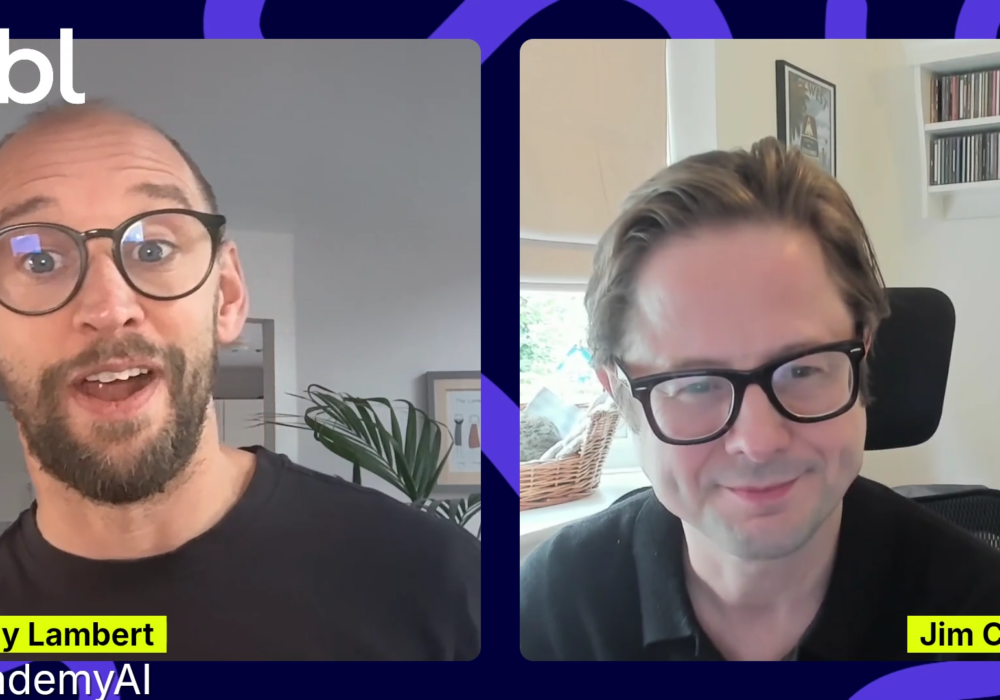
Watch the interview here
Ali Wright, SMB Director at Microsoft UK on how AI is moving faster than most leaders realise…
Your employees are already using AI, whether or not you have approved it. Microsoft research finds 71% of UK workers use AI tools their employer has not sanctioned, over half weekly, and nearly one in four are putting finance-related data into them. Ali Wright, SMB Director at Microsoft UK, argues the answer is not a ban but discovery: assume it is happening, find out what is actually in use, and treat the shift as a change-management challenge rather than a technology one.
Key takeaways
- 71% of UK workers use AI tools their employer has not approved, over half weekly, and nearly one in four put finance-related data into them (Microsoft research).
- Do not start with a ban: assume shadow AI is already happening and find out what is actually in use before deciding what to do.
- Adoption is a change-management problem, not a technology one; AI literacy plus human judgment matter most, and humans must be the final sign-off.
- Practical entry points include Microsoft agentathons (prototype an agent in a day with no-code tools) and agent-based coaching that turns a plain-language brief into an action plan.
- The bigger shift is redesign: hand whole processes to agents with humans signing off above a threshold; within 12 months this becomes a management question.
Ali Wright, SMB Director at Microsoft UK, talks to small and mid-sized business owners across the UK every day – and what she’s seeing is moving faster than most leaders realise.
Ali describes a progression from AI as assistant (writing emails, transcribing calls) through pre-built agents handling specific tasks, toward autonomous agents running whole processes with humans still in the loop. Most businesses are somewhere in the middle, and while their leaders are still working out the plan, their employees are already moving.
According to Microsoft research, 71% of UK workers are using AI tools their employer hasn’t approved. Over half do so weekly. Nearly one in four are putting finance-related data into those tools.
The instinct is to treat this as a compliance problem. Ali’s view: find out what’s actually in use before deciding what to do about it. “Assume it’s already happening,” she says.
Microsoft has worked with customers who found multiple tools they hadn’t known about, brought in by employees using what they know from home or filling a gap where no approved option existed. The risk is in that gap: tools operating without security guardrails, potentially training on the organisation’s own IP.
Ali’s recommended sequence: assume it’s happening, get visibility, offer an approved alternative with proper data security controls, then write a short policy. She sits on the board of a 50-person charity that wrote their AI policy in a page and a half. It covers which tools the organisation has chosen, when they can be used, and where a human needs to sign off.
It’s not the technology
That’s the picture for organisations where AI has arrived without a policy. The harder problem, Ali says, is organisations that have brought it in officially and still aren’t getting value from it. It’s a pattern aibl sees consistently across mid-market businesses: the technology lands, the announcement goes out, and then not much changes.
“It’s not necessarily about the technology or the platform you choose. It’s much more around that human and that change management.”
Part of that is AI literacy: understanding what the tools can and can’t do. But she also points to what tends to get overlooked: critical thinking, bias detection, emotional intelligence, judgment. “It’s those human skills, those soft skills that we don’t always focus on also being elevated by AI.”
AI can handle research, generate content, get you past a blank page. But where the output will engage customers, touch finances, or affect people, someone still has to judge whether it’s right. “Humans need to be the final sign off and the final arbiter of things,” Ali says.
Where AI tends to land first
One route from interest to action is what Microsoft calls “agentathons” – hands-on workshops where business owners prototype an AI agent in a day, run through partner channels using no-code and low-code tools. Participants don’t need to be technologists.
“People don’t actually have flashy ideas. It’s typically those boring things… This is time-consuming, it’s boring, and it’s repetitive. It’s typically there that AI delivers value fast.”
In one session, a five-person family distillery built a chatbot to help customers choose the right gin for a gift. It recommended products, suggested cocktail recipes, and cross-sold distillery tours. In another case, a 50-person company spread across three continents had been recording calls, transcribing them, sending them for translation, then distributing notes. A translator tool within Teams, Ali says, “helped them massively save time, save money” – and let them enter new markets for the first time.
Working backwards from the business
The agentathons work because they start with a business problem, not a tool. Microsoft’s framework, developed through their own adoption process, starts with four questions.
Where are employees losing time to work they don’t want to do? Where could customers get a better experience? Where are business processes duplicative or slow? And where could AI open something new, a market you couldn’t reach for before, or a capability you couldn’t afford to build?
Separate to the agentathons, Microsoft has been piloting an agent-based coaching experience designed to reach the businesses the workshops can’t. Still new and already oversubscribed, it lets a business owner describe their situation in plain language and get an action plan tailored to it. Ali’s example: a pizza company in Liverpool wanting to reach more students. Give the agent that brief and it helps build the plan, covering prompts, a social media campaign, and action steps.
“If you don’t know where to start, particularly if you’re not a technology company… it’s finding a great partner that can help you on that journey, show you the art of the possible.”
From automation to redesign
Ali poses a bigger question: if you started from scratch, would you design your organisation the way it currently runs? “Potentially not,” she says.
At Microsoft, the sales function went through exactly this process – and even an organisation of that scale had to start from the same place. Rather than salespeople spending time on early-stage prospecting, sifting data that could be a goldmine or a waste of time, they introduced what Ali calls “digital sellers,” AI agents that handle prospecting, prioritisation, and outreach. Once a customer engages, a human takes over. For smaller businesses, she suggests treating this as a side project, not a full reorganisation.
Her hypothetical: a home decor retailer running out of stock. Right now, someone notices, places an order, tracks it. An agent could run that whole process, with a human signing off above a certain threshold. “It’s less of a technology shift, but it’s a mindset shift of actually giving off work to agents and the fact that they can completely run these processes for me.”
Her prediction: over the next 12 months, this will feel less like a technology question and more like a management one. “You may not have given them a people manager job, but you could give them an agent manager job easily.”
Watch the interview here
Ali Wright, SMB Director at Microsoft UK on how AI is moving faster than most leaders realise…