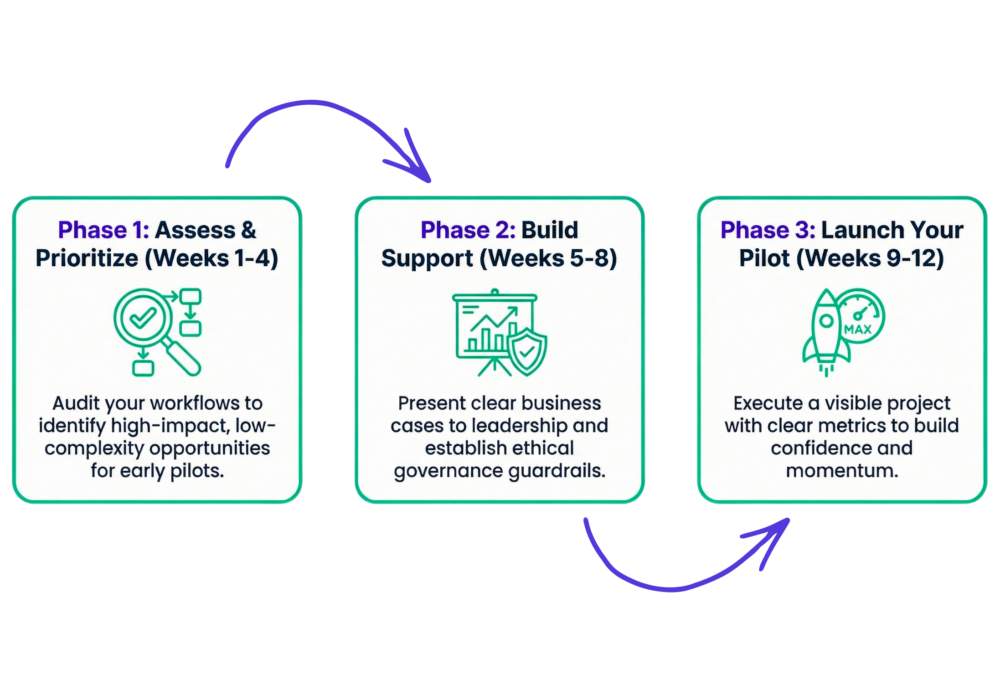
An AI adoption roadmap is the plan that takes AI from a few promising ideas to something your business actually runs on. A realistic one runs 12 to 18 months and moves through five phases.
Most companies never make it that far. In aibl’s State of UK AI Adoption Survey 2026 (755 UK mid-market leaders, revenue £50m to £500m), just 14 per cent had scaled AI across three or more functions with a measurable return. Plenty run pilots. Far fewer turn a pilot into something the business depends on. That gap, between a promising experiment and production, is exactly what a roadmap is for.
The five phases
Assess and decide. Work out which AI opportunities matter, which come first, and whether you’re ready for them. You come out of this phase with a shortlist of three to five use cases and an honest read on what’s blocking you.
Prepare. The unglamorous phase: data engineering, hiring or training for the skills you’ll need, a governance framework, and any infrastructure work. Most roadmaps live or die here.
Run a first pilot. One team, one process, one metric. Measure it properly and make a clear go or no-go call at the end. A pilot with no decision point is just a project that never finishes.
Scale or iterate. If the pilot worked, roll it out wider. If it didn’t, change it or stop. Either way you’ve learned something fast and cheaply.
Sustain and expand. The first use case becomes business as usual, and you start the next one.
Costs build gradually, from mostly internal time in phase one to roughly £15,000 to £30,000 a month by phase five.
What blocks what
The order matters because each phase depends on the last. Bad data breaks everything downstream, so finish the data engineering before you try to scale. Specialist hiring is slow, so start it early if a use case depends on it. And change management begins before the first pilot, not after: tell people what’s coming and why, from phase two onwards.
Governance sits in a category of its own, which is why it goes in phase two. You can pilot with very little of it, but you can’t grow without it. The survey makes the size of that difference hard to ignore: among companies with no governance, 22 per cent report a measurable return on AI; among those with mature, embedded governance, it’s 85 per cent. Same kinds of tools underneath. The thing that changes is whether anyone can show what the tools actually did, and that is what a governance framework builds.
What makes a roadmap work
Four things separate the roadmaps that deliver from the ones that gather dust. One person is accountable for delivery, not a committee, usually a senior operations or technology leader. The sequence is deliberate, with early phases setting up later ones. The timeline is honest: twelve months minimum from concept to scale, and anything faster is usually wishful. And there’s room to flex, because you’ll learn things that change the plan.
Five mistakes to avoid
Chasing too many use cases at once spreads your teams thin, so pick three and add more once the first has scaled. Skipping the readiness assessment catches people out, because you’re ready for some use cases and not others. Running a pilot with no go/no-go decision lets it drag on, so decide upfront what success looks like. Forgetting how long change management takes stalls adoption when people don’t understand the why. And expecting a return in year one sets you up to look like you’ve failed: in the survey, most AI initiatives only turn positive in year two, so build that into what you promise the board.
Use the roadmap to communicate
The roadmap is as much a communication tool as a plan. It tells the organisation where you’re investing in AI and why, when things happen, how the work changes, and how you’ll know it’s working. Share it widely, update it each quarter, and point back to it when you make decisions.
Read the full research
Adoption is common, scale is rare. Just 14% of UK businesses run AI across three or more functions with a proven return. It’s one finding from State of UK AI Adoption 2026, aibl’s benchmark of 755 UK mid-market leaders, in partnership with Executive Summary.
Read the full State of UK AI Adoption 2026 report →
Frequently asked questions
How detailed does a roadmap need to be?
High level is fine for the 18-month view; detailed for the next six months. Don’t spend six months on detailed planning, because you’ll only have to redo it as you learn.
Should we commit to the roadmap or revise it often?
Commit to the 12-month sequence and revise quarterly as you learn. Radical changes every month are a sign of poor planning, not agility.
When should we expect a return?
Plan for year two. Most initiatives in the survey turned positive then, not in the first twelve months, so a roadmap that promises payback in year one is setting the wrong expectation with your executive team.
What if we finish faster than planned?
Good problem to have. Start the next use case.