Personal AI integration varies sharply by function across UK mid-market firms — and the gap predicts ROI. Tech and IT leaders are 2.8x more likely to be fully integrated AI users than Ops and Finance leaders, despite Finance being the most cost-focused function. Leaders at ROI-positive organisations are 43% fully integrated versus 18% at ROI-negative ones. These are findings from aibl’s State of UK AI Adoption Survey 2026, n=755 UK mid-market senior executives.
One of the many ways in which AI is different from the other transformative business technologies is that most of you reading this have a personal relationship with it. We asked mid-market leaders to identify how they personally use AI in their work, and before we look at the results, it might be useful for you to do the same.
How do you personally use AI?
Non-user. I don’t use these tools in my role.
Light use. I use them occasionally for light administrative tasks (e.g. fixing grammar, rewriting emails), but they aren’t part of my core workflow.
Routine use. I use them regularly to speed up routine execution (e.g. summarising long documents, drafting agendas), but I do strategic thinking myself.
Decision-enhancing use. I use them to enhance my decision-making and creativity (e.g. brainstorming strategy, challenging my assumptions, problem-solving).
Fully integrated. These tools are fully integrated into my workflow; I start almost every significant task with AI and view it as an extension of my own capabilities.
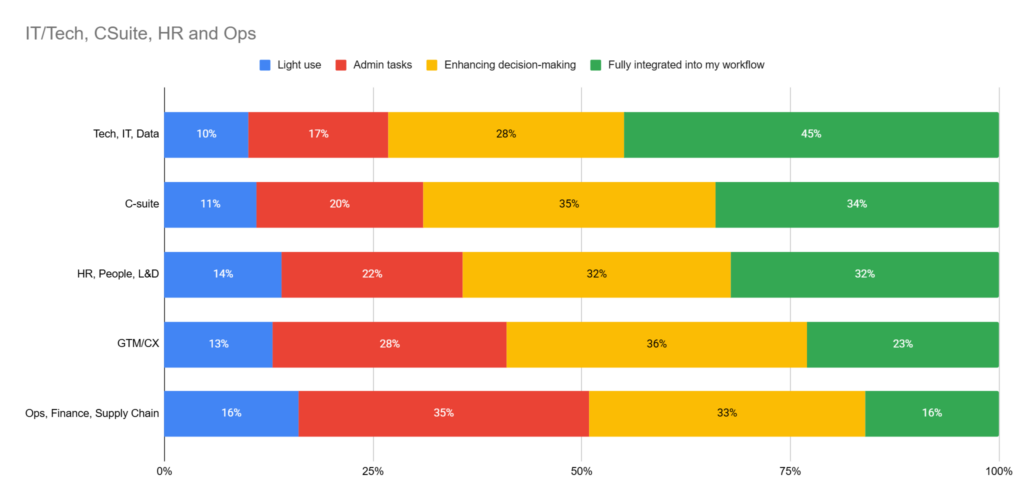
With your answer in mind, here’s how it shakes out when we look at AI sophistication through the lenses of business area and seniority. Note that in the chart below, we bundled the rare non-users into the Light Use category because they’re essentially a rounding error.
Sample: 755 senior mid-market executives.
The Ops and Finance gap
Ops and Finance leaders are predictably the most efficiency-focused group in our survey, 61% cite cost reduction as their primary reason for investing in AI. Yet they are also the least likely to have integrated AI into their own working lives. Only 16% describe themselves as fully integrated users, meaning they start most significant tasks with AI. More than half sit at the admin-or-below level, so while they might use AI frequently, they’re taking advantage of its most basic business uses.
Compare that to Tech/IT leaders, where 45% are fully integrated. HR and People leaders, who tend to get dismissed as the soft end of the AI conversation, come in at 33%, more than double their Ops and Finance counterparts. Even GTM leaders, often characterised as moving fast and breaking things, are at 24%.
This creates an odd dynamic. The function most focused on extracting efficiency from AI is being led, in many cases, by people who haven’t worked out how to extract efficiency from it personally. They are designing programmes they aren’t running experiments in. That distance between theory and practice is risky in a rapidly evolving area where personal knowledge helps determine what’s real, what’s possible, and what’s vaporware.
HR’s lead on strategic clarity
The HR finding is worth a shout out. People leaders score highest on strategic clarity in our data, with 30% believing all five managers in their organisation would agree on the top AI priorities, compared to just 16% for GTM. They are more likely to see AI embedded across teams (59%) than any other group. Whatever assumptions the market makes about where AI sophistication lives, HR is outperforming on some of the dimensions that really matter.
Does personal AI use predict ROI?
Maybe. Leaders at ROI-positive organisations are more than twice as likely to be fully integrated AI users as those at ROI-negative ones, 43% versus 18%.
But while that’s striking, we’d be overstating it to call it a driver. We’d be in danger of a classic chicken-and-egg error. We can’t say from the data whether personal fluency produces better organisational outcomes, or whether the conditions that produce good outcomes also make leaders more likely to engage deeply with the tools. What we can say is that the two things travel together. The leaders generating and measuring ROI have, almost without exception, made AI part of how they personally work.
Frequently asked questions
How do mid-market leaders rate their own AI sophistication?
aibl’s 2026 survey of 755 senior mid-market executives asked leaders to self-classify across five levels: non-user, light administrative use, routine execution, decision-enhancing use, and fully integrated. The spread varies significantly by function, from 45% fully integrated among Tech/IT leaders to 16% among Ops and Finance.
Which business function has the highest personal AI integration in the mid-market?
Tech and IT leaders lead at 45% fully integrated. HR and People follow at 33%, GTM at 24%, and Ops and Finance trail at 16%, despite Ops and Finance being the most cost-focused group, with 61% citing efficiency as their primary AI investment driver.
Why are finance and ops leaders the least personally integrated with AI?
Our data doesn’t give a definitive answer. What it does show is a structural tension: the function most focused on extracting efficiency from AI is, in many cases, led by people who haven’t extracted efficiency from it personally. They’re designing programmes they aren’t running experiments in. In a fast-moving field, that gap matters.
Does personal AI use correlate with business ROI?
Yes, consistently. Leaders at ROI-positive organisations are 43% fully integrated versus 18% at ROI-negative ones. The survey can’t establish causation, the conditions that produce good outcomes may also make leaders more likely to engage deeply with AI. But the correlation is strong and consistent across functions and seniority levels.