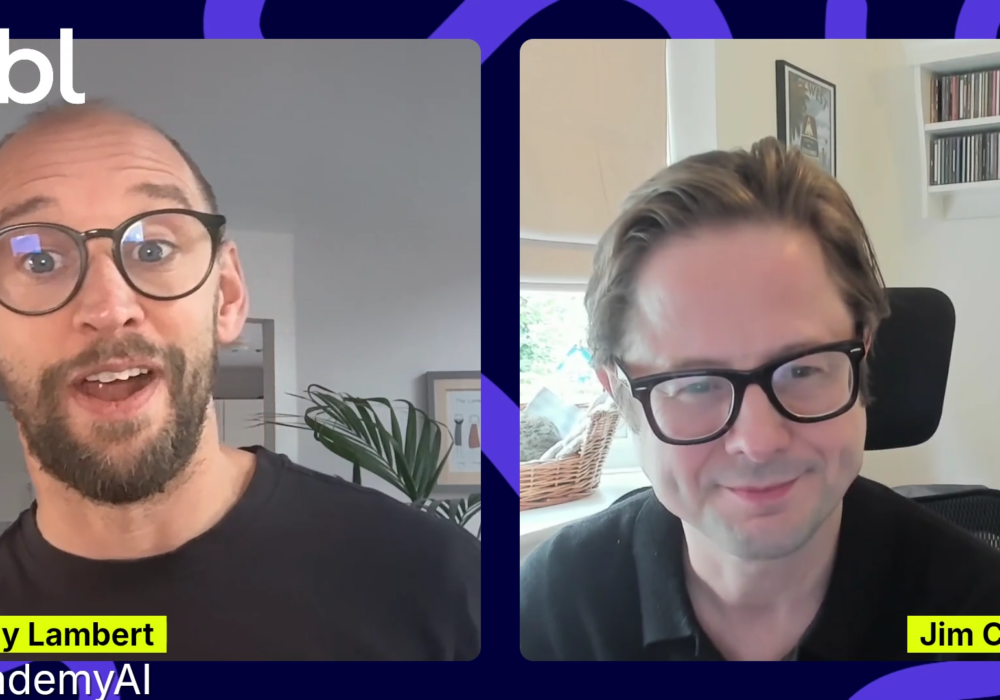
Watch the interview here
Ed de Minckwitz, director of Public Policy UK at ServiceNow explains why the gap between tool use and genuine organisational change is wider than most leaders admit…
Ed de Minckwitz, Director of Public Policy at ServiceNow UK, doesn’t start with the technology. He starts with the people using it. ‘We are creatures of habit and we’re also, I think, enterprising creatures. We want to work, we want to endeavour. We want to feel the satisfaction of having done a thing, created a thing, or offered a service.’
That instinct gets compounded in mid-market firms. The day job is so consuming, Ed says, that teams don’t have the bandwidth, the resource, the senior cover, or the space to stop and redesign how they work.
When change does come from the top, it arrives framed as efficiency which can threaten what people find meaningful without showing them what might improve. The tech industry tries to underscore that AI will do the grunt work and leave the interesting bits, but everyone is busy and deep down, uncomfortable with change.
Most people, as Ed puts it, are flying the plane, not thinking about how to re-engineer and build the next generation of aircraft.
It takes a storm to change course
Nobody stops flying their usual route until something forces the issue, and these days that’s often an AI-native competitor. ‘We are beginning to see firms emerge that are disrupting sectors and forcing that top-down pressure.’ The businesses that won’t be caught out are the ones watching what competitors do. As Ed puts it: ‘someone can come up on your blind side very, very quickly to disrupt your sector and your industry.’ Coding is already showing what that looks like, with output jumping a hundred, even a thousand times in some cases.
And while gains can be real, they’re unevenly distributed in mid-market firms and often hit walls in practice. Infrastructure that isn’t ready, processes that haven’t evolved, tools installed without a redesign of the work around it. We’re still in the foothills, Ed says, the 1870s or 80s if you want to overlay the industrial revolution.
Which is what makes the timing decision hard. Models are improving constantly and use cases are shifting. Every decision to adopt reshapes workflows and creates dependencies, and then the technology moves again.
When do you commit to a solution even knowing that something better might come along by Friday? The good news is that, tokens aside, the relative costs of AI infrastructure keep dropping. The bad news is that innovation is happening at an unprecedented pace.
Teams won’t wait for the answer
AI-native workers have worked out what the tools can do for them. The time saved, the output gained. They’ve pocketed it and moved on. ‘A lot of us that are AI native now have worked out quite how much time and effort AI can save us. But how many of us have honestly turned around to our seniors and said, do you know what? I’m at least 40% more productive because of these tools I’m using. Could you give me 40% more work?’
Organisations haven’t restructured around what their people are already doing, haven’t set new expectations, haven’t asked what to do with the capacity. But the pressure arriving from outside is beginning to land inside, Ed argues. Could the same function deliver 150% more with the same headcount? ‘That’s coming, I think, this year.’
Meeting that challenge will be particularly acute in mid-market firms, where knowledge lives in spreadsheets, inboxes, individual heads. But acting on it requires someone senior to carve out the time for people to understand what the tools can actually do. At ServiceNow, that’s actively encouraged. ‘I’ve got agents and code running loose, just to see what they’re capable of. You can’t work out the end state until you can actually see it.’
The playbook has to be yours
In Ed’s view, the tools are not the starting point: ‘Where do you want to get to? What do you hope this tech can achieve for you?’ Once that’s clear, the next step is an honest audit of where time actually goes, what the value-driving hours are, and what’s just consuming cost. Soft targets to start, but targets all the same.
‘You know your business, your sector better than anyone else.’ That’s the actual advantage. The tools don’t know your customers, your workflows, your competitive pressures. The people who do are better placed than any lab to work out what these tools can actually do in context. That’s where useful innovation happens: not in building models, but in bending them to problems only you can see.
The skill, says Ed, is changing the way you work as much as learning how to use the tools. The anxiety isn’t about clicking the wrong button. It’s about being asked to work differently.
That capacity to adapt matters more than any single platform decision. New models, new use cases, and new disruptions will keep arriving. The organisations that do well won’t be the ones that picked the right tools in 2025. ‘The AI isn’t a thing that’s happening to us. It’s a thing we’re all shaping.’
Watch the interview here
Ed de Minckwitz, director of Public Policy UK at ServiceNow explains why the gap between tool use and genuine organisational change is wider than most leaders admit…