Many leaders are frustrated with AI. They see the potential but struggle to move beyond small, isolated experiments. The result is often pilot fatigue and a sense of being stuck.
This is a common problem for mid-market companies. The hype around AI creates pressure to act. Yet, a clear path to value is missing. This guide provides a practical, 90-day framework to build an effective AI adoption roadmap.
The Problem: Why Most AI Roadmaps Fail
Most AI roadmaps fail for predictable reasons. They often start with technology instead of business needs. This leads to solutions looking for problems.
Another major issue is the ‘frozen middle’. This refers to resistance from mid-level managers. They may feel threatened by change or lack the skills to adapt.
Starting with tools is a frequent mistake. Leaders buy a new AI tool without a clear use case. The focus should be on improving specific workflows first. This ensures AI adoption is tied to measurable business outcomes.
The 90-Day AI Adoption Roadmap: A Step-by-Step Framework
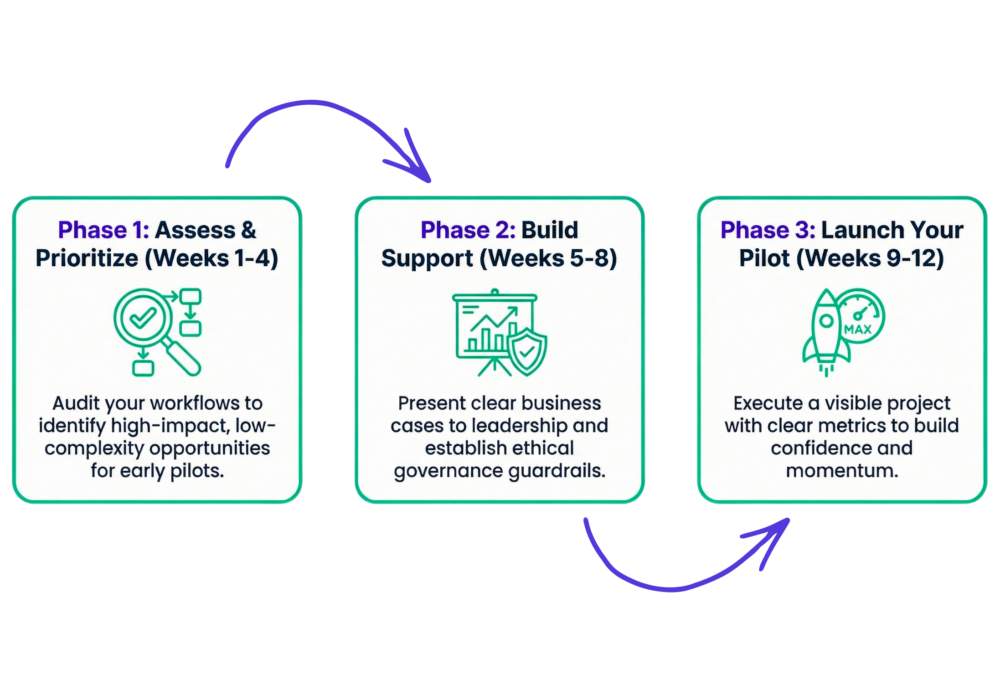
A 90-day roadmap provides a structured and agile approach. It creates momentum and delivers early wins. This framework is broken into three distinct phases.
Phase 1 — Assess and Prioritise (Weeks 1-4)
The first phase is about discovery. You need to understand your starting point. Audit your current workflows to find opportunities.
Look for high-impact, low-complexity areas. These are the best candidates for early AI pilots. A workflow-first approach is critical for success.
Build a simple business case for each high-priority opportunity. This does not need to be a complex financial model. Instead, focus on clear, practical metrics. Estimate the potential time savings, cost reductions, or revenue gains. This initial quantification is crucial for securing buy-in later. It transforms a good idea into a credible investment proposal.
Phase 2 — Build the Case and Secure Buy-In (Weeks 5-8)
With a prioritised list and clear business cases, you can now build support. Present your findings to the leadership team. Focus on the practical, real-world value of your proposed projects. Avoid technical jargon. Frame the discussion around business outcomes and strategic alignment. Your goal is to secure a mandate to proceed with a pilot.
Address the ‘frozen middle’ directly. Involve middle managers in the process. Help them understand how AI can support their teams.
Establish clear governance guardrails. This ensures AI is used responsibly and ethically. It also helps manage risk and compliance from the start.
Phase 3 — Launch Your First High-Impact Pilot (Weeks 9-12)
Now it is time to execute. Select the first pilot project from your prioritised list. The ideal pilot is visible, meaningful, and has a high chance of success. It should address a real pain point for a specific team. A quick, measurable win is the goal. This builds crucial momentum and confidence across the organisation.
Define clear success metrics before you begin. How will you measure the impact of the pilot? This is essential for proving value.
Build feedback loops with users. This helps you iterate and improve the solution. It also ensures the final product meets their needs.
Finally, plan for how you will scale successful pilots. A good pilot should have a clear path to wider implementation. This turns small wins into long-term value.
The Five Biggest Mistakes in AI Roadmap Planning
Many organisations make similar errors when planning for AI. Avoiding these common pitfalls is crucial. It helps ensure your roadmap leads to real-world results.
Boiling the ocean. The ambition to tackle everything at once is a common mistake. It leads to a lack of focus and diluted resources. A successful AI roadmap is not a long list of every possible application. Instead, it concentrates on a small number of high-impact, achievable projects. This approach builds momentum, delivers early wins, and creates a foundation for future success.
Ignoring the people element. Successful AI adoption is as much about people as it is about technology. It is fundamentally a change management challenge. Employees may be resistant or fearful of new technology. You must invest in clear communication, training, and support. This helps to build trust and ensures your teams have the skills to work effectively with new AI tools.
Starting with the tool. Many organisations fall into the trap of buying a new AI platform without a clear problem to solve. This technology-first approach rarely delivers value. The most effective strategy is to start with the business workflow. Identify the specific process you want to improve. Then, and only then, should you look for the right tool for that specific job.
No clear success metrics. If you cannot measure it, you cannot manage it. Without clear, predefined success metrics, it is impossible to know if your AI initiatives are working. Before you start any project, define what you want to achieve. Establish the key performance indicators (KPIs) you will use to track progress. This is essential for demonstrating return on investment and justifying future funding.
No governance framework. AI is not a neutral technology. It introduces new operational, reputational, and ethical risks. A clear governance framework is not optional; it is essential. This framework should outline your principles for responsible AI. It must also define roles, responsibilities, and processes for managing risk. This ensures AI is used safely and in alignment with your company’s values.
What a Good AI Roadmap Looks Like
A good AI roadmap is a living document. It provides a clear, practical path for your organisation. It balances ambition with achievable steps.
Here is a summary of the 90-day framework:
Phase
Timeline
Key Activities
Deliverables
Phase 1
Weeks 1-4
Assess current workflows. Identify high-impact opportunities. Build the business case.
A prioritised list of potential AI projects. A clear business case for each.
Phase 2
Weeks 5-8
Quantify the opportunity. Present to leadership. Establish governance.
Secured buy-in from leadership. A clear governance framework.
Phase 3
Weeks 9-12
Select and launch the first pilot. Define success metrics. Build feedback loops.
A successful pilot project. A plan for scaling the solution.
Frequently Asked Questions
What should be in an AI roadmap?
An AI roadmap should contain several key elements. It needs a clear vision of what you want to achieve with AI. It must also include a prioritised list of specific use cases. Each use case should have a business case. The roadmap must also define the resources required. This includes people, technology, and data. Finally, it needs a timeline with clear milestones and success metrics.
How long does it take to implement AI?
This depends on the project’s complexity. A simple pilot might take a few weeks. A full-scale enterprise implementation could take many months. The 90-day roadmap framework helps deliver value quickly. It focuses on launching an initial high-impact pilot within three months. This approach builds momentum and demonstrates progress.
Who should own the AI roadmap?
Ownership of the AI roadmap should be a collaborative effort. A senior leader, such as a Chief Technology Officer or Chief Operating Officer, should be the executive sponsor. However, a cross-functional team should manage the roadmap itself. This team should include representatives from business units, IT, and data teams. This ensures the roadmap is aligned with business priorities.
What is the first step in AI adoption?
The first step is to assess your organisation’s readiness. This involves understanding your current workflows, data maturity, and skills. Do not start by buying technology. Instead, identify a specific business problem you want to solve. Our AI Readiness Checklist can help you with this process.
How do I get buy-in for AI from my board?
To get buy-in, you must speak the language of business outcomes. Present a clear and compelling business case. Focus on the expected return on investment. Show how AI will reduce costs, increase revenue, or improve efficiency. Start with a small, high-impact pilot to demonstrate value quickly. This builds credibility and makes it easier to secure further investment.
Next Steps and Further Reading
Building an AI roadmap is a critical step. It provides the clarity and focus needed to succeed. Use this framework to guide your planning.
Explore our other resources to support your journey: