Beyond Chatbots: Why Leaders Need to Understand Agentic AI
Many business leaders are now familiar with generative AI. They have seen how tools can create text, images, and code. This technology is becoming a common part of business operations.
However, a new shift is happening. Agentic AI is the next step. It moves beyond content creation to autonomous action. Leaders need to understand this to stay competitive.
This guide provides a practical framework for mid-market leaders. We will explain what agentic AI is. We will also show how it can be used in your business.
What is Agentic AI in Plain English?
Agentic AI refers to systems that can take action on their own. They are not just for creating content. They can plan, reason, and execute tasks with multiple steps.
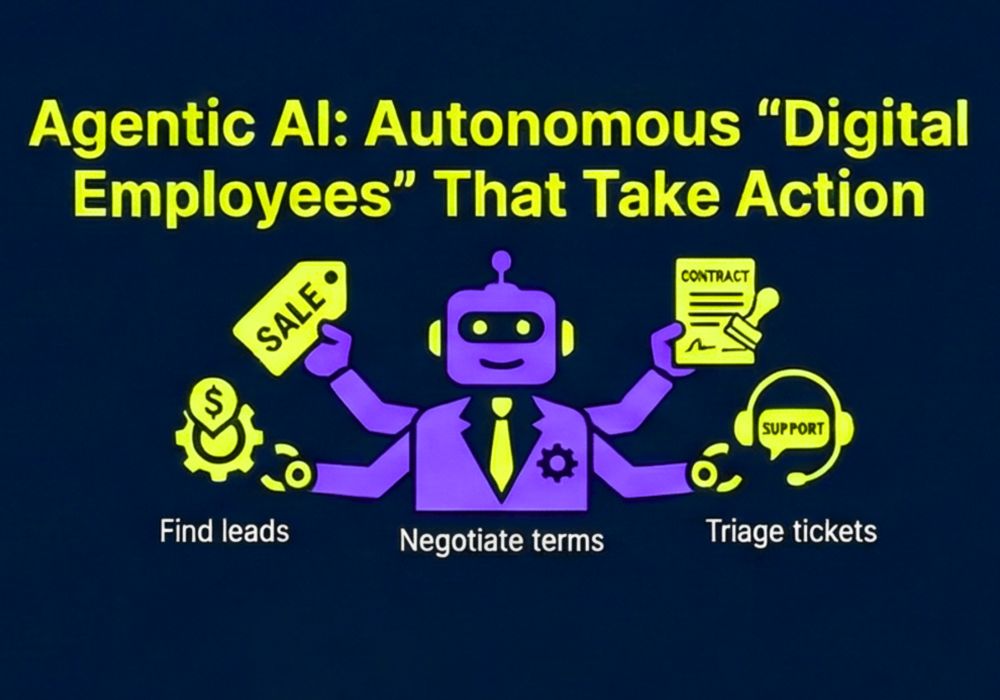
Think of an AI agent as a digital employee. You give it a goal. It then works out the steps to achieve it. It can use different tools and systems to get the job done.
This is different from a simple chatbot. An agentic system can manage complex workflows. It can make decisions and adapt to new information. This allows for a higher level of automation.
Generative AI vs. Agentic AI: What is the Difference?
Understanding the distinction between generative and agentic AI is key. Generative AI is a powerful tool for creation. Agentic AI is a powerful framework for action.
Here is a comparison to clarify the differences:
Feature
Generative AI
Agentic AI
Purpose
Creates new content (text, images, code) based on prompts.
Autonomously plans and executes tasks to achieve a goal.
Autonomy
Low. Requires human prompts for each output.
High. Can operate independently with minimal human oversight.
Output
A piece of content (e.g., an email, a design).
A completed task or a series of actions (e.g., a booked trip).
Human Oversight
High. Humans guide, review, and use the output.
Low. Humans set the goal and define the guardrails.
Examples
ChatGPT, Midjourney, aibl content assistant.
Autonomous sales agents, procurement bots, customer service triage.
Three Practical Use Cases for Agentic AI in Mid-Market Businesses
Agentic AI is not just a concept for large enterprises. It offers practical benefits for mid-market companies. Here are three real-world examples.
1. Automating Sales Prospecting and Outreach
A sales team can use an AI agent to find new leads. The agent can search for companies that fit a specific profile. It can then identify the right contacts within those companies.
The agent can also draft and send personalised outreach emails. It can follow up with prospects who show interest. This frees up the sales team to focus on building relationships.
2. Streamlining Procurement and Vendor Management
Procurement can be a time-consuming process. An agentic AI system can automate many of the steps. It can identify potential vendors based on your requirements.
The agent can request quotes and compare proposals. It can even negotiate terms based on predefined rules. This leads to more efficient and cost-effective procurement.
3. Intelligent Customer Support Triage
Customer support teams often deal with a high volume of requests. An AI agent can help manage this workload. It can analyse incoming support tickets and understand their urgency.
The agent can then route the tickets to the right team members. It can also handle common requests on its own. This improves response times and customer satisfaction.
The Risks of Agentic AI and How to Manage Them
Like any powerful technology, agentic AI comes with risks. It is important to be aware of these and to have a plan to manage them. Strong governance is essential.
Human oversight is a critical component. You need to have clear rules and guardrails in place. This ensures that the AI agents operate within acceptable boundaries.
Data security is another key consideration. AI agents may have access to sensitive information. You must ensure that this data is protected. Regular audits and monitoring are necessary.
What This Means for Your Business
Agentic AI presents a significant opportunity for mid-market businesses. It can help you automate complex processes. It can also improve efficiency and drive growth.
To get started, you need a clear plan. Our AI Adoption Roadmap can help you identify the best opportunities. Our AI Governance Framework provides a structure for managing the risks.
We recommend starting with a small, well-defined project. This allows you to learn and adapt. It also helps you build confidence in the technology.
Frequently Asked Questions
Is Agentic AI the same as AGI?
No, agentic AI is not the same as Artificial General Intelligence (AGI). AGI refers to a hypothetical future AI with human-like intelligence across many domains. Agentic AI is a specific type of AI available today that can autonomously execute tasks to achieve a defined goal. It operates within a specialised scope.
What is an example of an AI agent?
An example of an AI agent is a system that can book a holiday for you. You would provide the destination, dates, and budget. The agent would then find flights, book a hotel, and arrange transport. It would perform all these actions without needing you to approve each step.
Do I need Agentic AI for my business?
Whether you need agentic AI depends on your business goals. If you have complex, multi-step processes that are currently manual, agentic AI could provide significant value. It is best to start by identifying a specific business problem you want to solve and then evaluating if an agentic approach is the right fit.
How is Agentic AI different from robotic process automation?
Robotic Process Automation (RPA) is designed to automate repetitive, rule-based tasks. It follows a strict set of instructions. Agentic AI is more advanced. It can handle more dynamic and complex situations. It can make decisions and adapt its approach based on new information, which is beyond the capability of traditional RPA.
Ready to build your AI capability?
Explore our practical playbooks and operator-led events. Sign up for the aibl newsletter to get our latest insights delivered to your inbox.