

Off the record: what AI is doing to business models
aiblLIVE is under two weeks away. I needed to write something for this week that would be useful, but not take up...
Read moreAI has become the single most important research source in B2B buying. In Forrester’s 2026 survey of nearly 18,000 buyers, twice as many named generative AI or conversational search as their most meaningful research source than named any other, AI use across the buying process reached 94%, and buyers now fill four of five shortlist places on day one. The catch: this happens in a black box you cannot measure, and one buyer in five came away less confident after the AI gave them inaccurate information.
Earlier this year, Forrester surveyed nearly 18,000 business buyers for its State of Business Buying, 2026. Twice as many named generative AI or conversational search as their most meaningful research source than named any other single source.
That puts AI ahead of vendor websites, product experts and sales reps. Now you might say “well, that’s just a reflection of the role of search” but over 50% also say that they start more research in chatbots than Google, et al.
AI use across the buying process is now at 94%, up from 89 a year earlier. G2‘s Chief Innovation Officer put the history in one line: the Yellow Pages compressed the market into one big book, Google compressed it into the first page of results, and AI now compresses it into a single answer.
All that reading that buyers used to do still happens, but now it’s by a large language model in a few seconds before it hands over a short list.
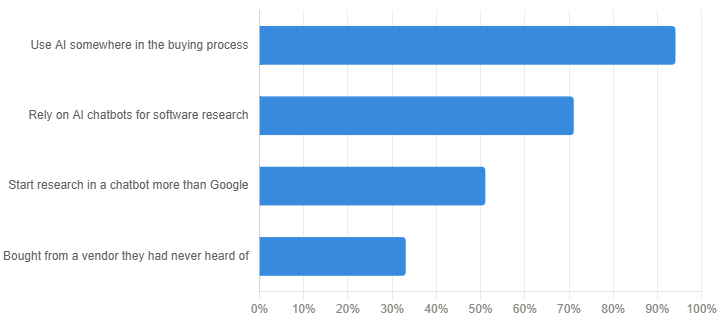
Sources: Forrester, The State of Business Buying 2026 (~18,000 buyers); G2, The Answer Economy 2026 (1,076 software buyers).
6sense found that buyers fill four of their five shortlist spots on day one of the journey, and buy from one of those four 95% of the time, up from 85% the year before. So the decision that matters gets made before any vendor knows a deal exists. G2’s buyers bear this out from the other side: a third of them bought from a vendor they had never heard of before the chatbot named it. The list arrives pre-built, and the names on it were chosen by an agent in conversation with content.
But what the model says in that conversation is often wrong. G2 found that 64% of software buyers hit hallucinations “often” or “very often” while researching, and Forrester’s own data shows one buyer in five came away less confident because the AI gave them unreliable or inaccurate information. Real facts get mixed with invented ones, quotes get pinned to the wrong source, and the missing context changes what a sentence means. Someone reading a confident, fluent and wrong paragraph has no reason to doubt it.
The hardest part is that none of this shows up on your dashboards. With traditional SERPs, you could at least work out how you ranked and (roughly) why you ranked there. Today it’s a black box and there is no single source of truth about how you ‘rank’ with LLMs, or whether you’re being accurately positioned.
Next week we’ll look at the state of research into how LLMs think about brands (GEO) and whether it makes any real difference to your SEO or content strategy.

aiblLIVE is under two weeks away. I needed to write something for this week that would be useful, but not take up...
Read more
Andy Lambert co-founded ContentCal, sold it to Adobe, and spent four years there as it became part of Adobe Express. He saw teams split between...
Watch video
Andy Lambert is a co-founder of AcademyAI, which measures and builds workforce AI capability, with a focus on...
Read moreGet ahead with the most actionable insights, playbooks and real-world AI use cases you can adopt right now, in your inbox every week