
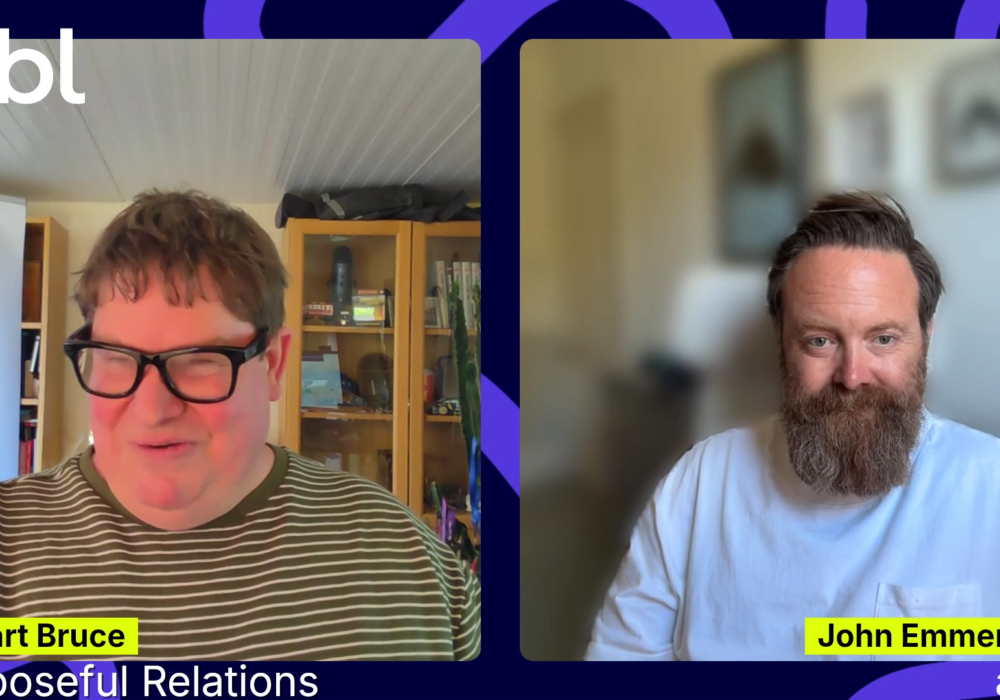
Watch the interview here
Aaron Asadi, CEO of Enterprise Nation, draws on his background to discuss the unique challenges facing the UK’s 5.8 million small businesses…
Aaron Asadi is CEO of Enterprise Nation. His father ran a small business in the 90s. Could fix anything. “He’s like BA Baracas from the A-Team – give him a box of matchsticks, he’d turn it into a washing machine.” But running a business takes more than being good at the work. He wasn’t an accountant, English wasn’t his first language, and he had no marketing experience. The business didn’t survive.
It’s a common story. Enterprise Nation has 150,000 members, mostly businesses with ten or fewer employees. The pattern repeats across them. Someone brilliant at one thing, exposed everywhere else, unable to hire the team to cover the rest.
AI could fill those gaps. Not perfectly. As Aaron puts it: “Maybe it’s 70% the best copywriter you’ve ever seen, but 70% is infinitely more than 0%.” It handles the work they never got into business to do. “You want artists to be artists. You want mechanics to be mechanics. You don’t want them doing stuff they didn’t get in business to do.”
There are 5.7 million small businesses in the UK, driving 52% of business turnover. Aaron does the maths: “If we can just affect every small business in terms of margin or profitability by 10%, you’ve grown the business turnover of this country by 5%.”
Why ChatGPT isn’t an AI strategy
Enterprise Nation’s members show the gap. 79% are using AI in some form. 84% say they’re ready to engage with it. But nearly half lack the expertise to do anything meaningful with it.
“I think some of that gap is healthy right now.” Founders have been experimenting rather than implementing. In a market where nobody’s sure which technology to back, that caution made sense. But caution becomes a problem when it hardens into staying at the surface.
“I think the most common one is thinking that AI is LLM.” What AI can do goes well beyond a chat interface, but most owners haven’t seen that yet.
“I’m not massively happy with how these things have been marketed.” Small business owners got the impression that AI tools were “magic wands.” Pay £20 a month, tell it what you want, and it delivers. That produced two outcomes. Some owners stayed at the surface because the surface was all they were sold. Others expected more, didn’t get it, and left. “They’ve been sold magic beans and then there’s no beanstalk and they’re like, well I shouldn’t have bought these magic beans.”
aibl sees this across mid-market organisations too. False confidence is the bigger risk: teams using AI enough to feel adopted without changing how the business operates.
Why most small businesses stay at the surface
Most small businesses are stuck at the surface layer. “We’re gonna run the business as we normally run it, using the same spreadsheets and the same systems, and we’re going to consult with an LLM.” Same workflows, same processes, chatbot on top. “80% of people that are experimenting are really doing that superficial layer and not quite even understanding how deep they could go.”
Most owners aren’t tracking which model is ahead this week or which platform just raised another round. They’re running a business. “It’s in flux and it’s hard to trust in that type of environment.” When you’re running a plumbing business, it just feels like risk. “Have I backed my plumbing business on a company that might not be there in two years?”
Small business owners are already stretched. Even when they’re willing to learn, the hours aren’t there. “I don’t have the time for this. Like, I don’t want to learn a prompt.” When AI doesn’t deliver on the first attempt and nobody’s shown them what else is possible, they move on. “Well, I haven’t got time then.”
That’s where education matters. Enterprise Nation has been running AI programmes with Google and OpenAI and onboarding members to NatWest’s accelerator. Aaron describes these as organisations “putting their best foot forward” and committed to the space. When owners learn from partners they already trust, they start to move.
“We are starting to see that shift from experimentation to implementation. We’re seeing it creep into people’s workflows.” Whether it goes deeper remains to be seen. The technology was never the problem. Nobody showed them the full picture.
What implementation looks like
The next step is simpler than it sounds: look at what you’ve actually got.
Every small business runs on a different combination of systems built up over years. Xero for accounts, a shared spreadsheet on Dropbox, a handful of Microsoft products, something offline that’s just how it’s always worked. When owners try a generic chatbot against that kind of setup, the result is predictable. The feedback comes back: “GPT was no good at all.” But that’s a narrow judgement on the technology. It’s what happens when a chat interface meets a combination of platforms and processes it was never designed for.
“If we’re starting today, how do we do it differently? Okay, that’s the end point then. How are we going to transition to that? And understand it is a project.”
Aaron compares it to something every business has been through. “We’ve all been at businesses where there’s big news, we’re moving from this CRM to Salesforce, and it’s a big project and everyone’s involved and there’s steering meetings and trade-offs and arguments and tension and training, and it takes ages. And it’s no different with AI.” That process is uncomfortable, slow, and contested. It should be.
“AI solutions when they’re effective have to be bespoke, have to be localized. And you’ve got to consider your entire existing operating system to get the benefit out of it.” The solution might be a single tool or several. “It might be different tools, it might be an agent that you make up in your own engineering team.”
The ones that move looked at how their business actually runs and built from there.
Watch the interview here
Aaron Asadi, CEO of Enterprise Nation, draws on his background to discuss the unique challenges facing the UK’s 5.8 million small businesses…