
Why 96% AI adoption at Make didn’t start with tools or training
Watch the interview here When Sara Maldon joined Make two years ago, there was no approved AI tool. Nobody...
Read more
PLUS: AI in the Friend Zone and More Real Talk From the Market
Part of the fun in starting AiBL is that we’re constantly in conversations with the people we serve – the leaders creating and applying AI in the UK’s mid-market. They’re founders, strategists and commercial leaders, from Make and Datastream to UKAI and Kaplan.
Some common threads are emerging across those chats.
If there’s a thread through it all, it’s that the mid-market isn’t waiting for perfect. The leaders I’ve spoken to are learning in public, solving one workflow at a time and caring less about appearances and more about what works by next month.
This week’s playbook is how to solve the garbage in, garbage out problem in AI. It’s a quick process fix, but the data shows that most of us are skipping a step and missing an opportunity.
Back in February of 2023, the computer scientist (and brilliant sci-fi writer) Ted Chiang called LLMs ‘a blurry JPEG of the Web.’ Conversational AI has improved in many ways since then, but his central thesis is still true; an average prompt spits back the ‘average’ of the internet.
The solution to better output isn’t a more powerful LLM, it’s better input, which comes down to context and retrieval-augmented generation or RAG.
You’re already familiar with the basics of context, but if you’d like a refresher click More below.
Business users are reasonably good at providing context. Using a dataset of 33,000 conversations, we found that 65% of their queries use at least one of the common approaches to adding context.
RAG? Not so much.
tl;dr RAG is the LLM accesses information before it generates an answer. This is in the form of a database, vector store, raw data (problems) or document set. Upload a white paper about your topic before building a piece of content and you’ve just used RAG to modify the results.
Why bother? Adding a “retrieval layer” typically improves relevance, factual accuracy and trustworthiness by 50% or more — and cuts hallucinations roughly in half. Of course, the exact benefit depends on how relevant and well-indexed the supporting data is.
Yet, only about 6% of business queries take advantage, which is bad for the general quality of work, but good for those of us that take the few minutes to radically upgrade the LLM’s output.
For a fuller RAG process, click More below, but here’s the down and dirty:
This is great for day to day tasks and you will absolutely see an improvement, but if you’re working on something particularly strategic or important, read on for a more rigorous approach to RAG (and bit about context)…More
NEWS
But before that…here are some key findings from this week:
• 35% of UK SMEs now actively use AI – up from 25% last year.
• Firms with no plans to use AI dropped from 43% to 33% in a year.
• 43% of global SMEs still have no AI adoption plans at all.
• Nearly 40% of Europe’s SMEs lack the digital infrastructure to scale AI.
• Just 13% of mid-market firms in Australia have made AI a strategic priority – most are still dabbling.
Awareness is everywhere. Execution is rare. The gap between “trying AI” and “using it properly” is now the biggest competitive divide in the SME market.


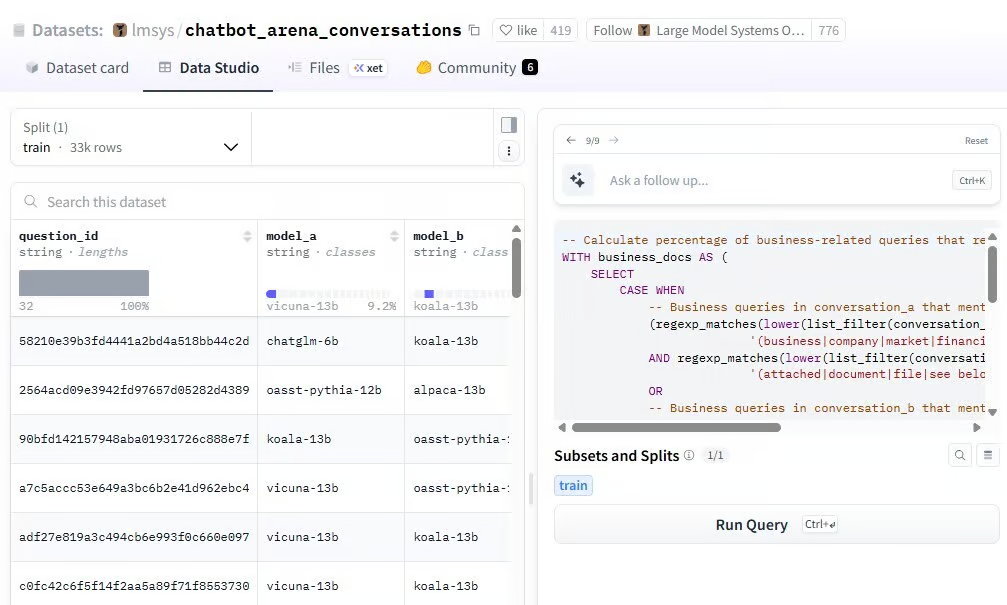
This isn’t your standard ‘tool’ – it’s the database of 33,000 LLM queries we used for the analysis used in this week’s playbook. It lives on Huggingface and we strongly recommend playing around. You can use a conversational AI interface to find out how others are using LLMs in your sector or role. It’s educational and fun, but you only get a few queries running out of free tokens, so make them count!
“69% of my audience would trust ChatGPT more than their mother-in-law to pick out a birthday gift for them (n=105)”
Kiri Masters ChatGPT vs. MIL Series
We’re looking for an advisory board, a select group of business, policy and tech leaders looking to help shape how mid-market firms adopt AI responsibly and profitably.
The board meets three times a year to keep our insights grounded in real business priorities and market needs.
You’ll join leaders from the following companies: Mindstone, UKAI, Business AI Alliance, Make, British Chambers of Commerce, Google, Microsoft and many more.
If you’re leading AI adoption inside a growth or mid-market firm and want to help steer the conversation, reach out to terry@aiblmedia.com

Watch the interview here When Sara Maldon joined Make two years ago, there was no approved AI tool. Nobody...
Read more
Voice notes from calls, meeting transcripts, half-formed ideas recorded on the move. They contain commercial...
Read more
For this week's AI in practice, we spoke to the founder of a regional managed IT services provider that had grown...
Read moreGet ahead with the most actionable insights, playbooks and real-world AI use cases you can adopt right now, in your inbox every week