
Why 96% AI adoption at Make didn’t start with tools or training
Watch the interview here When Sara Maldon joined Make two years ago, there was no approved AI tool. Nobody...
Read morePLUS: It’s high time you built an agent, the skills shortage and a somewhat self-serving caution from Google to the UK’s smaller businesses
Advisory Board Insights: What’s Really Driving (and Blocking) SME AI Adoption
Our inaugural AiBL Advisory Board brought together leaders from across industries to unpack the realities of AI adoption for small and mid-sized businesses.
What emerged was a shared picture of opportunity and frustration in equal measure, but let’s start with a few sharp observations.
“You don’t know what you don’t know.” One board member captured the adoption barrier perfectly: “Every single thing comes down to that. Once executives actually know what’s possible, everything else gets unlocked.” It reframed AI not as a tech issue but as an awareness issue – a line that drew nods across the room.
[Editor’s note: If you’re nodding too, check out this week’s playbook/homework…it’s time for you to get your hands dirty.]
False mastery trap. Another member described most companies as being “at the slightly-enhanced search engine stage” where people think they’re using AI, but really they’ve just swapped Google for ChatGPT. That line landed as both funny and uncomfortably true.
The cultural contrast. A comparison was made between UK and US boardrooms: in the US, leaders “run 10 pilots and scrap 9,” whereas in the UK, “we debate the cost of the first one for six months.” That struck a chord about Britain’s cautious corporate culture. And as a side note, this approach virtually guarantees that ‘shadow AI’ is alive and well.
Several members noted that AI is becoming a political football internally: IT wants control, marketing wants speed, HR worries about jobs and finance wants proof of ROI so AI projects often stall in ownership limbo.
Another pointed out that “AI strategy is the new digital transformation deck”, as in everyone wants to present one, but few can define what it means.
When we distill the transcript, five themes stood out.
First, there’s a knowledge and capability gap: many business leaders simply don’t yet know what’s possible, or how to link AI tools to real commercial outcomes. Awareness is rising, but genuine understanding remains shallow.
Second, culture and leadership: a uniquely British mix of caution, fear of failure and “wait and see” decision-making is slowing experimentation. This is especially frustrating to those that have watched the costs of such experiments drop by a factor of 10 in the last two years. Today’s barriers are more often time and will rather than budget.
Third, too many tools and too little trust: the market is saturated with options, making it hard for non-technical teams to know what to adopt – or who to believe. Every old school tech consultancy has thrown “AI” into their services or a quick rebrand. The theoretically rapid ability to spin up an AI solution has meant some providers start with marketing materials and wait for the hook to set before building anything tangible.
Fourth, there’s a scaling challenge: even when pilots succeed, poor data quality and unclear ownership stop progress cold.
Finally, community and formats: leaders want practical, peer-to-peer learning – not another theory-heavy conference or consultant-led playbook. Yes, this one is entirely self-serving, but that’s what advisory boards are for!
The board’s view was remarkably consistent: SMEs need a trusted, independent guide that cuts through noise, simplifies decisions and showcases what good looks like. AiBL’s role is to make AI adoption feel less abstract and more achievable, to create confidence through credible frameworks, lived examples and community-driven learning.
A huge thank you to the Advisory Board for their energy, candour and ideas – helping AiBL focus on what really matters: making AI practical, human, and within reach for every ambitious business.
If you want to join us next time, drop a line to terry@aiblmedia.com

This week we have homework: build an agent. It will be easy to say no…you’re busy, but think back to when you took the time to build a pivot table or set up email rules. You didn’t just save time, you advanced your understanding and expanded the window on what was possible the next time.
Take the time to become savvy with the real capabilities and limitations of these tools so you’ll better know how to invest, what to automate and where AI can be integrated into real workflows.
If you studied languages in school, you either choked on irregular verbs for a few years or jumped straight into conversation with a barbarous accent and shocking disregard for the formal tenses. We heartily endorse the latter method when it comes to learning how agents really work.
Most teams try to learn AI agents the way they’d learn a new app or tool, but agents aren’t a product; they’re a pattern. The fastest route to progress is to understand how reasoning, memory and action work together to deliver a real outcome your business cares about.
Start from a result, not a feature. Choose one repeatable outcome such as drafting a report or routing enquiries. Work backwards to map what reasoning, context and action it needs.
Build a simple working loop. Use a visual workflow builder like n8n or a LangChain template to connect three things: reasoning (the model), memory (context or history) and action (the tool). Keep it small and functional.
Measure what changes. Run it on one real task. Note what improves in time saved, quality, or accuracy. The insight you gain from that loop will teach you more than any tutorial.
What good looks like. You finish the week understanding how agentic systems think and where that logic can create value inside your business. Learning becomes something you prove in practice, not something you watch happen.
The steps above aren’t enough to do the work itself – that’s up to you and your LLM of choice. But if you want to walk through the process, I used to build an email analyser agent.
NEWS
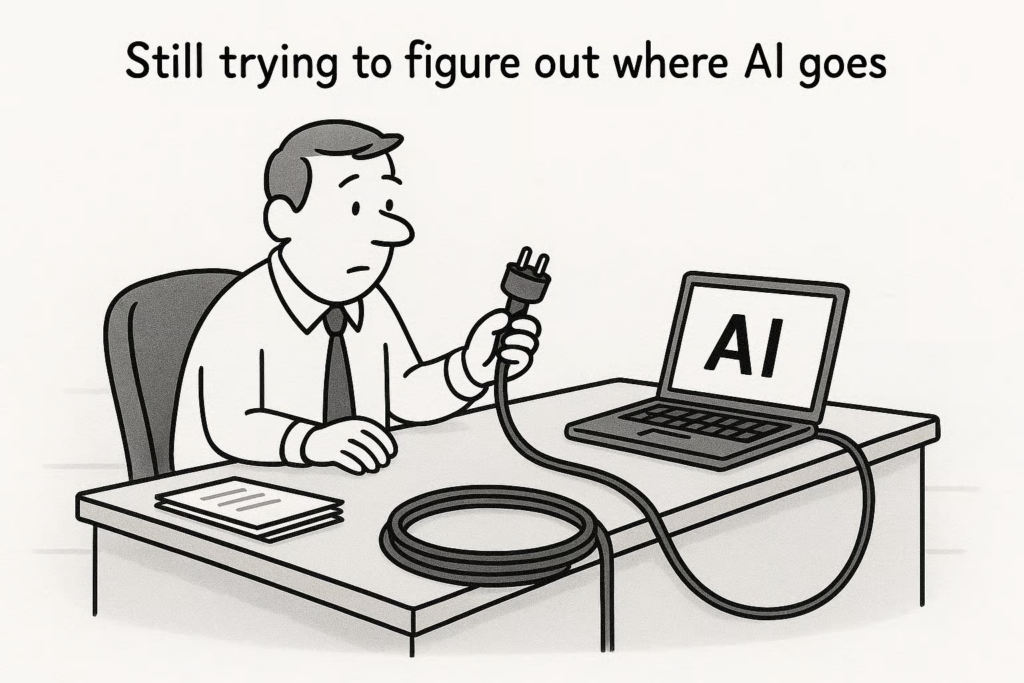
1.UK small businesses falling behind on AI, Google warns: Most UK SMEs say they know AI, but few are putting it to work. While 86% are familiar with the technology, only a third use it and just one in five apply it to decision-making. Google estimates AI could lift SME productivity by up to 20%, the equivalent of gaining an extra working day each week. The real story isn’t about awareness, it’s about capability. Growth will come from firms that build confidence with AI in everyday processes, not from those waiting for a perfect strategy.
2.9 in 10 UK mid-market firms face an IT skills shortage: Nine in ten UK mid-market firms say they can’t find the tech talent they need and more than half report a direct hit to operations. IT support, data and DevOps roles are hardest to fill, pushing many to rely on contractors, up-skill staff, or automate work. The shortage is slowing digital progress, but it’s also forcing a shift in mindset. The next wave of mid-market growth will depend less on finding rare skills and more on building flexible teams that can learn, adapt and use AI confidently in their day-to-day work.
3.UK firms pour an average £15.9 million into AI, but only 7% have a plan: UK firms are spending big on AI, around £16 million each this year on average, but few have a strategy to match. Only 7% report an enterprise-wide plan, with most efforts described as piecemeal or department-led. Early returns are promising, averaging 17% and expected to nearly double by 2027. The lesson for mid-market leaders is simple: investment alone doesn’t create impact. Without a clear plan that connects spend to value, AI risks becoming another fragmented project.

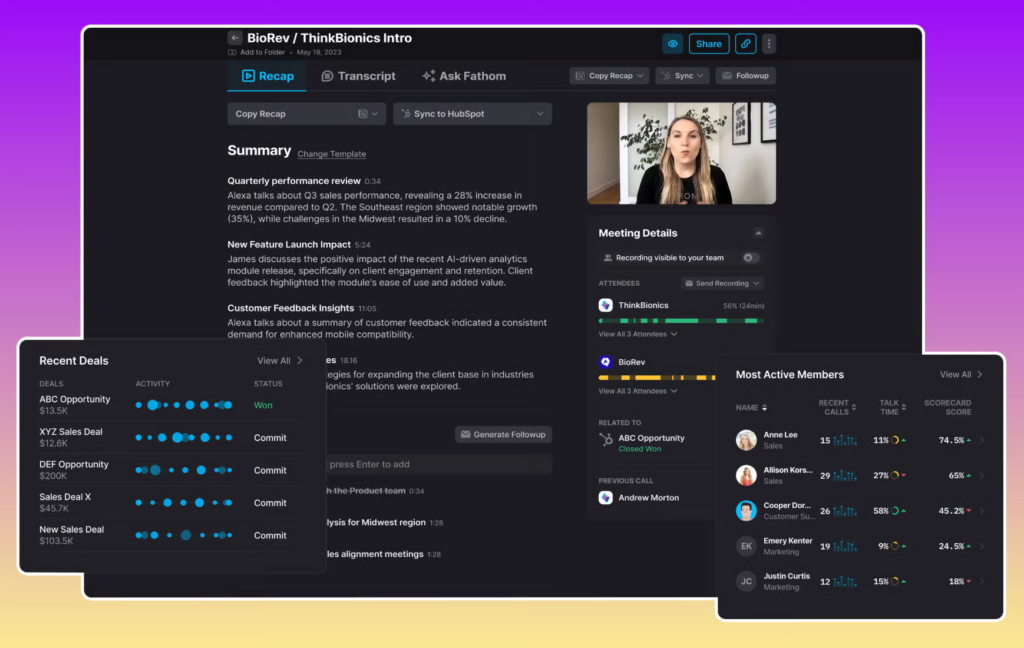
Most teams finish a call with ten ideas and only half of them written down. We tried Fathom.ai, a meeting assistant that records, transcribes and summarises calls across Zoom, Teams, and Meet, to see if it could help.
It joined our sessions smoothly and sent a clear summary within minutes – good enough to share with clients and colleagues straight away.
What’s impressive is how easy it is to use. No set-up calls, no integrations maze just install, link your calendar and Fathom joins automatically. You can even highlight important moments live during the meeting.
The average knowledge worker spends around 40% of their time on meetings, but tools like this aren’t just about saving time. They help capture what’s decided, keep projects moving and stop small details slipping through the cracks.
It’s a simple example of AI doing what it should: freeing people to think, not type.
“AI will handle the volume. Your advantage is knowing what’s worth saying.”
Best of 20 quotes provided by ChatGPT to the prompt: “You are a copywriter. Generate sharp quote about how small to medium businesses should think about integrating AI. Avoid cliche and obvious lines of thought like ‘start small, think big.’
We’d give it a B-, but the quote does underline the key advantage that SMBs bring to automation; knowledge of the customer and the business is all we have in the face of new technology (or larger competitors with more of everything).
We’re looking for an advisory board, a select group of business, policy and tech leaders looking to help shape how mid-market firms adopt AI responsibly and profitably.
The board meets three times a year to keep our insights grounded in real business priorities and market needs.
You’ll join leaders from the following companies: Mindstone, UKAI, Business AI Alliance, Make, British Chambers of Commerce, Google, Microsoft and many more.
If you’re leading AI adoption inside a growth or mid-market firm and want to help steer the conversation, reach out to terry@aiblmedia.com

Watch the interview here When Sara Maldon joined Make two years ago, there was no approved AI tool. Nobody...
Read more
Voice notes from calls, meeting transcripts, half-formed ideas recorded on the move. They contain commercial...
Read more
For this week's AI in practice, we spoke to the founder of a regional managed IT services provider that had grown...
Read moreGet ahead with the most actionable insights, playbooks and real-world AI use cases you can adopt right now, in your inbox every week